Visa
About Arabian Gulf University
A shared Gulf university in Bahrain
Arabian Gulf University is an autonomous government university based in the Kingdom of Bahrain. It serves the Gulf Cooperation Council countries through higher education and joint scientific research. Its governing General Conference comprises ministers responsible for education, higher education or scientific research from member states, while a Gulf Board of Trustees also oversees the institution under its governing framework.
The university’s history traces the proposal to a conference of Gulf education ministers in Riyadh in 1975, followed by approval at their fourth general conference in Bahrain in 1978. Its timeline identifies 1980 as the university’s establishment year. The Arab Bureau of Education for the Gulf States supervised planning and implementation. This regional background remains central to the university’s stated mission, which connects education, innovative research and partnerships with human development and sustainable development across the Gulf countries.
Sources: About Arabian Gulf University ↗ · University history ↗
Salmaniya and the university’s Bahrain locations
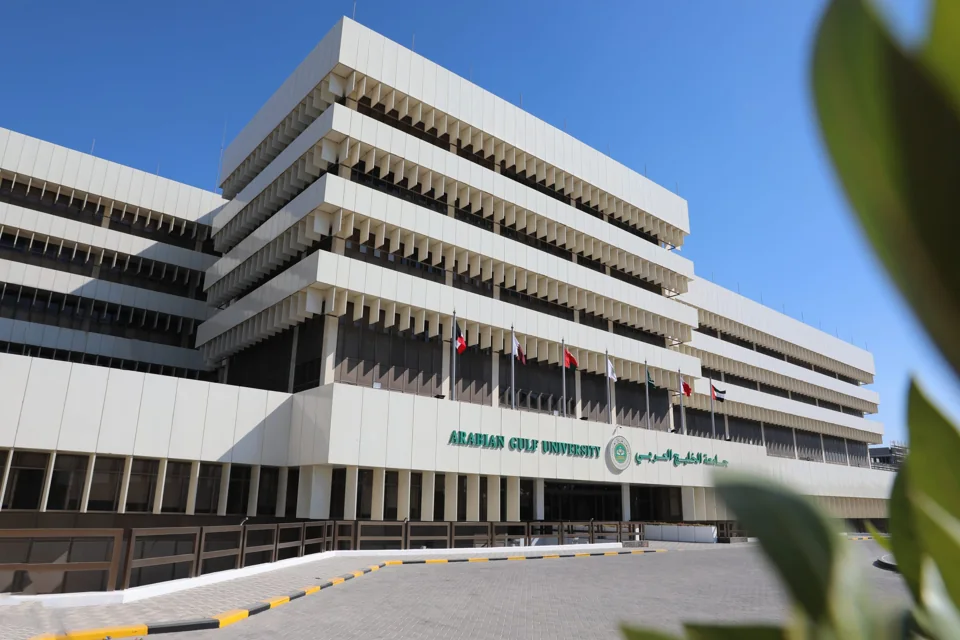
The Salmaniya Campus is identified as Arabian Gulf University’s main campus. Its principal building houses academic departments, classrooms, lecture halls, student services and administrative offices. The campus account brings teaching, research and university administration together within the same setting, alongside the Princess Al Jawhara centre, university hospital and associated support infrastructure.
The university also maintains a residential community in Zallaq, approximately thirty kilometres from the Salmaniya campus. Its published housing description includes separate student residences, accommodation for married students, and residences for faculty and staff. A different location, Durrat Al Bahrain, is associated with King Abdullah Medical City. The university presents that medical city as a strategic development project intended to integrate education, research, healthcare and community services. Its description of the project’s future role distinguishes this planned development from the existing Salmaniya facilities and the university’s established residential provision.
Sources: University campuses in Bahrain ↗
Postgraduate disciplines beyond medicine
The College of Education, Administrative and Technical Sciences was established in 1994 under a common academic and administrative structure. Its subject range brings educational studies together with management, environmental science and computing. The college’s current programme list includes doctorates in Innovation Management, Learning and Developmental Disabilities, and Gifted Education.
At master’s level, the listed fields include Gifted Education, Learning and Developmental Disabilities, Digital Education, Business Administration, Natural Resources and Environment, Next-Generation Computing, and Innovation Management. This combination gives the college a postgraduate focus spanning human learning, organisational questions and technical subjects. Its account identifies smart classrooms, technical laboratories, computer laboratories, digital learning platforms and library resources among its learning and research facilities. The college describes an interdisciplinary approach and specialisations connected with regional priorities, placing these subjects within the university’s wider concern for education, technology and development in the Gulf region.
Sources: College of Education, Administrative and Technical Sciences ↗
Simulation as an educational setting
The Clinical Skills and Simulation Center supports education within the College of Medicine and Health Sciences. Its remit includes medical students at different stages, interns, junior doctors and other healthcare professionals. The centre’s account describes simulation as an artificial representation of real situations used for experiential learning, with mannequins or simulated participants providing settings for educational activities.
Its medical director coordinates administration and simulation activities in connection with the college’s dean. The published educational provision includes courses, symposia and sessions associated with internal medicine, surgery, obstetrics and gynaecology, paediatrics and family medicine. A standardised-patient programme involves people portraying patient roles for learning and assessment. These arrangements provide a dedicated setting for practising professional interaction and examining decisions within an educational scenario. The centre is therefore part of the university’s teaching infrastructure, connecting the medical curriculum with organised simulation activities for students and professional learners.
Agricultural research in arid environments
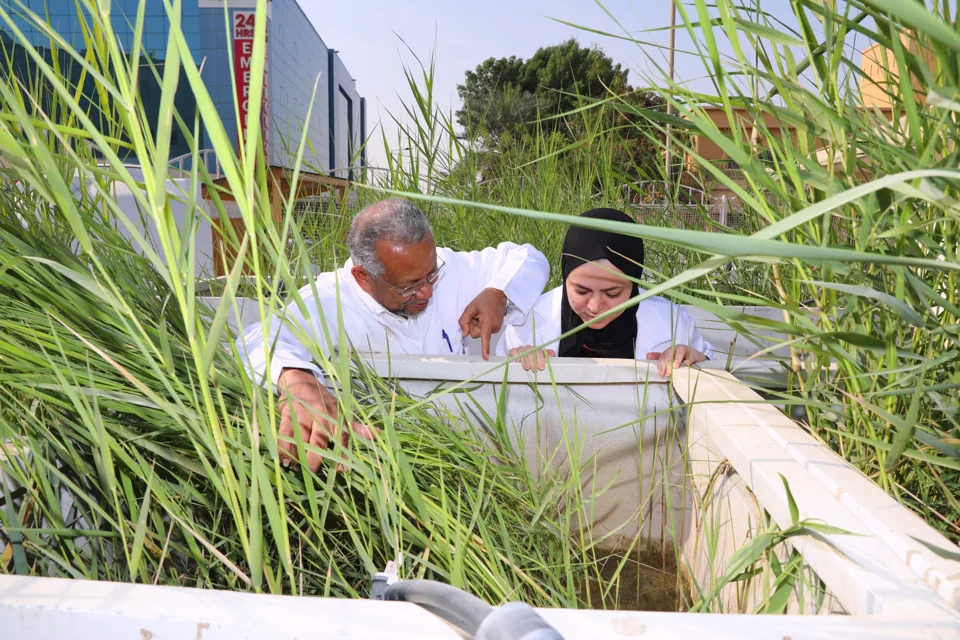
The Sultan Qaboos Centre for Desert Farming and Soilless Agriculture Techniques is linked with the university’s academic chair for desert farming, established in 1994. The centre acts as a technical and field-research resource for agricultural and environmental study. Its work supports practical research, training workshops and community service concerned with desert agriculture and the efficient use of resources.
The centre describes laboratory equipment for analysing soil and plant material, including nutrients, heavy metals and biological pollutants. Its research examples include amino acids in date-palm irrigation water, experimental quinoa cultivation in Bahrain, and partial irrigation monitored through Internet of Things technology. The palm-irrigation project involved collaboration with Bahrain’s National Space Science Agency, the relevant municipal and agricultural ministry, and a Dutch smart-agriculture company. These examples connect the centre’s academic role with specific investigations into cultivation, irrigation and agricultural conditions in dry environments.
Sources: Sultan Qaboos Centre for Soilless Agriculture ↗
Library resources and research support
The Library and Learning Resource Center supports students, faculty members and researchers through print and digital collections. Its public service description includes books, journals, electronic books and online databases, together with research guides, tools and assistance. The library presents these resources as part of the university’s provision for teaching, learning and research.
Several services connect readers with material and study facilities. The catalogue provides a route to finding books and journals; room reservation supports the use of study spaces; and a book-recommendation service allows users to suggest additions to the collection. Document delivery offers another way to request material, while library membership and librarian assistance are separately identified services. The library page also links to electronic theses, circulation information and its resource portal. Together, these services provide both discovery tools and personal support for locating and using academic information across the university’s subject areas.