Visa

About Arab Open University
Arab Open University in Bahrain
Arab Open University’s Bahrain branch is based in A’ali, at Building 890, Street 3220, Block 732. It forms part of a regional university whose headquarters are in Kuwait. The wider university grew from an initiative announced by Prince Talal bin Abdulaziz Al Saud in 1996 and developed into an integrated university in 2002.
That regional history provides the background to the Bahrain institution’s emphasis on access to higher education. Its president’s introduction describes a nonprofit developmental mission, serving students from different social and economic backgrounds. Blended education is central to its approach, connecting teaching with digital communication and learning technologies. The university’s history also records its founding strategic partnership with the United Kingdom’s Open University. Within this wider organisation, the Bahrain branch maintains its own academic and student-support services, with local faculty pages and centres supporting students’ learning and development.
Sources: Arab Open University history ↗ · Bahrain president’s introduction ↗
Computing and digital disciplines
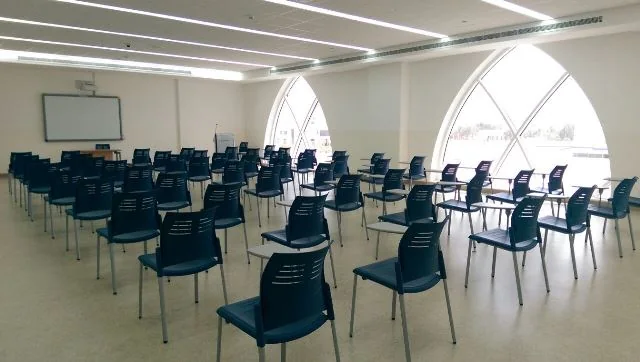
The Faculty of Computer Studies explicitly identifies the programmes offered in the Kingdom of Bahrain. Its undergraduate list includes Information Technology and Computing, Cyber Security, Artificial Intelligence, Data Science, and Graphic and Multimedia Design/Technology. The faculty describes blended learning as its method for combining technology-enhanced education with students’ academic study.
The information-technology programme draws on computing curriculum guidance and the Open University’s computing provision. Artificial intelligence study combines a theoretical foundation with technical work concerning intelligent computer programmes. Cybersecurity addresses the protection of data and information, including questions of confidentiality, integrity, risk and policy. Data science brings statistical knowledge together with computing and technical analysis. Graphic and multimedia study covers the relationship between artistic design and technological tools, including work connected with websites, computer graphics and mobile multimedia. The faculty’s educational philosophy emphasises keeping programmes responsive to technical developments, linking specialist knowledge with the ability to continue learning as technologies change. Its programme descriptions refer to computing curriculum guidance from ACM and IEEE and subject benchmarks from the UK’s Quality Assurance Agency.
Sources: Faculty of Computer Studies: Bahrain programmes ↗
Business and management study
The Faculty of Business Studies presents business education through blended learning and a combination of undergraduate and postgraduate study. Its programme page lists a BA Honours in Business Studies with Systems Practice, together with an MBA and MBA routes in Finance and Human Resource Management. It describes teaching as involving both direct engagement and independent learning activities.
The faculty’s educational aims include problem-solving, communication, teamwork, leadership and ethical decision-making. Systems thinking is a particular theme, applied to information systems, organisational change and professional practice. Students are encouraged to consider how economic conditions, public institutions and wider systems interact with business activity. The faculty also identifies reflective scholarship, free exchange of ideas, diversity and accountability among its values. Its research aims encompass basic investigation alongside applied and pedagogical work. The published outline gives a four-year duration for bachelor’s study and two years for master’s programmes. These priorities connect the study of management and finance with the analysis of organisations and the development of independent judgement.
Sources: Faculty of Business Studies ↗
Academic writing and spoken English
Two specialist centres support language-related academic work at the Bahrain branch. The Writing Centre offers individual sessions, collaborative group writing activities and workshops. At the beginning of each semester, it publishes its weekly schedule through the Learning Management System and notice boards so students can find the available support.
The English Speaking Skills Centre complements this writing provision. Its activities involve both full-time and part-time Faculty of Language Studies teachers, giving students opportunities to practise speaking and receive coaching from tutors. Sessions include conversations, discussion of themed topics and listening to spoken exchanges in English. The centre’s stated purposes include developing communication, creative thought and critical thinking within an academic setting. Together, these services address different aspects of participation in university study: producing written work, discussing ideas and building the confidence to communicate with others in English.
Sources: Writing Centre ↗ · English Speaking Skills Centre ↗
Learning resources and library support
The Learning Resources Centre supports both students and faculty members in teaching, learning and research. Its introduction describes a continuing effort to develop the collection and use technology to keep the university community connected with learning resources. The centre combines this resource provision with support for users’ academic work.
Its electronic subscriptions include databases providing full-text books, journals, theses and reports. The centre also points to open-access databases alongside subscribed resources. This gives its published account a focus on several types of academic material, rather than textbooks alone. Feedback and suggestions from users are invited as part of improving services. The centre presents the development of its collections and technological support as continuing work connected with the university’s educational and research activities.
Sources: Learning Resources Centre ↗
Career exploration and professional preparation
The Career Development Centre connects academic learning with preparation for professional practice. It works with the Career Guidance Unit and Internship Unit on counselling, skills workshops and job fairs. These activities give students ways to investigate possible directions and develop professional skills alongside their studies.
The centre also works with employers and alumni on mentoring and recruitment opportunities. Its published services include tailored advice, skill-building programmes and access to career resources. The emphasis is on helping students explore different paths and consider the transition from university study to work through guidance, training and contact with professional networks.
Sources: Career Development Centre ↗