Visa
About Andean University of Cuzco
Origins and institutional purpose
The Andean University of Cuzco is Universidad Andina del Cusco, a university based in Cusco, Peru. Its history begins with a founding initiative on 5 October 1979, led by Antonio Callo Cáceres, Néstor Bustos Silva, Luís Vallejos Santoni and César Cornejo Foronda. The founders organized a promotional society that subsequently became a civil association. The first admission examination took place in May 1980, followed by classes in July. Legal creation came later, through Law 23837 of 23 May 1984. Its early premises were at Parque de la Madre before development of its own Larapa Grande campus. The university connects its educational mission with research, innovation, environmental responsibility and social commitment. It also expresses its institutional outlook through Andean values: Yachay, associated with wisdom; Llank’ay, with work; Munay, with will; and Ayni, with reciprocity and solidarity.
Sources: Origins and institutional purpose ↗
Campus spaces in Cusco
The university’s infrastructure is distributed across distinct teaching locations in Cusco. At Larapa, its university campus includes buildings for economic, administrative and accounting sciences, engineering and architecture, and law and political science. A general-classroom building also accommodates sciences and humanities, together with administrative offices including the rectorate and vice-rectorates. Health-sciences education has a separate location at Qollana in the district of San Jerónimo. The university describes this site as combining educational facilities with its health-service activities. Qollana also contains Arena Qollana, a multipurpose sports and convention facility. In its account of campus development, the university emphasizes accessibility, provision for people with disabilities, environmental treatment, energy saving and information systems. These are presented as considerations in the design and operation of its buildings. The distinction between Larapa and Qollana is an important feature of its physical organization.
Sources: Campus spaces in Cusco ↗
Civil engineering and applied investigation
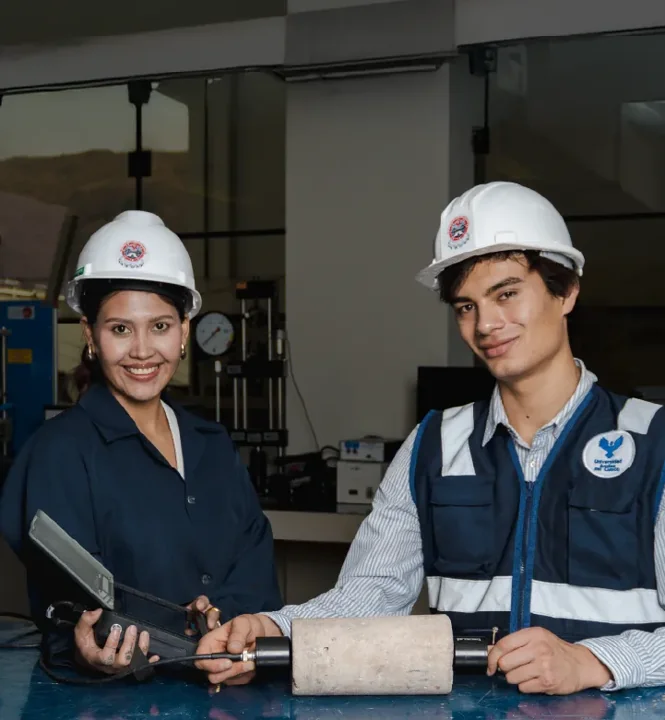
Civil engineering is organized as a ten-cycle undergraduate programme. Its educational objectives cover planning, design, construction and supervision, connecting scientific and technological knowledge with sustainable infrastructure and structural safety. The graduate profile combines technical competencies with ethics, communication, teamwork and attention to the effects of engineering decisions on communities and the environment. It includes experimentation, interpretation of evidence, mathematical and computational knowledge, and the use of modelling tools. The programme’s published 2025 research lines give concrete examples of this approach: construction materials, concrete and pavements; numerical and experimental modelling of structures and hydraulic systems; and digital methods such as building information modelling, geographic information systems and digital topography. Other lines address seismic and hydrometeorological risks, landslides, slope stability, urban mobility and resilient infrastructure. Project management and continued learning also form part of the stated educational profile.
Sources: Civil engineering and applied investigation ↗
Tourism, heritage and destination management
The tourism programme brings together scientific, humanistic and technological preparation over ten academic cycles. Its objectives connect tourism activity with sustainable development and the protection of cultural and environmental resources. The graduate profile covers management of tourism enterprises, including hotels, travel agencies and transport services, as well as the planning and investigation of tourism destinations. Organizing group visits and interpreting natural and cultural heritage are further areas of preparation. The programme identifies research topics that range from tourism markets and different forms of tourism to local development and regional economic relationships. Destination management, the effects of tourism, protected natural areas, business quality and environmental responsibility also appear in its research agenda. Communication and language skills sit alongside critical thinking, entrepreneurship and heritage conservation in the programme’s educational aims. Together these areas describe tourism as a field involving both enterprise organization and stewardship of places.
Sources: Tourism, heritage and destination management ↗

Education and pedagogical development
The education programme offers preparation in early-childhood and primary education through a ten-cycle structure. Its description places pedagogy alongside scientific, technological and humanistic knowledge, with an emphasis on the creation and application of knowledge in educational settings. The programme’s stated aims include innovative teaching, active learning methods and the use of technology. Inclusive learning environments and formative assessment are also part of its approach, along with educational projects and leadership. Its research agenda extends beyond individual classroom techniques. Topics include the relationship between education and its social and cultural setting, early-childhood development, teaching processes and the assessment of learning. Educational management, policy, higher education and problems within education are further subjects for investigation. Andean and Amazonian culture also appears among the research interests, giving the programme an explicit connection with the cultural contexts in which education takes place.
Library, repository and university publishing
The Directorate of Library and University Publishing operates within the Vice-Rectorate for Research and dates its activity from 2015. Its structure brings library services and academic publishing into the same directorate, while assigning them distinct coordinating functions. Library coordination oversees cataloguing and classification, together with the institutional digital repository. Publishing coordination handles the editing and publication of intellectual work by university teachers, students and graduates, as well as other relevant contributors. The service network listed by the directorate includes central and engineering collections, business and humanities libraries, law, health sciences and postgraduate provision. It also identifies libraries serving Quillabamba, Sicuani and Puerto Maldonado. Its functions include acquiring physical and virtual bibliographic material, promoting scientific databases and developing the repository. This combination supports access to existing literature and the organization and dissemination of work produced within the university community.