Visa

About Amazon National University of Madre de Dios
A public university for Madre de Dios
The Universidad Nacional Amazónica de Madre de Dios, commonly known as UNAMAD, is a public university in Puerto Maldonado, Peru. Its identity is closely connected with the southern Peruvian Amazon and the development of the Madre de Dios region. Created under Law No. 27297 in 2000, it received operating authorisation in 2001 and definitive authorisation in November 2009. Its institutional mission brings together professional education, research, innovation, cultural identity and social responsibility. The university presents scientific, technological and humanistic education as complementary parts of its contribution to regional development. Its stated vision also gives importance to respecting the knowledge of Amazonian Indigenous peoples and conserving natural and cultural biodiversity. These are institutional commitments that connect its teaching with the environmental and social setting in which the university works.
Sources: University history ↗ · Institutional presentation and mission ↗
Forestry and environmental study
Forestry and Environmental Engineering is described as both a teaching and research unit. Its focus is the responsible use of forest resources and environmental conservation, particularly in the ecosystems of the southern Peruvian Amazon. The programme connects scientific knowledge with technological development and innovation in forestry. Its academic description places research and teaching capacity alongside specialised investigation of the region’s natural resources. The educational purpose is to prepare professionals concerned with sustainable development and the management of Amazonian environments. This field therefore gives UNAMAD a direct connection to the forests that shape Madre de Dios, rather than treating environmental questions as separate from the region’s economic and community life. The school’s published contact address is on Avenida Jorge Chávez.
Ecotourism and multidisciplinary preparation
UNAMAD’s Ecotourism programme combines teaching, research and social responsibility with the sustainable use of natural and cultural resources. Its professional approach draws on tourism, social studies, culture, economics, environmental knowledge and public policy. The programme description identifies the design, planning, management and implementation of projects as important areas of preparation. These projects can concern hotels, gastronomy, ecotourism, environmental activity and cultural or social initiatives. Its curriculum is presented as multidisciplinary, reflecting the range of knowledge involved in organising tourism within an Amazonian setting. The educational aims include identifying problems, developing proposals and assessing possible solutions. Conservation and the responsible treatment of local resources are therefore linked with the practical organisation of tourism services and projects.
Sources: Ecotourism programme ↗
Library organisation and information access
The Central Library Directorate manages the university’s library system and the preservation and dissemination of bibliographic and documentary holdings. Its responsibilities include organising materials so that students and the wider university community can find and use them. It also proposes acquisitions, conservation measures and policies for maintaining the collection. The directorate provides classified bibliographic information through a database and supports access to reading spaces and virtual-library services. Information literacy forms part of its role: the library is intended to help the university community develop skills in finding and using information. Its place within the academic vice-rectorate connects these services with teaching and research, while its published location is the university campus in Tambopata.
The herbarium project and botanical knowledge
The university’s Madre de Dios herbarium project is intended to support the study and understanding of regional plant diversity. Its description explains the value of collecting and preserving plants or plant parts together with identifying information. Relevant records include scientific and common names, collection locality, habitat, distinctive characteristics, altitude and collection date. These details allow botanical material to serve as a reference for investigation rather than simply as a display. The project’s proposed teaching role includes supporting forestry degree and master’s work, while its research role includes collaboration on projects and the exchange or loan of specimens. Public outreach is also part of its stated purpose, connecting botanical knowledge with awareness of the importance of caring for regional flora.
Sources: Madre de Dios herbarium project ↗
A scientific meeting point at Iñapari
The Aldea Científica Iñapari-UNAMAD was built to provide a meeting place for academic exchange and field researchers. Located in Tahuamanu province near the borders with Brazil and Bolivia, it is intended to connect teachers and student researchers from neighbouring countries. The university describes it as a station for professionals from different academic schools conducting fieldwork. Its location gives the initiative a cross-border dimension within the Amazon region. The project description also presents further research laboratories and the extension of educational and outreach services as development intentions. These planned additions sit alongside the original purpose of creating a place for encounters, collaboration and the exchange of scientific experience in the border area.
Sources: Iñapari Scientific Village ↗
Research skills and responsible digital tools
A university report dated 26 October 2026 records the opening of training on artificial intelligence, information searching and bibliographic-reference management. Organised by the Central Library and Specialised Libraries Directorate, the course was scheduled for 26–28 October in a virtual format. Its content included finding reliable scientific information, using artificial intelligence responsibly in research, and organising references with Zotero and Mendeley. APA seventh-edition citation and plagiarism prevention were also included. The report places the activity within the library’s role in supporting academic work based on trustworthy sources. It provides a dated example of how information services extend beyond access to collections into the practical skills needed to search, assess, organise and cite research material.
Academic community and student participation
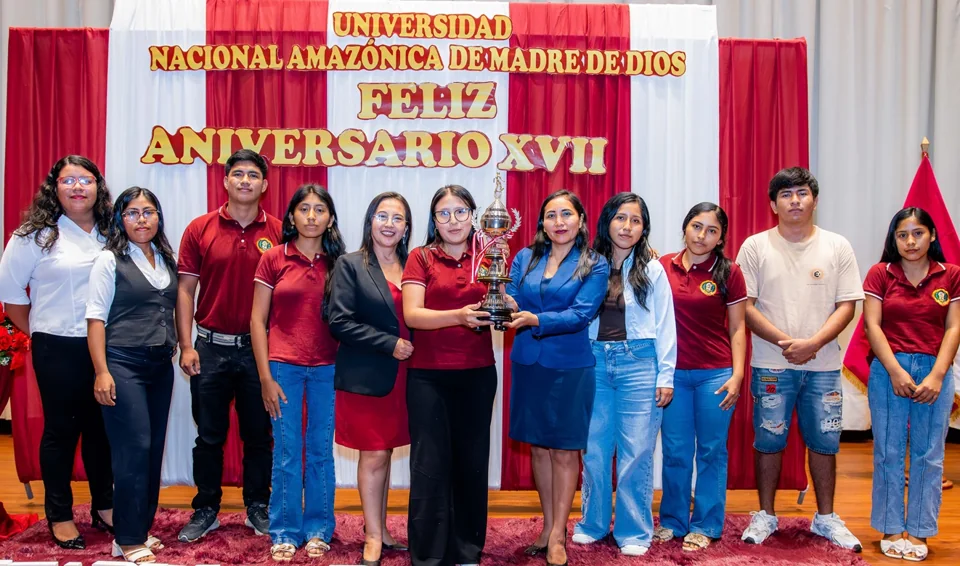
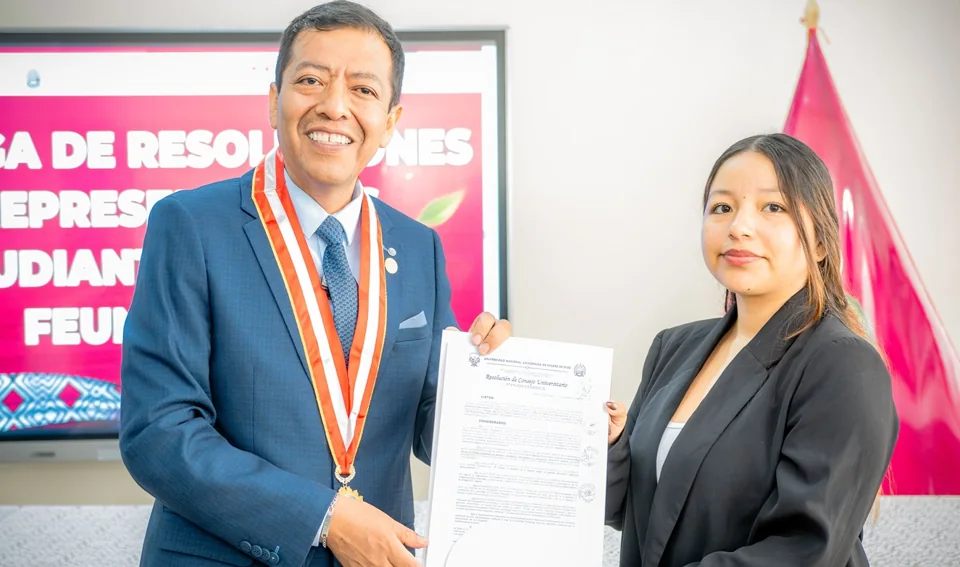
University reports from October 2026 also document activities that bring students, teachers and graduates together. On 23 October, the Accounting and Finance school marked its seventeenth anniversary with a ceremony recognising its academic community and graduates. The programme included a commemorative video, acknowledgements and awards connected with anniversary activities. On 27 October, the university formally recognised representatives of the FEUNAMAD student federation at the rector’s office. Its report describes student representation as a channel for communicating proposals, needs and interests within institutional spaces. Together, these events illustrate two aspects of university life: the shared identity built around an academic programme and the organised participation of students in dialogue with university authorities.
Sources: Accounting and Finance anniversary, 23 October 2026 ↗ · Student representation recognition, 27 October 2026 ↗