Visa

About American University of Central Asia
From a Kyrgyz-American school to a regional university
The American University of Central Asia, usually known as AUCA, is based in Bishkek, Kyrgyzstan. Its institutional history begins in 1993 with the Kyrgyz-American School, established within Kyrgyz State National University. In 1997 a presidential decree made it an independent institution called the American University in Kyrgyzstan, with an international Board of Trustees. The university adopted its present name in 2002 as its mission expanded across Central Asia. These changes explain the regional emphasis of a university whose origins were specifically Kyrgyz-American. The history also connects its development with the introduction of an American liberal arts approach to higher education in Kyrgyzstan, bringing a broad educational model into a new national and regional setting.
Sources: History of AUCA ↗

Educational purpose and values
AUCA places critical thinking and intellectual inquiry at the centre of its educational purpose. Its mission brings together teaching, research and civic engagement, with interdisciplinary study as an important part of the curriculum. Student participation in learning is central to this approach: the university describes an environment in which questions and independent judgments matter alongside subject knowledge. Its stated values include honesty, respect, responsible freedom and the ability to examine one's own assumptions. Academic freedom and open inquiry form part of that framework. The mission therefore links individual intellectual development with responsibility toward other people, positioning university education as preparation for informed participation in society as well as for further academic work.
Sources: Mission and values ↗
Academic fields and learning support
AUCA organises its academic work across applied sciences, social sciences, arts, humanities and communication, business and entrepreneurship, and law. Undergraduate fields listed by the university include anthropology and international development, applied mathematics and informatics, business administration, economics, environmental sustainability and climate science, international and comparative politics, psychology, sociology, software engineering, and journalism and mass communication. Television, cinema and media studies and international business law extend that range. Graduate study includes business administration, applied psychology, Central Asian studies, economics, teaching, anthropology and international development, and law. Academic support is also part of this structure. The university identifies academic advising, a Writing and Academic Resource Center, general education, and teaching and learning technology services alongside its disciplinary programmes, connecting subject study with help in developing academic skills.
Sources: Academics ↗
Preparation through the New Generation Academy
The New Generation Academy provides an academic preparatory route within AUCA. Its dedicated programme description offers a one-year or one-semester format, with study in English, college mathematics and Russian. The curriculum also addresses analytical thinking, academic writing and leadership. Preparation extends beyond formal language and mathematics lessons: clubs, language laboratories, practice tests, workshops and field trips are included in the programme's account of learning activities. This combination gives the academy a distinct role within the institution, concentrating on the transition to university study. Its emphasis on writing and analysis complements its language teaching, while organised activities give participants opportunities to practise communication and work with others outside the conventional classroom setting.
Sources: New Generation Academy ↗
Research on Central Asia and wider public questions
Research at AUCA includes several centres and collaborative arrangements with different purposes. The Central Asian Studies Institute, established in 2011, supports research across departments on the region. The Institute of Education combines educational research with teaching and advocacy. The Presidential Research and Education Fund, established in 2019, supports projects involving faculty, students and staff, including work that crosses disciplinary boundaries. The Tian Shan Policy Center addresses subjects such as migration, sustainable development, environmental questions, human rights and democratic governance, and organises seminars connected with its work. AUCA also identifies collaborative faculty research through SILK and AKYN teams. An Institutional Review Board provides an ethical framework for research involving people, including attention to voluntary participation and informed consent.
Sources: Research ↗
Civic engagement and community projects
The Center for Civic Engagement connects university activity with community initiatives involving students, faculty and staff. Its Student Initiative Development Program supports projects proposed by students. The centre's account includes initiatives concerned with access to basketball, opportunities for girls in villages, and digital literacy for teachers in regional communities. Environmental work is another strand. AUCA and AFKE began their joint EcoPark work in Bishkek's Elm Grove urban forest at the end of 2018. Green AUCA, introduced in spring 2022, adds waste management to the university's civic engagement activities. These examples show how the centre's work encompasses education, community participation and the urban environment, rather than being confined to a single type of volunteering.
Sources: Civic Engagement ↗
Library resources and access
The AUCA Library supports teaching and research through print and digital resources. Its stated purpose includes information fluency, lifelong learning and academic honesty, with equal access and collaboration among its guiding principles. Library services are organised for the university community, while access arrangements also recognise other readers. Students, faculty and staff use identification to borrow materials; reference works remain available for consultation within the library. Renewals can be requested through several channels, including the service desk, telephone, email and chat. Researchers and members of the public may arrange visits by appointment, and alumni have access to materials for use within the library. These arrangements distinguish borrowing privileges from opportunities to consult the collection on site.
Sources: About the Library ↗ · Library Policies ↗
The 2015 campus move
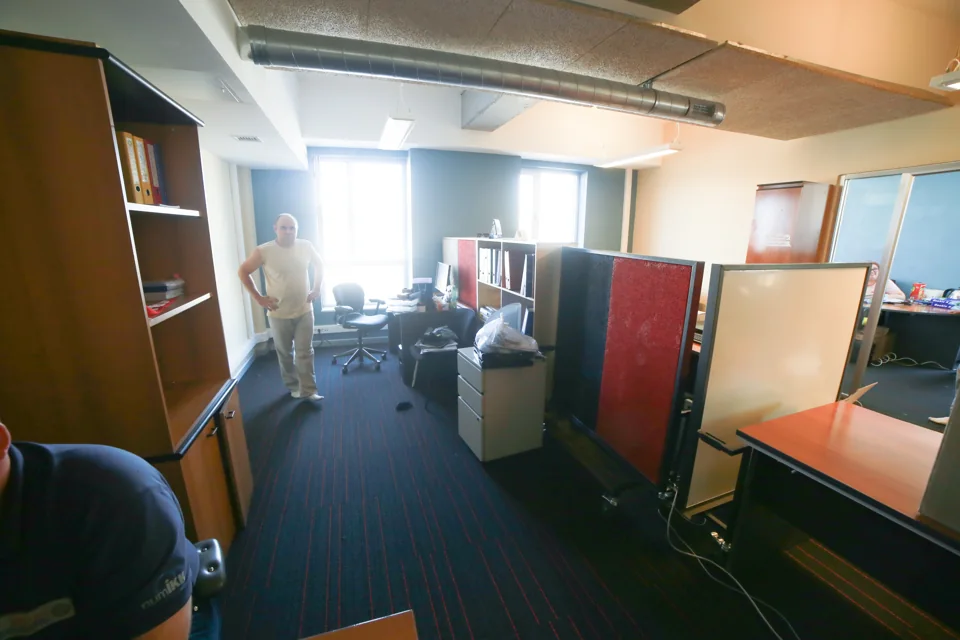
A major physical change in AUCA's history came in June 2015. A university report dated 29 June described departments beginning work in the new campus building in Bishkek's Micro-District 12. The move was still under way: offices were being occupied and staff were adjusting to their new surroundings. The report connected the building with possibilities for developing additional educational programmes, while describing preparations for students to begin studying there later that year. The accompanying photographs document that transition, showing office partitions, furniture and moving boxes as the building entered use. They are a historical record of the 2015 move, rather than a depiction of how those rooms are arranged today.
Sources: AUCA is now operational on new campus building, 29 June 2015 ↗
Collaboration with Bard College
AUCA's relationship with Bard College adds an international dimension to its liberal arts work. The university describes cooperation in curriculum development, joint research and exchanges involving faculty, staff and students. Its dedicated partnership page also explains academic arrangements for particular undergraduate programmes. The collaboration is therefore more extensive than an occasional visiting lecture or a single student exchange: it includes work on educational content and connections between the two academic communities. Within AUCA's wider institutional profile, it sits alongside regional research and civic engagement, linking a university rooted in Bishkek with another liberal arts institution while retaining AUCA's own Central Asian mission and academic organisation.
Sources: AUCA and Bard ↗