Visa


About American Center for Education
A Singapore education institution established in 2007
The American Center for Education, generally known as ACE, is a Singapore higher-education institution established in 2007. Its current main campus address is 6 Tampines Street 92, within yo:HA Commercial at Tampines, next to SAFRA Tampines. ACE’s academic provision spans foundation and certificate study, diplomas, advanced and higher diplomas, postgraduate diplomas and bachelor’s pathways. Its stated subject areas include business administration, hospitality, information technology, logistics and supply-chain management, digital marketing, and banking and finance. The institution describes educational approaches associated with both British and United States higher education as influences on its programmes. Alongside its own awards, university partnerships form part of its approach to academic progression. ACE’s current campus information identifies Tampines West station on the Downtown Line as the nearest MRT station.
Sources: Introduction and institutional story ↗ · Contact and Tampines campus ↗
Values and the learning environment
ACE’s institutional values emphasise academic work, continuing improvement, engagement, integrity and inclusion. Its educational culture places particular importance on lifelong learning for both students and teaching staff. This applies not only to gaining subject knowledge but also to developing the skills used in further study and professional settings. The centre describes an engaging learning environment and personal attention as important elements of student support. Its culture statement also recognises the adjustment that learners may face when studying in English and gives teaching strategies a role in supporting that transition. Management is expected to demonstrate respect and care, while the student-support environment is intended to be fair, approachable and responsive to learners’ needs.
Business administration across related disciplines
The Advanced Diploma in Business Administration is awarded by the American Center for Education. Its programme description combines theoretical knowledge with practical aspects of business in commercial, manufacturing, financial and service settings. The published module list extends beyond management alone: it includes business English, interpersonal and professional communication, economics, accounting, statistics, research methods and information technology in organisations. Business ethics, international marketing, global business and society, operations management and electronic commerce also appear among the listed subjects. These areas place organisational decisions alongside communication, quantitative understanding and the wider social environment. The course structure includes an internship module, with an approved final-project replacement identified in the graduation requirements. Lectures and tutorials are the teaching methods specified for this programme.
Digital marketing and analytical subjects
ACE’s Advanced Diploma in Digital Marketing brings together marketing strategy, digital channels and the analysis of information. Its modules include customer-experience management, search-engine marketing, social-media marketing, content strategy, search-engine optimisation and applied data analytics. Marketing-campaign management and advanced digital marketing extend the programme beyond introductory material. The course is awarded by ACE and is described as using lectures and tutorials in a blended format. Its listed completion work includes a final project or an on-the-job training component. The subject combination addresses how audiences encounter organisations through digital services and how campaigns are planned and assessed. It therefore connects the commercial purpose of marketing with the tools used to organise content, reach users and interpret data.
English-language development
The Certificate in English Language Enhancement Course focuses on accuracy, fluency and confidence in using English. Its purpose is to build a language foundation for learners who intend to continue studying in an English-medium environment. The programme is organised into basic, intermediate and advanced English modules, with ACE identified as the awarding institution. Teaching is described through face-to-face lectures and tutorials. Assessment combines assignments with mid-term and final examinations; the assignment category includes homework, quizzes and group work. This mixture gives students several ways to practise and demonstrate their learning. Within ACE’s broader academic provision, the language course addresses a skill that supports participation in subject-based study as well as communication in the classroom.
Classrooms and campus facilities
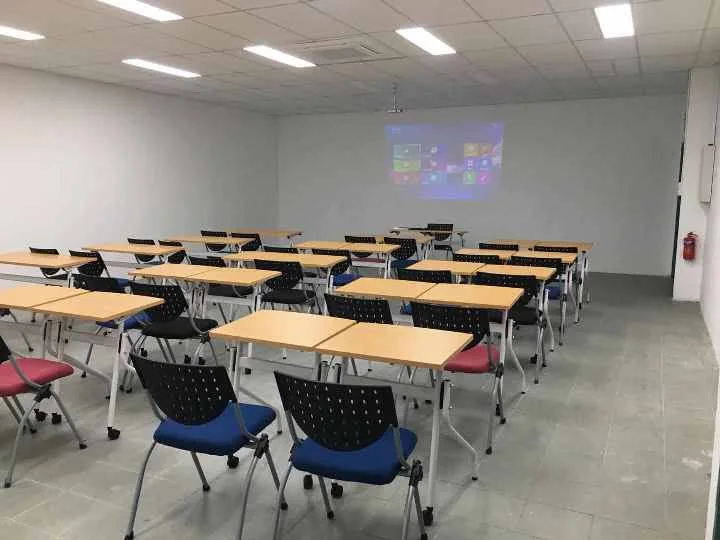
The school-facilities page describes classrooms equipped with air conditioning, desks, chairs, whiteboards, projectors and wireless internet access. Its room schedule lists ten classrooms, with different floor areas and seating capacities rather than a single room size used throughout the centre. The published capacities range from twenty-three to sixty-four students, and ACE states that enrolment in a classroom will not exceed its available capacity. The facilities material also identifies reception, library space and the surrounding campus environment. The classroom photographs show individual desks facing the teaching area, providing a concrete view of the setting used for instruction. These facilities support the lectures, tutorials and other academic activities described in ACE’s programme information.
Sources: Teaching facilities ↗
Orientation and student information
ACE assigns responsibility for new-student orientation to its academic and operations leadership or designated staff. The orientation covers practical course information, including duration, class schedules, classrooms, assessment and graduation requirements. Students are also introduced to the centre’s support services and the information contained in its handbook. Attendance expectations and student conduct are among the topics identified for discussion. The orientation guidance includes relevant Singapore rules and the responsibilities associated with studying in the country. After the session, students are invited to complete a survey and give feedback that can be used to improve later activities. Orientation therefore provides a common introduction to academic expectations and available support before students settle into their individual programmes.
Sources: Student orientation ↗
The University at Albany relationship
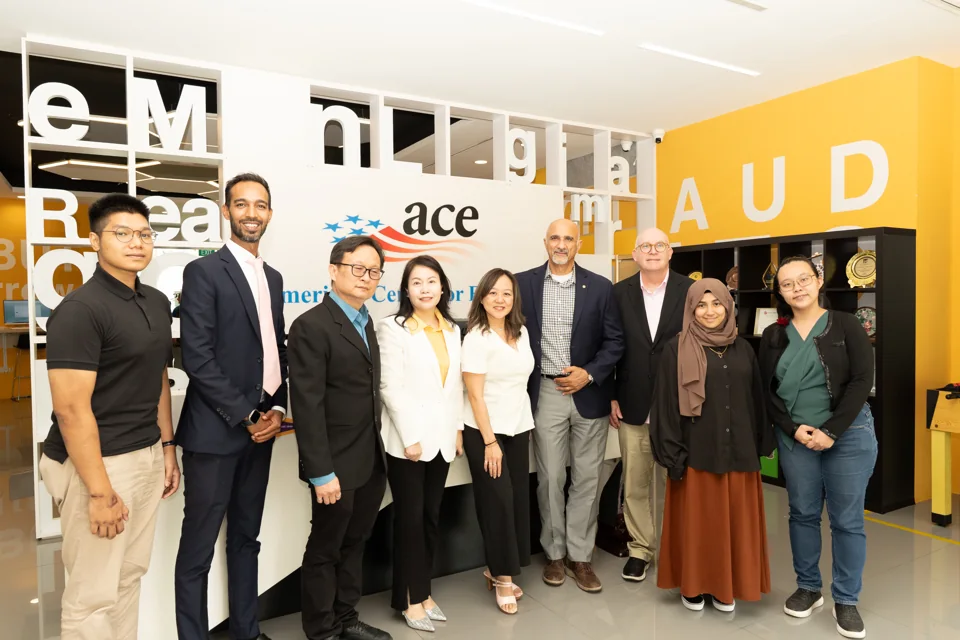
The University at Albany independently lists the American Center for Education among its international course-articulation partners in Singapore. ACE also reported a visit by senior University at Albany representatives in September 2026. The event brought representatives of both institutions together and included interaction with students. Its report describes discussions about academic pathways, collaboration between faculty, shared learning resources and opportunities for exchange. Those expansion topics were presented as areas for development rather than as completed new programmes. The relationship connects ACE’s Singapore teaching environment with a United States university partner, while the dated visit provides an example of direct institutional engagement. The group photograph accompanying the report places the meeting within ACE’s own campus setting.
Sources: University at Albany leadership visit, September 2026 ↗ · University at Albany international course-articulation partners ↗