Visa

About Ageing Research Institute for Society and Education
An ageing research institute within NTU
The Ageing Research Institute for Society and Education, known as ARISE, is a pan-university institute at Nanyang Technological University in Singapore. It coordinates ageing-related research, programmes and activities across academic groups and with external organisations. Its remit combines the study of psychosocial issues with the development and use of technologies, with the aim of supporting active, independent lives, social participation and meaningful activity as people age.
ARISE’s distinctive emphasis is implementation: understanding how protective habits can begin, persist and reach more people through technology, coaching and learning. The institute brings researchers from different NTU schools into a shared framework rather than operating as a separate degree-awarding university. Its work connects research projects with professional education, community programmes and tools intended for use beyond an academic setting.
Sources: ARISE mission and education overview ↗ · About ARISE ↗
Lifelong learning and changing skills
One strand of the current research agenda is Cognitive Vitality and Lifelong Learning. It focuses on adult artificial-intelligence literacy, skills mobility and cognitive reserve, with particular attention to people aged forty-five to sixty-four. The institute identifies curriculum development and policy tools as intended forms of translation for this work.
Two projects listed in this area examine different aspects of adult learning. One investigates skills-based job mobility within and across Singapore’s retail, food-services, precision-engineering, air-transport and healthcare sectors. The other concerns how adult learners acquire digital literacy and transfer what they have learned. Both are associated with Associate Professor Ho Moon-Ho Ringo of NTU’s School of Social Sciences, illustrating the link between ageing research, education and workforce questions.
Technology and active ageing
The Gerontechnology for Active Ageing strand studies exercise games and ways of sustaining older adults’ participation. Its research origins include an A*STAR-supported study begun in 2010 under Professor Theng Yin Leng. That work investigated how older adults engage with everyday digital technologies and informed the subsequent design of socially engaging, movement-based games.
The institute describes a design approach involving structured activity, competition and social participation. This brings the interface between people and technology into the research itself: the question concerns how an activity is presented and experienced as well as which device or game is used. ARISE identifies its I-SING programme and the ACTIMORI spin-off as routes for taking this research into community use.
Sources: Gerontechnology for Active Ageing ↗
The development of I-SING
The Singapore Intergenerational Games began nationally in 2016 through the Centre for Healthy and Sustainable Cities at NTU’s Wee Kim Wee School of Communication and Information. Led by Professor Theng Yin Leng, the event used digital exercise games to bring older and younger participants together. Participation and partnerships with senior activity centres expanded in the following year.
In 2018, the programme became I-SING, incorporating international participation through a live simulcast of its final round. Participants in that international format included finalists from Singapore, Japan, Taiwan, Finland and France. The programme paused in 2020 during the pandemic and resumed through ARISE in 2023. This history gives the institute a continuing platform for studying participation and organising intergenerational activity across community settings.
Sources: I-SING programme journey ↗
Community engagement in December 2025
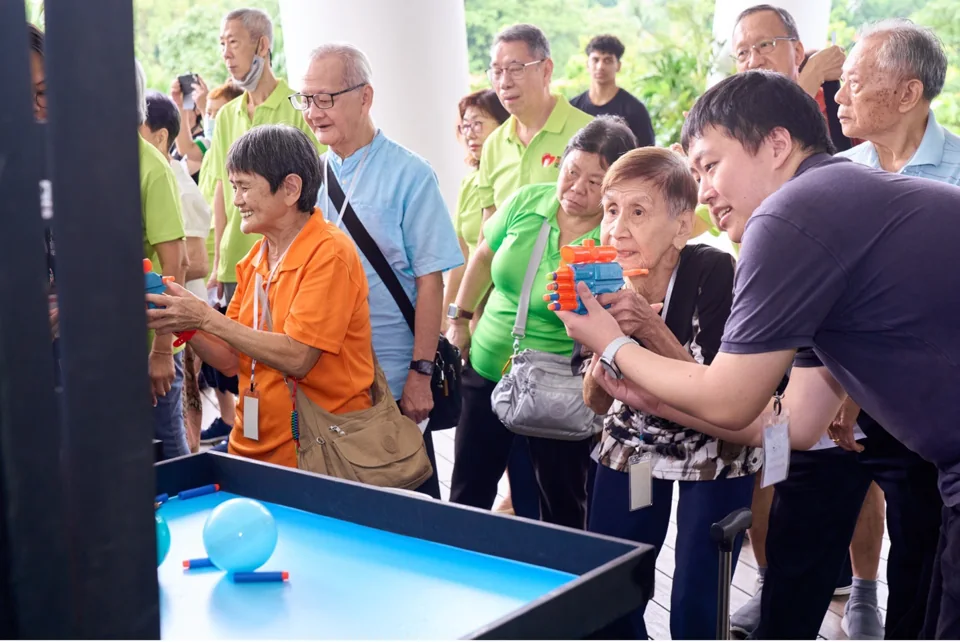
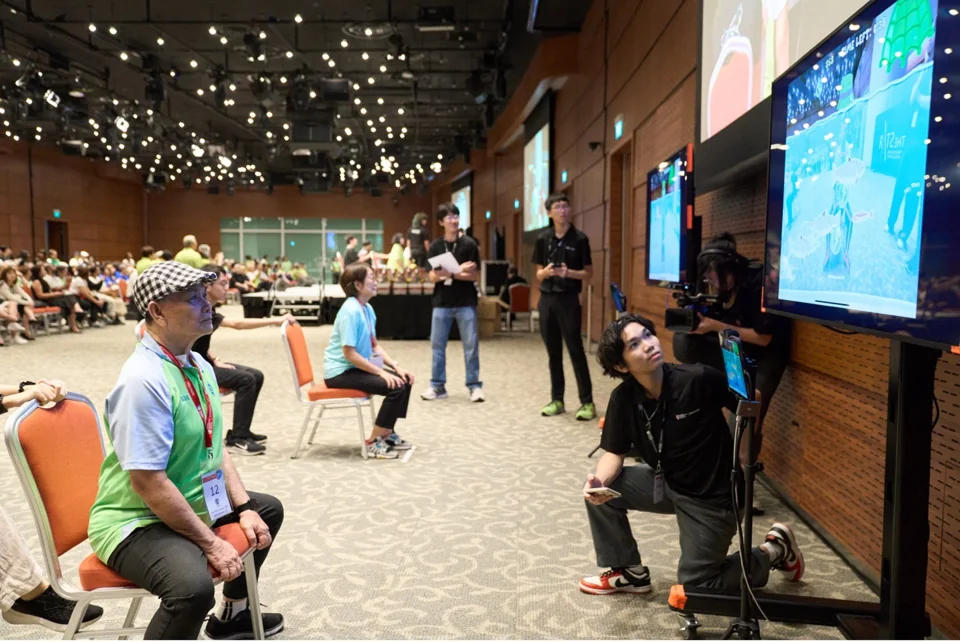
The December 2025 I-SING event involved more than four hundred seniors from nineteen Singapore Active Ageing Centres, alongside approximately one hundred participants from Hong Kong, Taiwan and Indonesia. The institute reports that this edition used fully in-house-developed exercise games. Its account connects that technical development with greater control over game design, user experience and the measurement of programme activity.
The official event record includes carnival games, a pre-event exercise-game session, Singapore and international competition segments, welcome addresses and group stretching. These activities show the practical setting in which participants, researchers and partner organisations meet. The institute describes the event as part of a longer effort to develop a platform for year-round community participation, extending beyond a single competition.
Sources: I-SING 2025 event account and photographs ↗
Research on health coaching
ARISE has also investigated technology-enabled health coaching in response to changing caregiving needs. One project proposed a system called Uber Coaches for Health Services and Knowledge, or UCHESK. Its design concerned the coordination of short, timely training modules and coaching support, with attention to older adults and people involved in their care.
The project explored how trained coaches might support the personalised plans developed by primary-care providers and how technology could help organise learning and services. Its published abstract presents anticipated changes in social connection and wellbeing as research hypotheses. This distinction places the project within an investigative programme, while showing the kinds of practical service-design questions addressed by the institute.
Sources: Technology-enabled health-coaching research project ↗
Professional education and coaching practice
ARISE’s educational work includes the Professional Certificate in Essential Health Coaching for Healthy Ageing, presented through NTU’s Academy for Professional and Continuing Education. The programme draws on a strategic research initiative conducted from 2018 to 2020. Its intended audience includes healthcare professionals, formal and informal caregivers, support staff, social workers and volunteers, as well as people in workplace wellbeing roles.
The curriculum covers healthy-ageing fundamentals, foundational coaching, caregiver support, mental health, ethics and professionalism. Motivational interviewing and communication are important themes. A partnership with the Singapore Red Cross contributes a psychological-first-aid component. The programme description combines classroom teaching with synchronous online learning and written or role-play assessment. It therefore provides a professional-education route through which the institute translates research interests into structured learning, while keeping ethical boundaries and person-centred support within the curriculum.
Sources: ARISE mission and education overview ↗ · Professional Certificate in Essential Health Coaching for Healthy Ageing ↗