Visa
About Allen Community College
From Iola Junior College to Allen
Allen Community College is based in Iola, Kansas. Its history began in 1923 with Iola Junior College, an extension of the local high school governed by the Iola public school board. Classes initially occupied the high school's third floor. The institution became Allen County Community Junior College on July 1, 1965, following the creation of a countywide community college.
A county bond issue approved in 1966 supported a separate campus on Iola's north side. Horton Hall opened in 1969, and the first classes in the new campus buildings took place on January 5, 1970. The college shortened its name to Allen County Community College in 1980. Its later development included online classes, first offered in spring 2000, and a Student Center renovation spanning 2017–2019. These milestones trace a change from a high-school-based junior college to an institution with its own campus and distance-learning provision.
Sources: Proud Past ↗
An academic range across disciplines
Allen's program directory covers the humanities, sciences, social sciences, creative fields, and occupational subjects. Students can explore agriculture, biology, chemistry, mathematics, physics and pre-engineering alongside English, history, political science, and general studies. Education offerings distinguish early childhood, elementary, and secondary education. Other listed subjects include business, criminal justice, psychology, sociology and anthropology, and leadership studies.
Creative and communication-related options include art, graphic design, music, communication, production media, and theatre and film. The directory also identifies information technology and cybersecurity, commercial driving, machining and manufacturing technology, and several health-related and pre-professional areas. The program page brings these different fields together with links to academic advising. It also provides transfer-equivalency resources from Kansas universities, including the University of Kansas, Kansas State, Wichita State, Pittsburg State, Fort Hays State, and Emporia State. These resources connect subject exploration with planning for further study.
Sources: Programs ↗
Focused certificate study
The certificate portfolio provides a more concentrated form of study across a range of occupational and technical fields. Allen describes certificate programs as taking between one and three semesters, with online courses and daytime in-person classes among the available arrangements. The published options include business technology, arts administration, leadership studies, criminal justice leadership, and early childhood education.
Technology-related certificates encompass cybersecurity, computer and network support, digital or web design, and machining and manufacturing technology. Livestock management is also included, reflecting another part of the college's subject range. Health-related listings include medical office assistant, pharmacy technician, mental health technician, emergency medical services, and several health-science aide subjects. The certificate directory identifies these as distinct fields rather than presenting one uniform course of study. Its academic-adviser contact gives students a place to discuss the particular certificate that interests them and the corresponding educational route.
Sources: Certificates ↗
Online learning and its support systems
Online study is a regular part of Allen's teaching provision, including complete degree and certificate programs as well as individual courses. The college states that online instructors cover the same content as their on-site counterparts. Students undertake their coursework through a computer and internet connection, using Canvas as the learning platform.
The college's online learning guidance covers orientation, student email, digital learning materials, and technical support. Orientation is available through the Canvas dashboard and introduces students to course participation and college resources. The myAllen portal provides access to enrollment information, transcripts, statements, fees, and financial aid information. Enrolled students also receive access to cloud-based Microsoft Office applications. Academic support remains part of this arrangement: the online learning page connects students with tutoring, library materials, and assistance in writing and mathematics. These services accompany distance delivery rather than limiting support to attendance at the Iola campus.
Sources: Online Learning ↗
Library study and access to materials
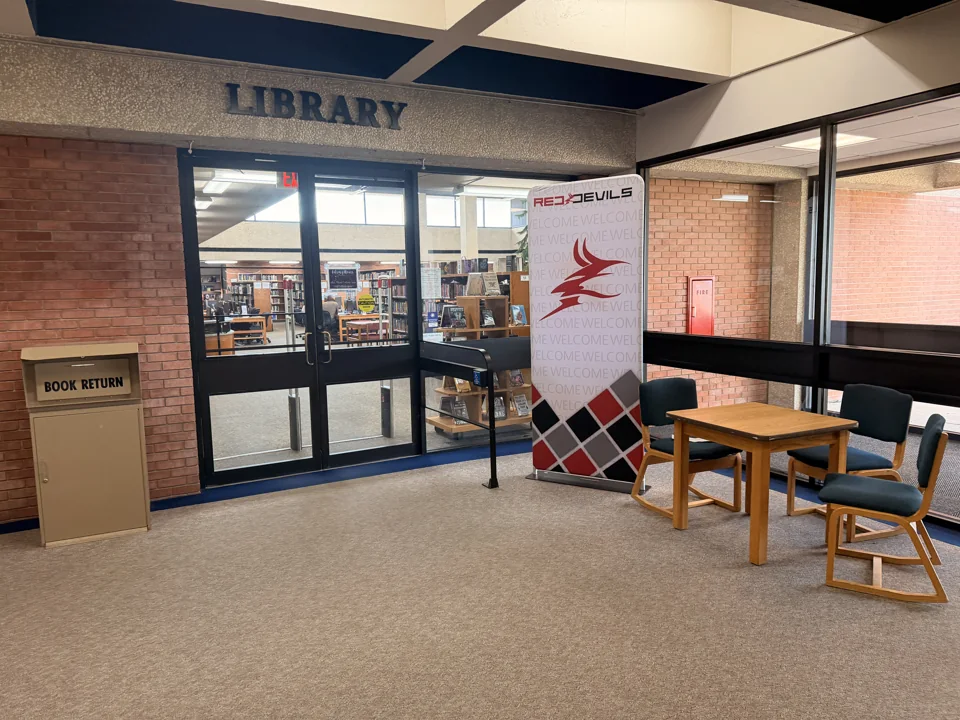
Allen Library supports learning in person, online, and through concurrent education. Its collection combines printed books with electronic resources such as academic journals, streaming video, and electronic books. A discovery service helps users locate material, while library guides, database access, and the catalog provide additional routes into research. Staff offer assistance through email, telephone, and arranged video conversations.
The library is also a shared college and community space. Students use it to study, meet tutors, and play chess; community visitors can browse shelves, read newspapers, and use computers. Interlibrary loan expands access beyond the local collection by obtaining items from other libraries. Online learners and high school students can also request Allen-held books through their local library branches, with materials sent there for collection and return. This connects a campus-based collection with students studying elsewhere and makes borrowing possible beyond a single physical location.
Sources: Library ↗
Priorities for the next stage
The college's 2025–2030 strategic plan sets out priorities for academic development, student support, regional partnerships, employees, and campus infrastructure. It calls for researching and investing in career and technical education pathways, reviewing academic programs, and exploring flexible, hybrid, and experiential forms of teaching. These are stated development objectives within the planning period.
Student-focused objectives include advising, an academic support model, clearer processes, and attention to communication preferences. Business and industry engagement is another priority, including workforce credentials and the participation of industry partners on advisory boards. Community objectives encompass student and staff involvement, campus events, collaboration with local resources, and alumni relations. The plan also addresses professional development, institutional information systems, facilities maintenance, safety, and technology. Together, these priorities describe the college's intended direction while keeping its educational role connected to the needs of its service region.
Sources: Strategic Plan ↗