Visa

About Allegheny College
A residential liberal arts college in Meadville
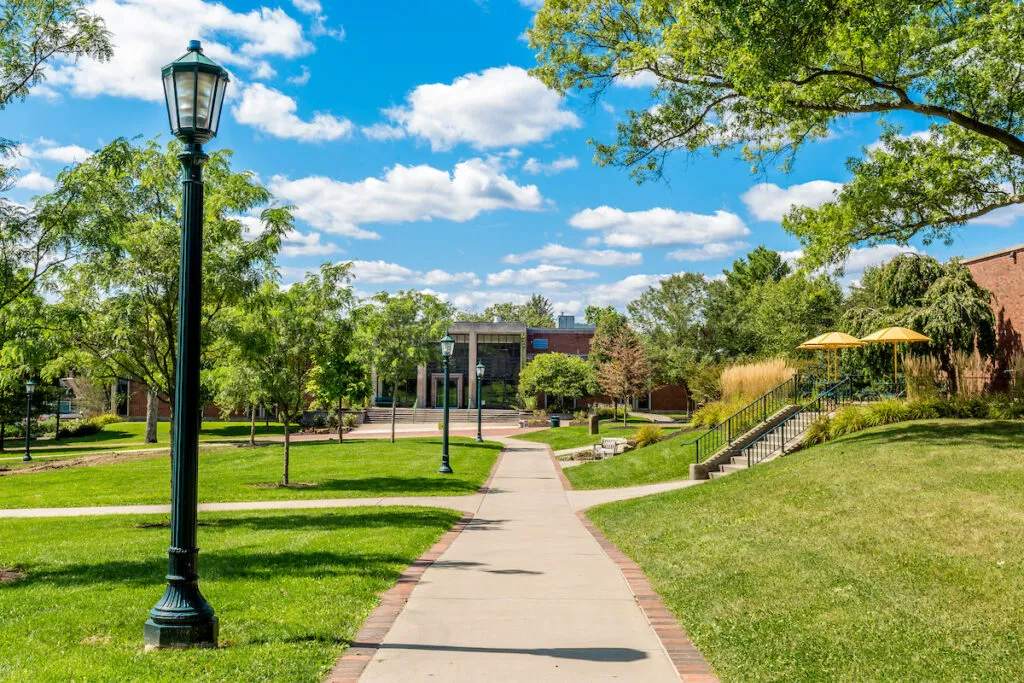
Allegheny College is an undergraduate residential college in Meadville, northwestern Pennsylvania. The college’s educational mission combines intellectual development with personal and civic responsibility, encouraging students to think critically and creatively and to communicate clearly in writing and speech.
A defining part of its academic approach is the combination of a major and a minor in different areas. Rather than treating a student’s interests as belonging to one narrow subject, Allegheny asks students to explore connections between fields. The college describes a learning community shaped by the exchange of ideas, academic inquiry and respect for different perspectives. Its residential setting provides the context for learning both inside and outside scheduled classes.
Sources: About Allegheny College ↗
A history beginning in 1815
Allegheny was founded in 1815, when Meadville was still a small frontier town. Local residents sought to create educational opportunities in the region, and the Reverend Timothy Alden became the college’s first president. Within its early years, Alden raised support for a permanent campus.
Bentley Hall developed from the need for a building to house the college’s library in the 1820s. Alden designed the building, which was named for William Bentley, a donor of a substantial private book collection. Bentley Hall remains a campus landmark and is associated with the tradition of graduating seniors passing through its doors at commencement. The college celebrated its bicentenary in 2015. Its Merrick Archives preserve institutional records and make historical material available for research.
Sources: College history ↗
Combining subjects and completing a Senior Comp
Allegheny’s academic structure encourages students to combine a major with study in another discipline through a minor. The published academic overview describes a progression from exploring that combination in the early years to concentrating more deeply on a field and undertaking the Senior Comprehensive Project, commonly known as the Senior Comp.
The capstone provides a setting for substantial independent inquiry or creative work. Allegheny traces some form of senior capstone experience to its first commencement in 1821, with its format changing over time. Academic support includes advising, peer tutoring, and help with writing and public speaking through the Maytum Center. The college also offers microcredentials that group courses around particular skills. Off-campus learning includes study-away opportunities for academic credit and community-engaged work.
Sources: Academic approach and resources ↗
Undergraduate research and creative activity
The Office of Undergraduate Research, Scholarship, and Creative Activities, or URSCA, supports research across the college. Its remit includes promoting student projects, organising presentations and helping students share their work beyond campus. The office describes research and creative activity as opportunities available at different stages of undergraduate study, not only in the final year.
Students work with faculty and staff mentors through activities such as fieldwork, community projects, conference presentations and co-authored writing. Summer collaboration is another part of the programme. URSCA also provides guidance on project applications and the presentation of scholarship. Its Gator TAILS podcast explores inquiry, learning and research, giving the college another setting for discussion of student and faculty work.
Sources: Undergraduate research, scholarship and creative activities ↗
Pelletier Library and research support
The Lawrence Lee Pelletier Library is a centre for study and research outside the classroom. Its physical holdings include books, archives and other materials, while digital resources can be accessed remotely with institutional credentials. The AggreGator search tool brings together material such as articles, books, journals, media and news. Research guides and database listings help users identify resources in particular disciplines.
Library staff and trained assistants provide research support, and students can arrange individual consultations with a librarian. Interlibrary loan helps users obtain items outside the college’s own holdings. Group-study rooms and individual study cubicles provide different working environments. Special Collections preserve rare books, manuscripts, letters, college photographs and publications. These services connect access to information with practical help in finding, evaluating and using sources.
Sources: Lawrence Lee Pelletier Library ↗
Learning with community partners
Allegheny’s Community Impact Hub links students, faculty and staff with regional partners. Community projects are incorporated into teaching and engagement activities so that students can apply knowledge while working with organisations beyond the college. The Hub organises its work around teams addressing shared community challenges.
Its five areas are health and wellbeing, community and economic development, arts and culture, education and social development, and environment and sustainability. Each team has a steering committee involving college and community participants. Proposed work ranges from engagement with cultural organisations to habitat conservation, educational partnerships and economic opportunity. This structure connects classroom learning with collaborative work rooted in Meadville and the wider region.
Sources: Community Engaged Learning ↗
Innovation, creativity and campus resources
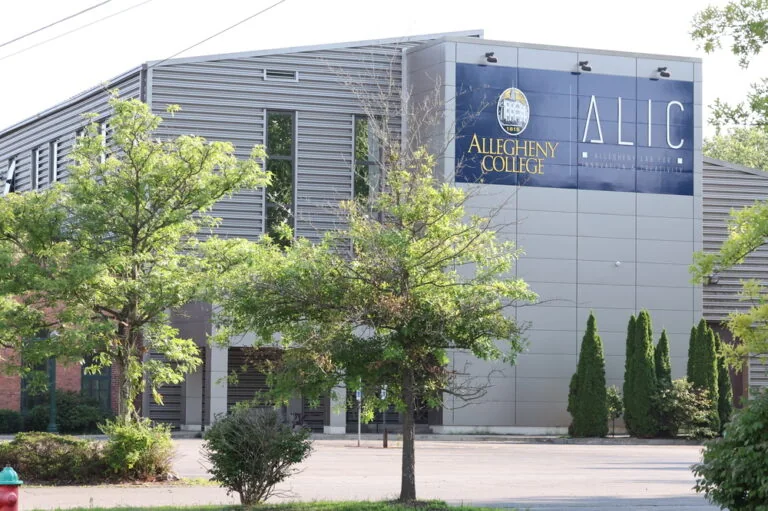
The Allegheny Lab for Innovation and Creativity, known as ALIC, provides resources for making and experimentation. Its on-campus laboratory supports prototypes, scientific equipment, artistic projects, robots, virtual environments and other designs. The college also identifies an ALIC location at Bessemer Commerce Park that connects educational work with community and industry partners.
ALIC describes mentoring and microgrants for student ideas, alongside a seed-stage business competition that offers feedback and coaching. Its work brings technological practice into contact with questions about context and social implications. Elsewhere on campus, the Playshop Theatre supports performance, the Campus Center houses everyday services, and the Wise Sport and Fitness Center provides recreation and athletic facilities. These spaces add creative, social and physical activities to the college’s academic environment. Its main campus address is 520 North Main Street.
Sources: Allegheny Lab for Innovation and Creativity ↗ · Campus and Meadville ↗