Visa
About Aletheia University
Foundation and university development
Aletheia University, known in Chinese as Zhenli University, is a church-founded university in Taiwan with campuses in Tamsui, New Taipei City, and Madou, Tainan. Its modern institutional history begins with plans adopted by the northern Taiwan Presbyterian Church in 1959. The school opened in 1965 as the Tamsui Institute of Business Administration, admitting students to three-year and five-year junior-college programmes. In 1994 it became a four-year independent college, using the English name Tamsui Oxford University College. The Madou division was formally established in 1996 and began admitting students the following year. On 1 August 1999 the institution adopted the name Aletheia University, drawing on the Greek word for truth. Its stated purpose combines the pursuit of truth with love and service. The two-campus history connects its northern Taiwan beginnings with its later development in the south, rather than describing two unrelated institutions.
Sources: Foundation and university development ↗
Oxford College and the university archives
The Tamsui campus preserves a much older educational landmark, Oxford College, associated with the Canadian Presbyterian missionary George Leslie Mackay. This heritage predates the modern university and is commemorated through the university archives. The archives introduction explains that the historic building was designated a monument in 1985 and assigned museum and archival functions through a church decision in 1986. Its responsibilities encompass university history, materials concerning Mackay and the history of the northern Taiwan Presbyterian Church. Staff collect, identify, organise, catalogue, preserve and display documents and objects connected with these subjects. Exhibitions and scholarly meetings make the collections available beyond their storage rooms. The archives also joined a national digital archiving programme in 2002, helping preserve and organise its historical holdings in digital form. These activities give the campus landmark an ongoing documentary and educational role within the university.
Development of the university library
The university library developed alongside the institution's changing status. Established in September 1965, it initially occupied the building known as the Little White House, now used as an international academic exchange facility. Construction of a dedicated five-storey library began in March 1972 and finished in June 1973. The library changed its name when the institution became a college in 1994 and again when it became a university in 1999. A reading room was established at Madou in 1997; the branch library building there was completed in 2001 and opened the following June. The library's institutional history also records successive stages of computerisation: an automated system introduced in 1992, an internet-connected replacement in 1996 and later changes in 2003 and 2015. These developments document how collection management and reader services evolved across several decades of institutional growth.
Library study spaces and collections
The published floor guide describes a library organised for several kinds of study. Reference works, student project reports and master's theses are grouped with Japanese-language and Chinese-language collections in the stack areas. At the principal entrance level, readers find the service counter, lockers, a newspaper-reading area and displays of new books. Catalogue terminals, multimedia viewing and listening resources, textbooks and reference materials are also located there. Discussion rooms provide places for collaborative work, while other floors contain reading areas and further Chinese-language collections. A separate periodicals room has its own service counter. The upper floor combines reading facilities with special collections and foreign-language books. The library administration centre is situated beside the library, behind Oxford College. Together, these arrangements distinguish spaces for finding material, consulting specialist collections, studying quietly and discussing work, rather than treating the library simply as a book store.
Chinese Language Center
Aletheia's Chinese Language Center is based in Tamsui and links language learning with the surrounding cultural landscape. Its introduction describes provision for international learners and new residents, including Chinese-language study and knowledge of Chinese teaching. Local historical settings such as Oxford College and Fort San Domingo are incorporated into its approach to learning through real situations. The centre identifies graded TOCFL preparation, tourism Chinese, everyday Chinese, business Chinese and professional language as areas of development. It also describes locally produced teaching materials centred on Tamsui, cloud-based courses and teaching videos. Short language camps, cultural exchanges and customised courses support relationships with institutions in Japan, Korea and Southeast Asia. Language learning is accompanied by cultural adaptation and everyday-life support for overseas students. This combination places formal language study alongside contact with the university's setting and international community, with local culture forming part of the learning environment.
Sources: Chinese Language Center ↗
Tamsui campus accommodation
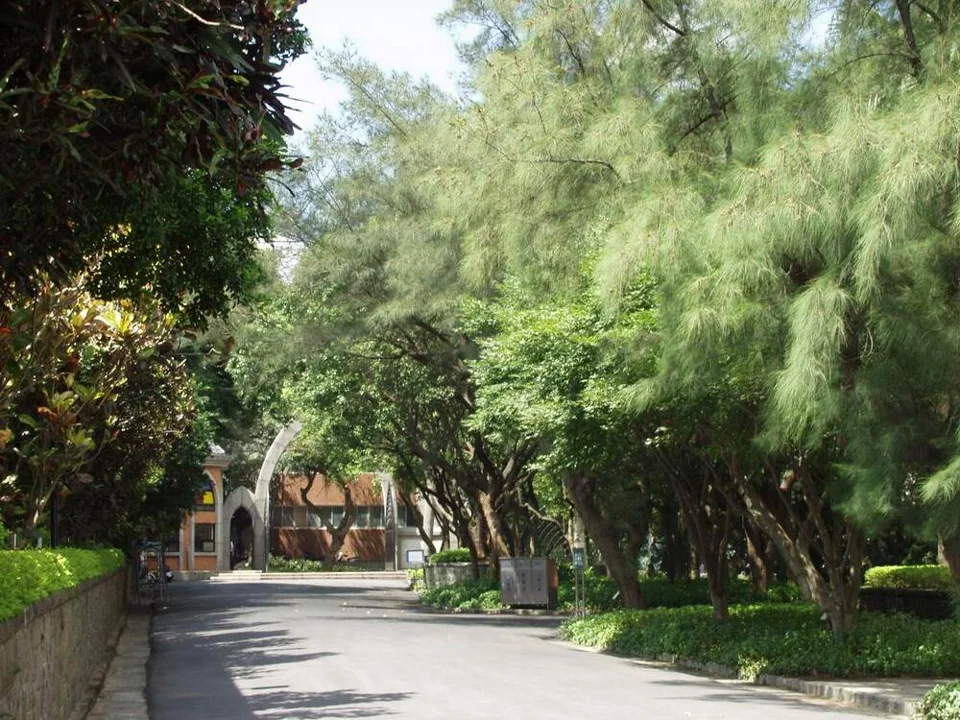
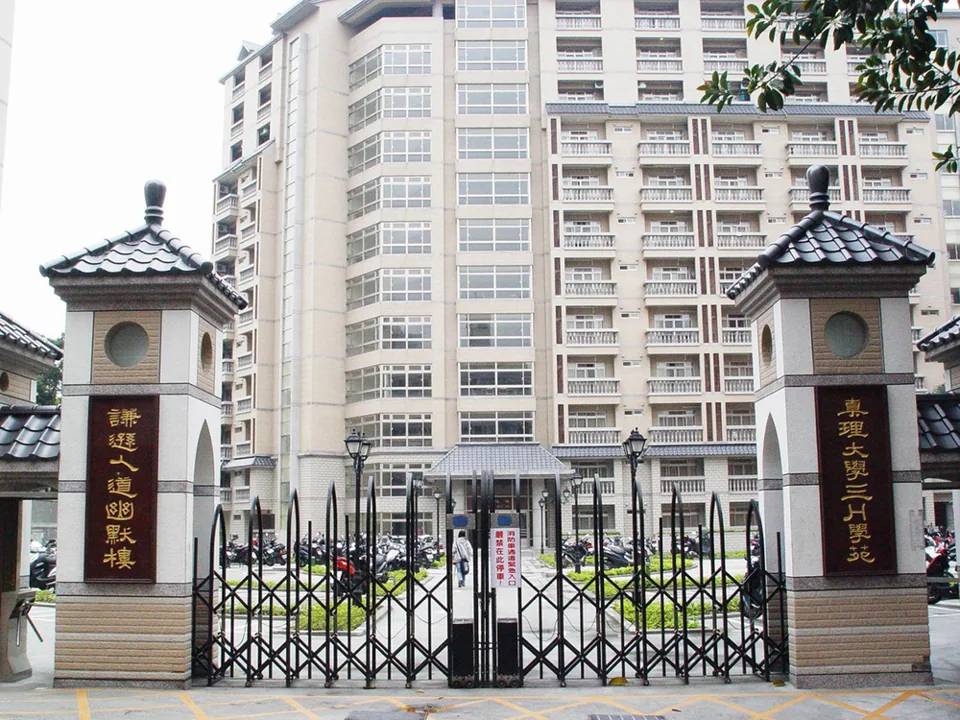
The university's Tamsui accommodation guide describes the Three H residences, named Humanity, Humility and Humour. These buildings provide student rooms alongside shared facilities, with the upper floors of Humour House designated for international accommodation. Common lounges, reading rooms and spaces for evening study complement laundry facilities. Residence activities and student support are described as part of helping students adjust to shared living. Three H Avenue is also the campus guide’s collective name for several campus routes, including the approaches to the Zhenli Street and Xinmin Street entrances and the route toward the residences. The selected photographs document the residence entrance in April 2005 and a tree-lined avenue in June 2004. They are historical illustrations of these identified campus locations.
Sources: Tamsui campus accommodation ↗ · Three H Avenue campus guide ↗