Visa
About Albright College
Origins in Pennsylvania
Albright College is a higher education institution in Reading, Pennsylvania, whose history brings together several nineteenth-century educational foundations. It dates its beginning to Union Seminary, established in New Berlin in 1856. Union Seminary later became Central Pennsylvania College and merged with Albright College at Myerstown in 1902. Another predecessor, Schuylkill Seminary, was founded in Reading in 1881 and moved to the present campus in 1902. It became Schuylkill College in 1923. The merger of the Myerstown and Schuylkill institutions in 1928 formed Albright College at Reading. Its name commemorates Jacob Albright, the Pennsylvania German preacher associated with the Evangelical Association. The college describes its present campus as a multifaith community with historic Methodist ties.
Sources: College history ↗
An adaptable programme of study
Albright's programme directory distinguishes majors, co-majors and minors, giving students several ways to organise their academic interests. Its subjects span the sciences, humanities, social sciences, business and creative fields. Biology, chemistry, computer science, English, history, psychology, sociology and theatre are among the areas available as majors or co-majors. Other subjects include fashion, accounting, artificial intelligence, digital studio art and game and simulation development. Minors range from classical studies and creative writing to photography, Holocaust studies and women's and gender studies. The directory also identifies pre-professional pathways in law and health-related fields. These options allow academic combinations that connect different methods, subject matter and forms of practice.
Sources: Programmes of study ↗

The general education framework
General education provides a common structure alongside specialised study. It includes a first-year seminar, English composition, foundations courses, connections courses and a synthesis experience. Foundations work covers fine arts, humanities, social science, natural science, quantitative skills and world cultures. Composition develops thesis-driven writing, research and information literacy. Connections courses examine cultural histories, ideas and creative work across different departments, including designated global perspectives. The synthesis course asks students to draw on their college experiences when approaching a shared topic during the later part of their degree. Examples include global health, baseball and American culture, and monsters in religion and literature. The framework emphasises communication, interdisciplinary knowledge and critical, creative and ethical reasoning.
Sources: General education ↗
Research with faculty mentors
The Albright Creative Research Experience, known as ACRE, supports independent research and creative projects undertaken jointly by students and faculty mentors. It is open across academic fields and is organised as a summer learning experience. The programme's selection criteria consider the learning opportunity, the collaborative relationship, the project's connection with existing scholarship or creative practice, and whether its scope is feasible. Participants meet during the summer to discuss progress and learn about one another's work. They subsequently present their projects at an Experience Event and submit a report. Required reporting includes a public-facing abstract and an account of the work, outcomes, current status and possible future development.
Honours and sustained inquiry
The Honors Program offers several routes for advanced academic work: inquiry-oriented honours courses, specially arranged modules within regular courses, and independent study with a professor. A module adapts a course through an additional or replacement project agreed with the instructor. A senior honours project extends this approach into sustained research, a written thesis and a presentation to the college community. Students develop the project with an adviser and readers, preparing a proposal that sets out goals, methods, preliminary research, a bibliography and a timetable. The programme also distinguishes College Honors from Departmental Distinction, each with its own academic requirements. A single senior project can contribute to both distinctions where the relevant conditions are fulfilled.
Sources: Honors Program ↗
Biology in the laboratory and field
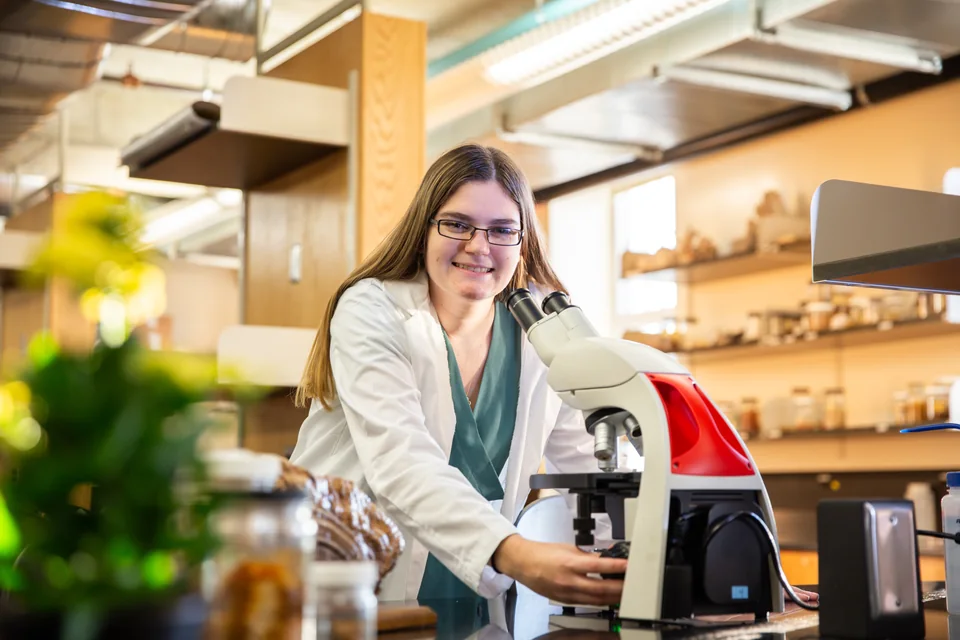
Biology teaching combines the study of organisms, ecosystems and cellular processes with scientific investigation. Programme goals include formulating hypotheses, designing experiments, recording and analysing data, and communicating findings. Practical skills encompass microscopy, molecular techniques, population sampling, observation and geographic information systems. The curriculum draws from field biology, cell and molecular biology, and organismal biology, alongside supporting chemistry and mathematics. Independent projects described by the department have examined bat ecology, insect visual receptors, local streams and wetlands, endangered mammals and gene cloning. A greenhouse, GIS computer laboratory and faculty-student research space support this work. The department also identifies collaboration with organisations including Berks Nature and the Reading Science Center.
Sources: Biology programme ↗
Fashion as creative and technical practice
The fashion programme links design, garment construction, visual communication and the business of clothing. Its core includes visual literacy, textile fundamentals, fashion history and computer-aided design. Different tracks focus on design, merchandising or a combination of the two. Depending on the route, students encounter patternmaking, draping, collections development, visual merchandising, trend forecasting, retailing and lifestyle marketing. Practical activities include the annual college fashion show and editorial work for Fashion Lion. The programme also describes student participation in New York Fashion Week under the mentorship of alumnus R. Scott French. These activities connect the preparation of designs and collections with presentation, production and the organisation of fashion events.
Sources: Fashion programme ↗
Learning beyond the campus
Study abroad forms another part of Albright's academic provision. The college directs students to an introductory Study Abroad 101 resource explaining options, requirements and the application process. Its Lions Learning Abroad platform brings related information together for students exploring international study. The published guidance distinguishes a full semester abroad from summer programmes and encourages students to discuss these possibilities through an appointment. Off-campus learning can also take place within the United States, including specialised coursework and programmes combining internships with classes. This adds geographical and experiential options to a programme of study, allowing students to investigate subjects in settings beyond their usual campus classrooms.
Sources: Study abroad ↗