Visa
About Albertus Magnus College
A century of college history
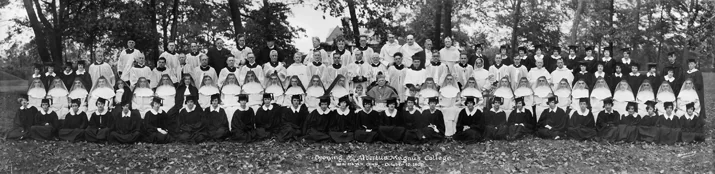
Albertus Magnus College is a coeducational Catholic college in New Haven, Connecticut, with a Dominican heritage. Its origins lie in the Dominican Sisters' purchase of an estate at 700 Prospect Street in 1924. The college received its charter on July 13, 1925, and held its first classes in Rosary Hall on September 24 that year. It originally served women. Continuing education later expanded its reach: an evening programme called Begin Again started in 1973, and the institution became fully coeducational in 1985. Its first graduate programme, the Master of Arts in Liberal Studies, followed in 1992. The college marked its centennial during the 2025–2026 academic year.
Sources: College history ↗
The Prospect Hill campus
The main campus occupies fifty acres in New Haven's Prospect Hill neighbourhood. Historic nineteenth-century mansions form part of its physical setting and have been adapted for residence halls and administrative offices. Aquinas Hall provides academic space, while the Tagliatela Academic Center contains science laboratories and a communications studio. The Hubert Campus Center includes the Behan Community Room, a pub and the campus store. Rosary Hall houses the library, Walsh Hall contains the college chapel, and Weldon Hall supports education programmes. Athletic facilities include the Cosgrove, Marcus, Messer Athletic Center and outdoor spaces for soccer, tennis, softball and informal recreation. These buildings combine teaching, residential and community functions within the campus.
Sources: Main campus and facilities ↗
Subjects and the liberal arts core
The college's undergraduate directory spans arts, humanities, social sciences, business and scientific disciplines. Listed subjects include art, biology, chemistry, English, history, mathematics, political science, psychology, sociology and Spanish, alongside accounting, finance, computer information systems, cyber security and sport management. Students can also pursue minors and concentrations, such as graphic design, photography, creative writing or entrepreneurship. The Invitation to Inquiry programme provides a shared liberal arts framework, encouraging students to connect ideas across disciplines and consider questions about themselves, society and the wider world. Experiential opportunities identified by the college include internships, education field experiences, service learning and collaborative research between students and faculty.
Sources: Undergraduate programmes ↗
Learning for working adults
Albertus offers an accelerated adult degree format using eight-week courses. Its adult-learning provision includes online and campus participation and is organised within the Division of Professional and Graduate Studies. The programme directory includes associate and bachelor's options as well as links to graduate study, with subjects such as business management, accounting, criminal justice, humanities and healthcare management. Academic planning can take previous college study and prior learning into account through the institution's transfer policies. The college also connects adult students with career assessments, workshops, internships and employer networking activities. This format extends the college's educational provision to learners balancing study with employment and other responsibilities.
Library collections and research
Rosary Hall Library provides access to academic databases, journals, books, videos, course reserves and subject research guides. Librarians offer research services to help students locate scholarly material and use academic databases. Its collections also feature writing by Albertus faculty, staff and alumni, including fiction, textbooks, memoirs and poetry. Other highlighted resources include material for psychology and art therapy, a diversity, equity and inclusion resource library, and guidance supporting the undergraduate Examined Life course sequence. The college archives preserve records from the institution's founding onward. Holdings include yearbooks, scrapbooks, photographs, meeting minutes, official memoranda and publications that document the college's social, cultural and administrative history.
Sources: Rosary Hall Library ↗
Dominican educational values
Albertus describes its Catholic and Dominican identity through the four pillars of study, prayer, community and service. Its mission places liberal arts learning alongside practical application, ethical reflection and respect for the diversity of its community. The college presents study as a way to understand both the world and the individual, while prayer and contemplation provide opportunities for members of different faith traditions. Community is expressed through mutual support and accountability, and service through participation in activities on and beyond campus. Its statement of Catholic identity also emphasises respectful debate, using the Dominican term disputatio, and identifies curiosity, academic freedom and the relationship between faith and reason as educational commitments.
Immersive learning facilities
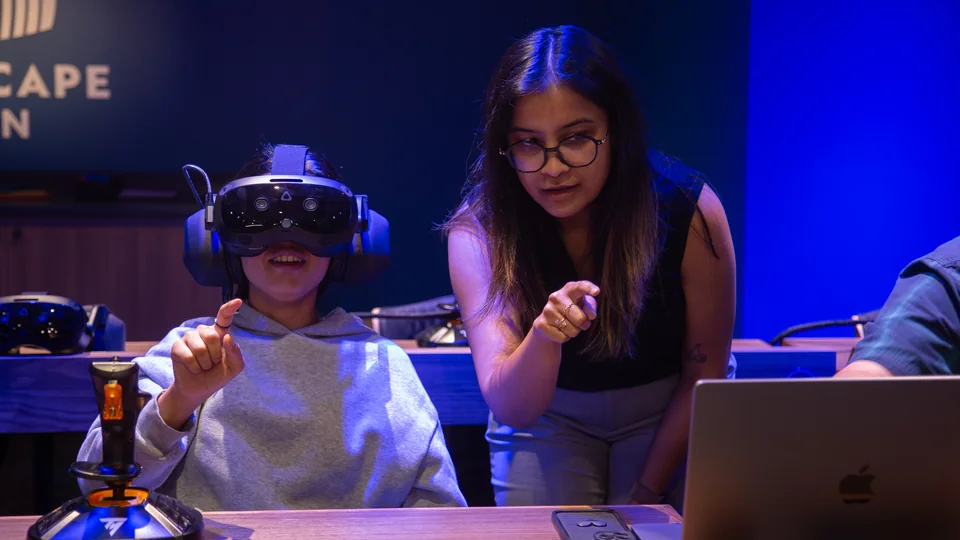
The Carol G. Ditkoff ’67 Immersive Learning Collaboratory is the college's home for Dreamscape Learn. Its facilities include a virtual-reality classroom, a free-roam pod and the college's esports programme. The free-roam setting combines movement with sensory effects such as wind and mist, while classroom experiences use interactive storytelling to frame decisions, evidence gathering and problem solving. The college identifies these experiences as components of academic learning. Its provision also includes two-dimensional interactive tools integrated into the learning management system for adult and online students. The collaboratory therefore brings together physical campus facilities and digital participation as parts of the college's developing approach to experiential teaching.
Sources: Dreamscape Learn ↗
A new facility in the centennial period
The college announced the collaboratory's formal launch for September 23, 2026, during its centennial period. The announced programme included a classroom demonstration followed by a speaking programme and ribbon cutting at the Hubert Campus Center. Its creation was supported by a three-million-dollar gift from alumna Carol Gutoski Ditkoff and her husband, James. The announcement identified Tarishi Verma as inaugural director and included opportunities for the media to observe a demonstration and interview participants. The September announcement presented the facility as an addition to its liberal arts-based teaching. It also connected the project with the Centennial Plan, the college's strategic framework for its second century.
Sources: Collaboratory launch announcement ↗