Visa
About Alberta College
A professional college in central Riga
Alberta College, known in Latvian as Alberta koledža, is a higher education institution in Riga. It was founded in 2001, the year of the city's eight-hundredth anniversary, and named in honour of Bishop Albert. Its educational focus is short-cycle professional higher education, with practical learning and the involvement of industry professionals identified as important parts of its mission.
The college is based at Skolas Street 22 in central Riga. Its institutional description brings together classroom study and an electronic learning environment. Students can use that environment to find study plans, individual notices, grades, teaching materials, lecture notes and video lectures. The college also describes traditions involving students and teaching staff, including applied business games, conferences and shared activities. Its stated educational priorities connect subject knowledge with the practical abilities students develop during their programmes, rather than presenting study solely as the completion of theoretical coursework.
Library and learning resources
The college's library provides books for borrowing and a reading room for on-site study. Students can arrange access or request books through the library, with collection available through the college's study administration. The reading room includes computers and internet access, supplementing the printed materials available for academic work.
Subject areas represented in the library include business economics, management, project management, human resources, psychology, public relations, accounting, financial management and law. Language-learning materials and dictionaries are also part of the collection. The library links to a book catalogue, a student-work catalogue and open electronic resources. Its guidance additionally points students towards the Latvian National Library's digital resources and services available through the college's partner, the EKA University of Applied Sciences. Teaching materials produced by the college and its lecturers are also made available through individual courses in the electronic environment.
Sources: Library and learning resources ↗
Programming and information technology
Programming is offered as a specialisation within the Information Technology study programme. The published curriculum combines theoretical knowledge with practical software development. Its activities include writing, testing and improving code, working with database management systems, automating processes with algorithms and scripts, and participating in group projects and simulations.
The programme also addresses the preparation of clear software-design documentation, understanding computer systems and analysing technical problems. Its educational objectives include scientific analysis, independent problem solving, professional ethics and familiarity with industry standards. The stated learning outcomes cover assessing requirements, preparing development environments, designing software, debugging and improving performance. Communication with colleagues and clients and cooperation in cross-functional teams are included alongside technical work. The published study format uses online evening teaching and recorded materials, connecting the practical content with a mode designed to accommodate students studying away from the college's classrooms.
Sources: Programming and information technology ↗
Event production and cultural organisation
The Event Production programme concerns the planning and delivery of cultural and entertainment events. It combines creative work with budgeting, coordination and technical organisation. Students develop concepts, plans and scenarios, consider the purposes of an event and work on managing the activities required to bring it about.
The programme's practical tasks include coordinating creative and technical teams, preparing budgets and monitoring an event's progress. Its curriculum includes cultural and art history, professional ethics, marketing, business fundamentals, foreign-language study and presentation skills. Workshops and project work provide opportunities to connect these subjects with event production. The programme also includes placement experience and a qualification project. Its objectives emphasise creative and analytical thinking, cooperation and the ability to assess and improve work. The combination of organisational subjects and cultural content gives this programme a different focus from the college's computing and business-oriented studies.
Applied research and creative work
The college's research and creative-work statement connects investigation with teaching and the development of staff and student skills. Its published strategy for 2019–2024 identified research capacity, participation by lecturers and students, and cooperation with external stakeholders as priorities. Applied research and creative work are prominent themes in that framework.
The research directions published alongside it are closely related to the college's subjects. Examples include adaptation of new employees, personnel management during organisational change, challenges facing small businesses and accounting practices in smaller organisations. Other areas address event trends, digital marketing, public relations and the use of information technology to solve business problems. This organisation links research questions to particular study programmes rather than treating research as a separate general activity. Since 2019, the college has included its scientific-activity reporting in its annual yearbook, alongside earlier separately listed research reports.
Sources: Applied research and creative work ↗
An international intensive course in 2026
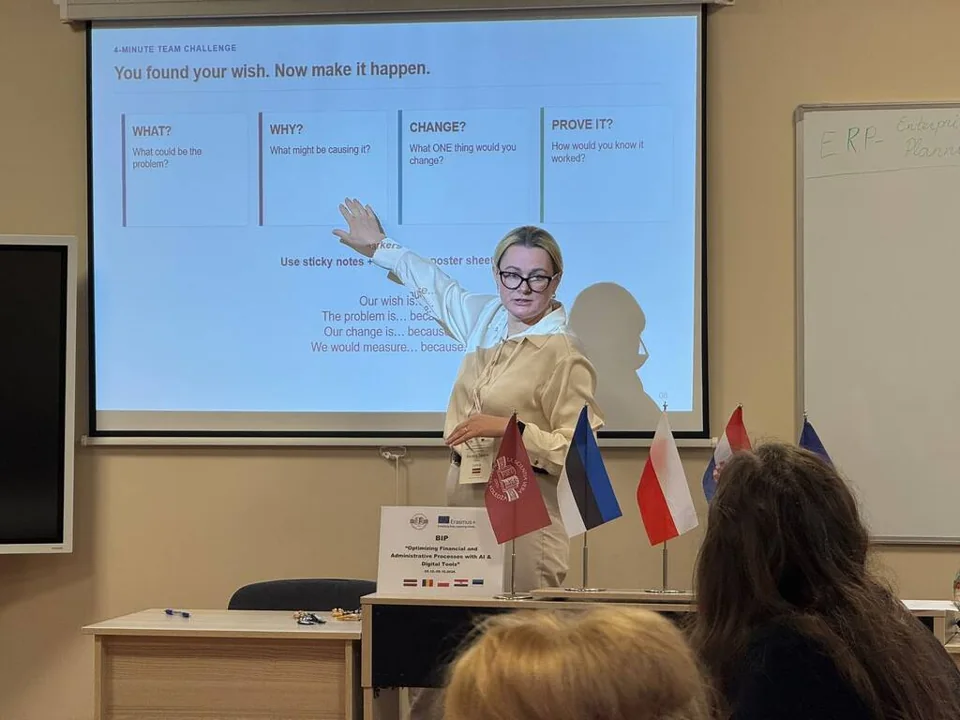
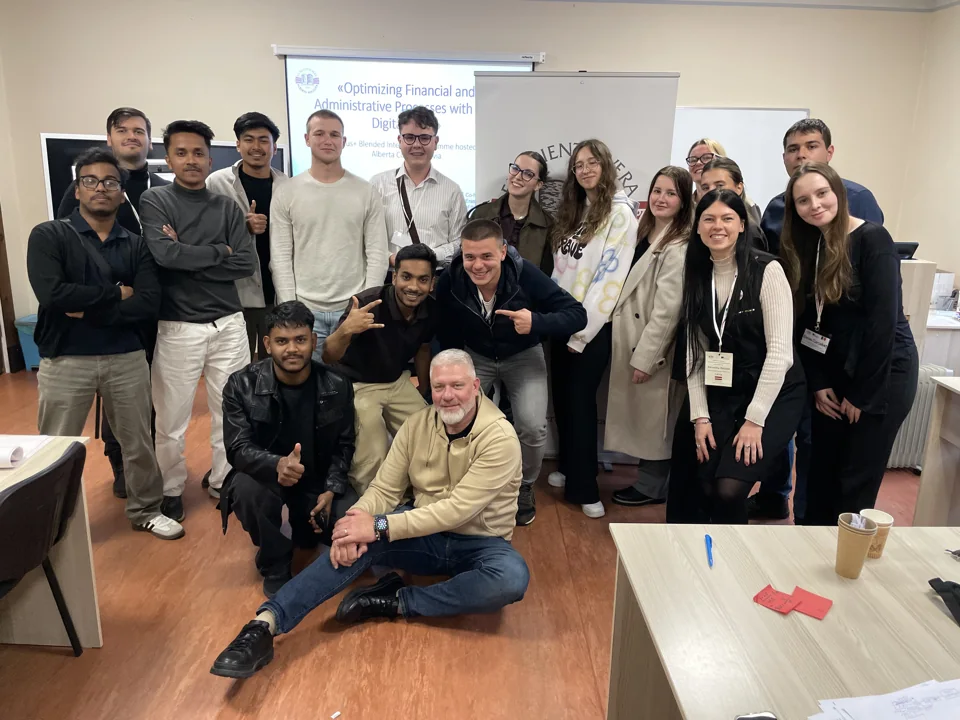
From October 5 to 9, 2026, Alberta College hosted an Erasmus+ blended intensive programme on financial and administrative processes using artificial intelligence and digital tools. Participants came from partner institutions in Romania, Poland, Croatia and Estonia. The course combined lectures, practical workshops, international teamwork and cultural activities.
Topics included digital transformation, process analysis, responsible use of artificial intelligence, sustainable business processes, document and data processing, and digital collaboration. The final day brought data analysis and presentation work together with team projects, which participants presented to an evaluation panel. Cultural activities included visits in Riga and an excursion to Sigulda. The completed course provides a dated example of how the college combines internationally shared study with practical assignments and opportunities to explore Latvia beyond the classroom.
Sources: An international intensive course in 2026 ↗