Visa
About Albert Einstein College of Medicine
Origins and institutional relationships
Albert Einstein College of Medicine is a medical and biomedical research institution in the Bronx, New York. Its origins lie in plans developed under Yeshiva University president Samuel Belkin. Albert Einstein agreed in 1953 to allow his name to be used for the medical school, and the first class entered on September 12, 1955. The college began offering doctoral study in 1957, extending its academic activity beyond medical education.
The institutional relationship with Montefiore developed over several decades. Einstein affiliated with Montefiore Medical Center in 1963. In 2015, Montefiore Medicine, now Montefiore Einstein, became the umbrella institution for the college and Montefiore Health System. Einstein's history records its transition to independent degree-granting status in 2019. These milestones distinguish its founding within Yeshiva University's academic setting from its later institutional structure and its continuing relationship with Montefiore.
Education and biomedical investigation
Einstein combines medical education, biomedical research and clinical investigation. Its educational provision includes the M.D., Ph.D. and combined M.D./Ph.D., alongside master's-level opportunities in clinical research, bioethics and public health. Research interests described by the college include cancer, diabetes, neuroscience, ageing, genetics and infectious diseases.
The institution places community engagement alongside its scientific and educational work. Medical students learn in several clinical settings, including Montefiore and other affiliated hospital systems, while community organisations contribute to service-learning experiences. For doctoral students, the emphasis is on developing independent investigators through research training and faculty mentorship. The college describes collaboration across departments and research centres as an important feature of its academic environment. This creates connections between laboratory investigation, clinical questions and the education of physicians and biomedical scientists within the Bronx-based institution.
Sources: Education and biomedical investigation ↗
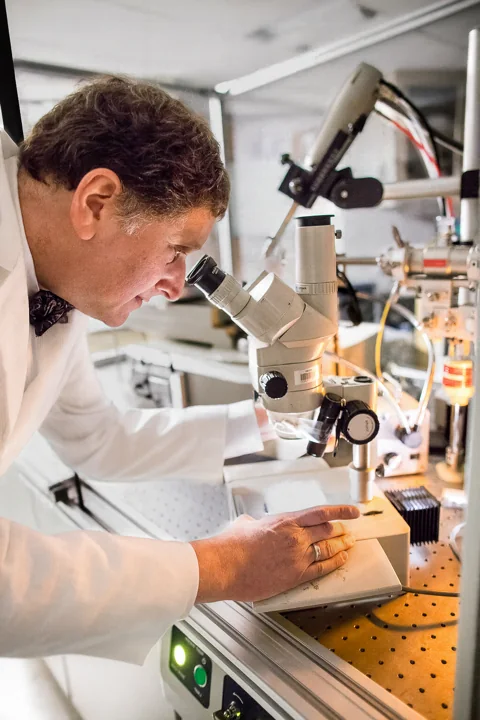
The medical curriculum
Einstein's M.D. curriculum brings biomedical, clinical and health-systems sciences into a programme that also includes research and service learning. The preclerkship phase provides foundational study of human biology and behaviour during the initial eighteen months. Clinical education then develops through training in private, public and government healthcare settings.
Two longitudinal components run across the four-year medical programme. Service learning connects students with community-based organisations, while Scholarly Impact and Research provides mentor-guided projects in research and scholarship. Learning communities bring together faculty advisers and peers to support clinical skills, academic work and professional development. The Office of Medical Education implements and evaluates the curriculum with the M.D. Curriculum Committee. These elements give the programme several connected strands: foundational science, clinical experience, scholarly work and engagement with the communities in which students learn. Students also encounter opportunities for dual-degree study and global-health learning experiences.
Sources: The medical curriculum ↗
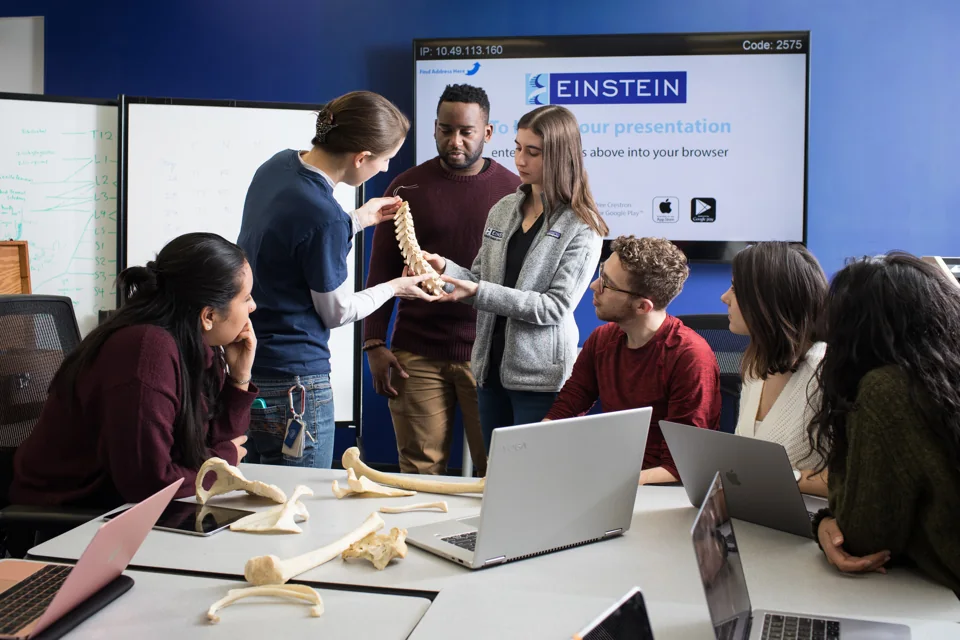
Biomedical graduate study
The Graduate Division organises its academic calendar into summer, fall and spring semesters. Coursework, laboratory rotations and thesis research have defined places within that structure. The fall includes a course block and rotation period, while the spring includes two further blocks and two rotation periods. This arrangement connects formal study with opportunities to explore research settings.
Doctoral progression also involves a qualifying examination combining written and oral work. A Student Advisory Committee reviews the student's research plan, assesses progress and advises on readiness to write and defend the thesis. The division provides academic policies, course registration resources and guidance on thesis defence and graduation. These arrangements make research supervision and assessment identifiable parts of graduate education. Administrative services additionally support documentation such as transcripts and enrolment verification, while the academic calendar sets out the timing of courses, rotations and research periods.
Sources: Biomedical graduate study ↗
Training physician-scientists
Einstein's Medical Scientist Training Program combines medical and doctoral education in an integrated course of study. It has received continuous support from the National Institutes of Health since 1964. Its educational purpose is the preparation of physician-scientists whose work connects biomedical investigation with academic medicine.
The programme does not treat the two degrees as entirely separate experiences. MSTP-specific courses are combined with medical and graduate coursework during the first eighteen months of preclinical study. During the doctoral research years, students continue clinical engagement through the programme's Continuity Clinic. The programme also describes an academic and social community within the college, with individual attention to students' developing research interests. Its combination of shared coursework, thesis research and continued clinical contact gives the joint degree a structure distinct from either the M.D. or Ph.D. taken alone.
Sources: Training physician-scientists ↗
Shared research facilities
Einstein's shared scientific facilities provide access to specialised equipment, technical services and experienced staff. The published facilities directory spans imaging, cell analysis, genomics, molecular structure, informatics and clinical and translational research. Named resources include flow cytometry, proteomics, structural nuclear magnetic resonance and X-ray crystallography, alongside computational genomics and high-performance computing.
The directory also identifies biostatistics, clinical-trials methodology, biorepositories and research informatics among the available areas of support. These services allow investigators to draw on expertise that extends beyond an individual laboratory. The iLab management system supports instrument reservations, service requests and centralised billing for participating facilities. Tutorials and other support resources accompany the system. The shared-facility model is therefore both a scientific resource and an organised service structure, bringing specialised methods and equipment into a common framework for the college's research community.
Sources: Shared research facilities ↗