Visa


About Albany State University
A public university in southwest Georgia
Albany State University is a public institution in Albany, Georgia, and a member of the University System of Georgia. Its identity combines a historically Black university tradition with a broad access mission serving southwest Georgia and beyond. The university offers certificates and associate, bachelor’s and graduate programmes through its Albany campuses, selected learning sites and online provision. Its East Campus is at 504 College Drive, while the West Campus is at 2400 Gillionville Road. These are two locations within the same university, rather than separate institutions. The mission connects teaching and learning with scholarship, public service and partnerships intended to support community and economic development.
Sources: Mission and vision ↗ · Campus maps ↗
From a training institute to a university
Joseph Winthrop Holley founded the Albany Bible and Manual Training Institute in 1903. It provided religious and basic education and teacher training for the local Black population. State support began in 1917, when the institution received two-year status and became the Georgia Normal and Agricultural College. It later joined the University System of Georgia. Four-year status followed in 1943 under the name Albany State College, with teacher education and home economics prominent in its work. The college subsequently expanded into humanities, social sciences and health sciences. Graduate degrees began in 1981, and the Board of Regents approved the name Albany State University in 1996. This sequence records an expanding academic remit across several institutional names.
Sources: University history ↗
The Darton consolidation
The present university also incorporates the legacy of Darton State College. The University System of Georgia’s Board of Regents granted final approval for the consolidation in December 2016, with an effective date of 1 January 2017. The combined institution retained the Albany State University name. The official approval explains that the new institution would build on the HBCU mission while also continuing an access mission and workforce-related education. It treats the consolidation as a way to bring together the strengths and community relationships of both predecessors.
Arts, sciences and the undergraduate foundation
The College of Arts and Sciences provides much of the core curriculum taken across the university’s undergraduate degrees. Its organisation includes arts and humanities, natural sciences, social sciences, and mathematics, computer science and physics. This places creative, quantitative and scientific study within the same academic college. The college also identifies a Master of Science in Integrated Biotechnology among its offerings. Its public introduction invites participation in lectures, colloquia, seminars, recitals, concerts and exhibitions, connecting academic departments with cultural activity. Faculty and students participate in programmes intended to enrich the wider university and surrounding service region. The college’s role therefore extends from shared undergraduate courses to specialist study and public academic events.
Sources: College of Arts and Sciences ↗
Business, education and professional subjects
The College of Business, Education and Professional Studies groups several fields concerned with organisations, public institutions and social needs. Its published structure includes the School of Business, School of Education, criminal justice and social work. It also identifies master’s programmes in business administration and public administration, alongside Army Reserve Officers’ Training Corps provision. The college’s dean’s message emphasises the relationship between academic study and practical relevance, including faculty scholarship, mentoring and engagement with external partners. Industry representatives, alumni and community members are described as participants in that wider network. Its administrative contact is on the East Campus, locating this part of the university’s academic organisation within the College Drive site.
Health-professions education
Darton College of Health Professions brings together nursing, health sciences, and health and human performance. Its educational aims emphasise teamwork, compassion, evidence-based practice and continued learning. The college’s administrative address is on the West Campus. Within it, the Division of Health Sciences lists fields including dental hygiene, diagnostic medical sonography, health information technology, histologic technology, medical laboratory technology, physical therapist assistance, radiologic science and respiratory care. It also provides information about associate study, certificates and a bachelor’s degree in health sciences. This range shows how the university’s access mission includes several kinds of health-related education. The division organises information and application pathways by programme, reflecting their different academic requirements.
Sources: Darton College of Health Professions ↗ · Health Sciences division ↗
Student engagement and representation
The Office of Student Engagement is based in the Orange Zone of the C.W. Grant Student Union. It supports students seeking involvement, new interests and connections with other members of the university. Its published pathways include the Student Activities Advisory Board, Student Government Association, Royal Court and student organisations. These provide several forms of participation, from helping shape campus activities to representative and ceremonial roles. The office presents involvement as part of the wider university experience, complementing coursework through opportunities to meet other students and contribute to campus life. Its location gives students a named point of contact for exploring those opportunities.
Sources: Student engagement ↗
Career exploration and professional development
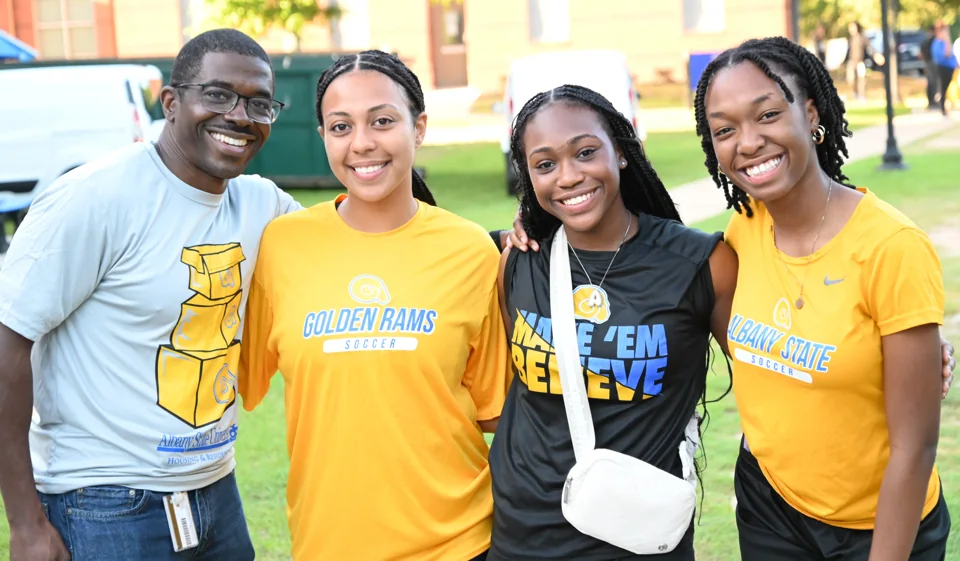
The Office of Career Services works with students and alumni on career exploration and professional preparation. Its described support includes developing résumés, preparing for interviews, considering internships and exploring graduate school or entrepreneurship. The office collaborates with employers, alumni and community partners and provides career action plans, assessment resources and appointment options. Its services address the process of identifying interests, communicating qualifications and connecting education with possible next steps. An employer portal and alumni resources extend the service beyond an individual appointment. The office’s West Campus contact places this support alongside other services available across the consolidated university.
Sources: Career Services ↗