Visa


About Albany Law School
An independent law school in New York’s capital
Albany Law School is an independent law school in Albany, New York. Founded in 1851, it places legal education within the setting of the state capital and connects classroom study with government, professional practice and community activity. Its educational mission emphasises legal knowledge, professional competence, ethical values and service. The school shares a campus with neighbouring colleges while maintaining its own institutional identity.
A collaboration with the University at Albany supports joint academic activity without making the law school a department of that university. The partnership includes dual-degree combinations linking the Juris Doctor with fields such as business administration, public administration, social work, regional planning and history. Albany Law also offers online graduate study in areas including cybersecurity and data privacy, financial compliance, government affairs, health law and human resources. These programmes extend its educational activity beyond the traditional law degree.
Origins and institutional development
The school's founders were Amos Dean, Ira Harris and Amasa Parker, lawyers who wanted a more structured alternative to preparation through legal clerkships alone. Their model combined the principles of law with opportunities to understand their application. The first lecture took place on December 17, 1851, in Albany's Exchange Building.
In 1873, Albany Law joined Albany Medical College and Union College in the Union University affiliation. The participating institutions retained responsibility for their own programmes and governance. The school published the student-edited Albany Law School Journal in 1875, an early expression of student involvement in legal scholarship. Later milestones included the expansion of clinical education and the establishment of the Government Law Center in 1978. Kate Stoneman graduated in 1898 as the school's first woman graduate. These developments form part of a history that links formal instruction with practical and public-facing legal work.
Learning through practice
Experiential education begins in the first-year Lawyering programme. Students are assigned to simulated law firms representing parties in a dispute that runs across the academic year. The exercise introduces legal institutions, professional ethics and the practical skills involved in working on a matter over time.
Later study offers several different ways to apply classroom knowledge. Advanced simulations combine substantive legal subjects with skills instruction and professional responsibilities. Problem-based courses ask students to use legal doctrine in real or simulated policy and legal situations. Clinics and field placements provide supervised experience beyond these exercises. Summer in Practice and Semester in Practice place students with lawyer-mentors in judicial, government and public-interest offices. The range of formats gives practical learning a place throughout the curriculum, from introductory simulated disputes to sustained work in professional settings under supervision.
Sources: Learning through practice ↗
Schaffer Law Library
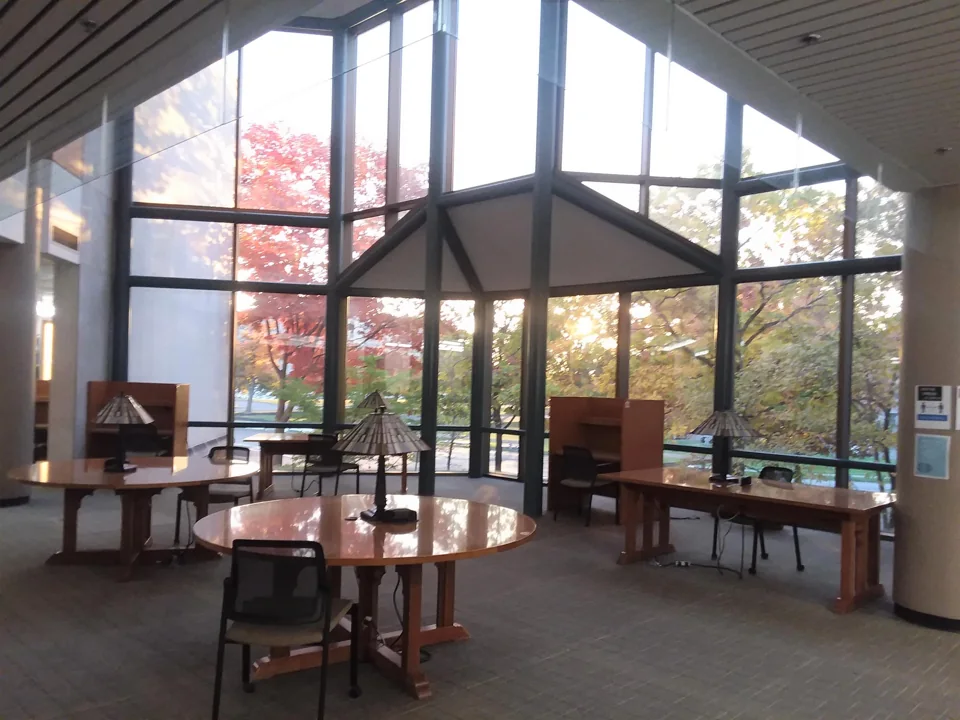
Schaffer Law Library opened in 1986 after construction began the previous year. Its three-storey building contains individual seating and group study rooms. A central stairwell beneath a skylight and a glass-walled reading room are distinctive features of the interior. The building replaced a library that had occupied space in the school's older building.
Alumni support played an important role in creating the new library, which was named for Harry M. Schaffer. The architectural firm Mendel, Mesick, Cohen and Hall designed the building, with the library director contributing to its planning. L.A. Swyer Company carried out construction. The library's history also records Mary Elizabeth Cox, a 1946 graduate who became both a faculty member and librarian in 1947. The facilities bring study spaces and the library collection together within a building designed specifically for their use.
Sources: Schaffer Law Library ↗

Government law and public service
The Government Law Center offers students ways to explore public-sector law through fellowships, research and supervised placements. Its fellowship brings students into conversation with government attorneys, judges, agency lawyers, nonprofit leaders and other practitioners. Fellows can contribute to the center's blogs or develop more extensive writing on public-policy questions.
The Edgar and Margaret Sandman Fellowship supports an extended investigation of a policy topic. The work can include interviewing practitioners, organising a roundtable and preparing a report for publication by the center. Separate internship opportunities involve substantive research under the director and staff attorneys. Students participate through the Field Placement Program or as research assistants, receiving feedback on their research and writing. These opportunities connect academic work with the questions encountered by government and community organisations and make public-service study an identifiable part of the school's wider educational provision.
Sources: Government law and public service ↗
Moot court and advocacy
The Anthony V. Cardona ’70 Moot Court Program gives students opportunities to develop legal research, analysis, writing and oral advocacy through competition. Internal competitions involve members of the school community, while travel teams compete against students from other law schools. Federal and state judges and practising attorneys participate in evaluating student work.
The school's internal competitions cover several different professional tasks. The Karen C. McGovern Senior Prize Trials concern trial advocacy; the Domenick L. Gabrielli competition focuses on appellate advocacy; and the Donna Jo Morse competitions address client counselling and negotiations. The programme also involves student organisers and volunteers alongside competitors. Its published participation structure includes roles such as witnesses, clients, jurors and bailiffs, allowing students at different stages of study to become involved. These activities add structured opportunities to practise communication and advocacy outside ordinary classroom assignments.
Sources: Moot court and advocacy ↗