Visa
About Alabama State University
A public HBCU in Montgomery
Alabama State University is a public historically Black university in Montgomery, Alabama. Its present identity combines a long history of educational access with teaching, research and service. The university describes a student-centred environment delivered both on campus and virtually, and places community relationships within its mission. Its published values include integrity, cultural perspective, pride in its heritage and the development of partnerships that involve students as well as external organisations. Teacher education remains an important part of that heritage, alongside STEM, business, social work and creative fields. The institution’s Montgomery location also connects its educational story with the city’s civil-rights history. These strands give Alabama State a distinctive setting for disciplinary study, scholarly work and engagement beyond the classroom.
Sources: A public HBCU in Montgomery ↗
Origins in the Lincoln Normal School
Alabama State traces its origins to the Lincoln Normal School in Marion, Alabama, which opened on November 13, 1867. Nine formerly enslaved men, remembered as the Marion Nine, raised money to purchase land and establish an educational opportunity for African Americans after the Civil War. State sponsorship followed in 1873. The institution moved to Montgomery in 1887, initially using Black churches for classes. Tullibody Hall became its first permanent campus structure in 1890 and was rebuilt in 1906. The university’s history also records its first Master of Education degree in 1943. The Alabama State University name was adopted in 1969, marking another stage in the development of an institution whose early emphasis on preparing teachers shaped its later academic life.
Sources: Origins in the Lincoln Normal School ↗
Academic fields and learning resources
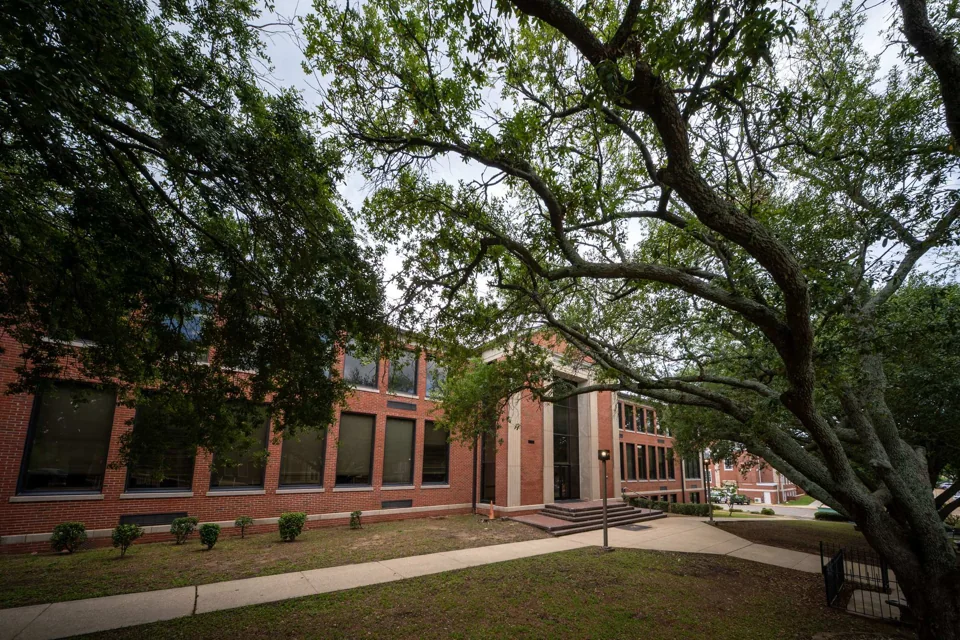
The university’s academic organisation spans education, health sciences, liberal arts and social sciences, STEM, visual and performing arts, and business. Its official academic listing also identifies University College and the Harold Loyd Murphy Graduate School. The Office of the Provost oversees academic programmes and supports teaching, research, creative activity and service. The academic overview describes both traditional classroom instruction and online study as parts of the institution’s provision. Resources linked from that overview include academic advisement, academic laboratories, the Academy of Excellence for Research and eLearning, continuing education, retention support and the testing centre. The Levi Watkins Learning Center is included within this academic structure, connecting programme study with research materials, learning facilities and support for scholarly work.
Campus and city setting
Alabama State’s campus is situated near downtown Montgomery, within reach of the state government complex, museums, galleries, archives and historical sites. The university describes a setting in which traditional and modern facilities sit alongside historic landmarks. Its campus account identifies the John Garrick Hardy Student Services Center as a place combining recreation with important student services. The same account records the opening of the university’s football stadium in November 2012 and describes the expansion and renovation of library and media facilities at the Levi Watkins Learning Center. Together, these buildings illustrate the different purposes served by the campus: academic work, student administration, recreation and large community gatherings. The city setting provides a wider cultural and historical context for university life.
Sources: Campus and city setting ↗
Library collections, archives and making
The Levi Watkins Learning Center provides access to a catalogue of books, electronic books and multimedia resources, together with databases, electronic journals and subject research guides. Its research repository makes university scholarship, theses and other research outputs available, while citation resources and tutorials support academic writing and information use. Students can reserve study rooms and find computer-lab resources for coursework and collaborative study. Makerspace and innovation-lab services introduce tools such as 3D printers, laser cutters and sewing machines. The library also maintains archives and special collections concerning the university and its community. Its civil-rights resources include the National Center for the Study of Civil Rights and African-American Culture and a repository project devoted to preserving and providing access to voting-rights materials.
Communications students and project-based learning
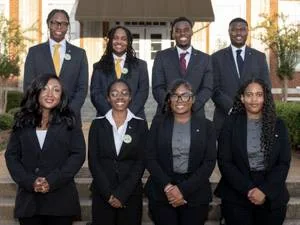
An October 28, 2026, university report describes communications students applying their skills in the Bank of Ideas Challenge hosted by Regions Bank. The Hive Minds team received runner-up honours for Regions Next Play, a proposed financial-literacy platform for student-athletes. Their presentation combined a live skit with video interviews and an app concept using personalised learning, gamification and an AI assistant. The competition asked students to address banking problems and evaluated ideas for creativity, impact, feasibility and presentation. Finalists presented at Regions Field in Birmingham. The report offers a concrete example of project-based learning crossing disciplinary boundaries: communications students used storytelling and audience research in a competition involving business, finance and technology. The platform was presented as a concept rather than a deployed university service.
Sources: Communications students and project-based learning ↗
Biomaterials research and student participation
Research in the Department of Engineering includes work at the Laboratory for Polymeric Biomaterials. An October 27, 2026, university account describes investigations involving advanced biomaterials, plasma-engineered interfaces and 3D-printed scaffolds for tissue-engineering research. One line of work examines how scaffold structure and surface properties influence cell behaviour and bone-tissue formation. The laboratory also investigates nanofibrous materials for potential wound-dressing applications. These are research aims, rather than established clinical outcomes. The report notes participation by undergraduate, graduate and postdoctoral researchers, including conference presentations and scholarly publications. It also records biomedical-engineering professor Vineeth Vijayan’s selection for the Early Career Board of the American Chemical Society journal ACS Biomaterials Science & Engineering, linking laboratory activity with the wider research and editorial community.