Visa
About Alabama School of Fine Arts
A specialised public school in Birmingham
The Alabama School of Fine Arts, commonly called ASFA, is a public secondary school in Birmingham, Alabama. It serves students in grades seven through twelve whose interests centre on the arts, mathematics or science. The school combines general academic education with substantial daily time in a chosen specialty. Its six specialist departments are Creative Writing, Dance, Math-Science, Music, Theatre Arts and Visual Arts. Academic classes and specialty work form complementary parts of the school day. ASFA also offers boarding, enabling students from beyond the Birmingham area to participate in its educational programme. Its campus address is on Reverend Abraham Woods Jr. Boulevard in downtown Birmingham.
From a pilot programme to a permanent campus
ASFA traces its beginnings to a 1967 pilot programme proclaimed by Governor Lurleen Wallace. Early teaching took place at Phillips High School and the University of Alabama at Birmingham, with dance, theatre, music and visual arts represented. The Alabama legislature formally established the school in 1971. Seventh and eighth grades and Creative Writing were added in 1974, when the institution adopted its present name. A foundation created in 1976 supported fundraising and the search for a permanent home. Math-Science became the sixth specialty in 1991. The school moved into its purpose-built downtown campus in April 1993. A later development was the Dorothy Jemison Day Theater, which opened in 2012.
Academic study alongside specialty education
All ASFA students complete general academic requirements as well as the curriculum of their specialty. The school offers advanced and Advanced Placement classes across academic subjects. Its diploma requirements include English, social studies, mathematics and science throughout grades nine through twelve, together with consecutive study of a foreign language. Younger students have a traditional study-hall period to help them adjust to the school. Electives extend the curriculum through subjects such as art history, screenwriting, technical theatre and acting for students outside the theatre specialty. Their availability depends on student interest, staffing and instructional priorities. A film minor offers another route for students from different departments to study media arts through a sequence of electives.
Writing as practice and public exchange
The Creative Writing department combines close reading with sustained practice in literary forms and genres. Writing prompts, discussion of published texts and supportive group criticism help students develop their own approaches to language. The department also treats writing as a shared activity. Students work on the literary magazines Cadence and The Star Review and present their work through public readings and community showcases. Faculty support the preparation of submissions to literary journals and writing competitions while discussing the relationship between personal creative satisfaction and publication. The educational aims include establishing habits that students can maintain beyond school. Reading, critical thinking and the use of collaborative and multimedia tools sit alongside the development of an individual literary voice.
Sources: Writing as practice and public exchange ↗
Dance technique and production
Dance education combines technique classes with rehearsal and the preparation of performances. The published curriculum includes classical ballet, modern technique, partnering and repertory. Choreography draws on different forms and styles, including traditional works and pieces created by resident or visiting teachers. Professional Dance Practicum extends this training into the wider processes surrounding a performance. Junior work can include dance history, composition, stage production and research into further study. The senior practicum centres on a choreography project and the production of new work for the DJD stage. Topics include collaboration, lighting, music rights, production schedules and artists’ statements. This gives students opportunities to consider how movement, interpretation and practical production decisions work together.
Sources: Dance technique and production ↗
Music through lessons, ensembles and analysis
The Music department connects individual performance training with ensemble work and musicianship. Applied study includes a weekly private lesson with a specialist teacher, supported by the student’s own practice. Technical exercises and repertoire change as a learner develops. All students perform in a recital each semester, while junior and senior recitals provide more extended opportunities to present solo work. The curriculum includes choir, orchestra, chamber ensembles and jazz study, with audition requirements for some groups. Practical musicianship is developed through music theory, ear training and sight-singing. Music history introduces critical reading and discussion of the Western musical tradition. Repertoire classes also allow students to present developing work for observation, feedback and discussion of style and interpretation.
Visual arts from foundations to independent work
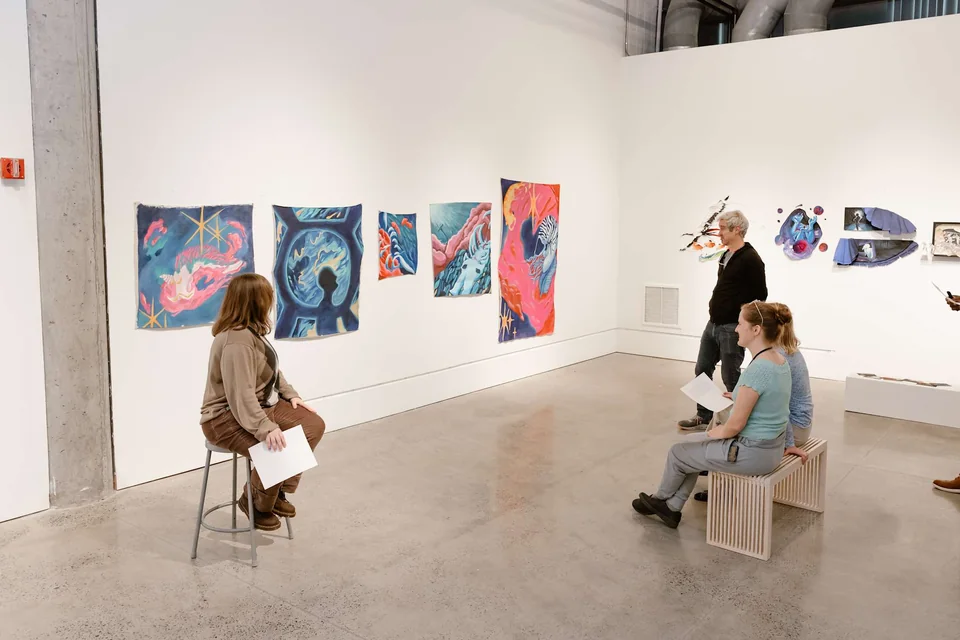
Visual Arts students undertake regular studio work in drawing, design, painting, sculpture and printmaking. Foundation study explores relationships between line, shape, value, texture and colour through different materials and techniques. Drawing develops from work with traditional media towards more individual expression in the upper grades. The painting sequence introduces water-based materials and then oil painting, with later attention to content and the relationship between materials and ideas. Art history supplies a wider context for studio practice. Senior students undertake independent work that culminates in a cohesive body of art and a final exhibition. The department also connects students with visiting artists and changing exhibitions at the campus’s Vulcan Materials Gallery, introducing different perspectives on creative practice.
Sources: Visual arts from foundations to independent work ↗
Residential life and the statewide community
ASFA’s boarding provision is intended for students who live outside the Birmingham metropolitan area. The residential programme presents living on campus as part of the wider educational experience, with attention to personal responsibility, independence and relationships with peers. Residential staff provide support with academic and personal concerns. The school’s description also highlights everyday skills such as managing time, setting priorities and learning to budget. Shared living brings students from different backgrounds into contact beyond their classrooms and specialty departments. This residential setting supports the school’s statewide purpose by allowing participation from students whose homes are too far away for a regular daily journey, alongside the students who commute to the Birmingham campus.