Visa


About Al-Sultan Abdullah Ahmad Shah Quranic University of Pahang
A Quran-centred university in Kuantan
Al-Sultan Abdullah Ahmad Shah Quranic University of Pahang, known as UNIQSAAS, is based at kilometre eight of Jalan Gambang in Kuantan, Malaysia. Its institutional history begins with approval by the Pahang State Executive Council on 27 August 1996. Private higher-education registration followed in April 1998, and the institution was formally inaugurated on 16 November 2000. The university identifies its earlier names as Kolej Islam Pahang, Kolej Islam Pahang Sultan Ahmad Shah, Kolej Universiti Islam Pahang Sultan Ahmad Shah and Universiti Islam Pahang Sultan Ahmad Shah. These names describe stages in the development of the same institution. Its mission brings together knowledge grounded in revelation and intellectual inquiry, with Quranic and Sunnah-based values informing both scholarship and personal development. The original campus development included academic and administrative buildings, a library, student accommodation, a cafeteria, a hall and sporting facilities.
Quranic study and recitation
The Kulliyyah Al-Quran dan Al-Sunnah offers a diploma in Quran and Sunnah studies, an honours bachelor’s degree in the same field, and an honours bachelor’s degree combining Quran memorisation with Islamic management. Its academic departments distinguish Tahfiz Al-Quran and Qiraat from Quran and Sunnah studies. Published staff specialisms include Quranic interpretation, recitation, the teaching of Qiraat and Quranic orthography. The Quran and Sunnah department also lists expertise in Hadith methodology, contemporary interpretation and Braille Quran studies. Together, these areas show the range of textual, interpretive and teaching interests represented within the kulliyyah, alongside its formal qualifications.
Sources: Quran and Sunnah programmes ↗ · Tahfiz and Qiraat department ↗ · Quran and Sunnah department ↗
A centre for Hadith scholarship
The Hadith Studies Centre grew from an initiative associated with the Sultan of Pahang’s directive of 21 June 2019. An academy was established in 2020 under the institution’s research and innovation division. The centre’s account links this development to the aim of strengthening specialised Hadith learning as Quran memorisation education expanded in Pahang. It describes the university’s responsibility for developing a more formal setting for study and research in this field. A Hadith fellow was appointed in 2022 to support that work. The centre’s website brings together Hadith collections, questions and answers, news and activities, providing several routes through which its scholarship can reach a wider audience.
Sources: Hadith Studies Centre ↗
Languages and a multidisciplinary foundation
Language education emphasises speaking, reading, writing and listening. The language faculty also publishes a foundation curriculum spanning Islamic studies, languages, business, accounting, technology and multimedia. Its description organises the programme into three semesters over one year. Subjects include introductory Arabic, English proficiency, study skills, Quranic recitation and Islamic belief. Later elements introduce entrepreneurship, business communication, information and communication technology, multimedia authoring, accounting, business mathematics and academic writing. Community service also appears in the curriculum. This combination gives students an introduction to several fields before more specialised undergraduate study. The published curriculum notes that course offerings can vary by semester, reflecting the organisation of the foundation stage across different subject areas.
Management, finance and business
The Kulliyyah Pengurusan dan Informatik extends the university’s academic range into management and technology. Its programme portfolio lists diplomas in finance and banking, accounting, Islamic financial management, business studies, marketing, information technology and computer science. Bachelor’s offerings include business administration, Islamic finance and multimedia with a digital advertising focus. The faculty also lists master’s programmes in business administration and Islamic finance. Its business department brings together staff whose published expertise includes marketing, strategic management, behavioural ethics, governance, statistics and mathematics. Other listed specialisms include service marketing, educational leadership, Islamic economics and zakat. This range connects the faculty’s business subjects with quantitative, organisational and ethical perspectives.
Sources: Management and informatics programmes ↗ · Business department academic expertise ↗
Computing and visual communication
The creative multimedia and computing department represents both technical and design-oriented scholarship. Staff profiles identify specialisms in computer networking, management information systems, database and information-system development, and human–computer interaction. Visual communication, digital graphics, videography, corporate identity and digital marketing are also represented. Other published interests include augmented reality and new media. These academic backgrounds illustrate the department’s combination of computing infrastructure, information management and visual production. They also give context to the faculty’s multimedia and digital advertising provision: its academic community includes expertise concerned with how digital systems function as well as how visual messages are developed and communicated.
Accessible Quran education in the community
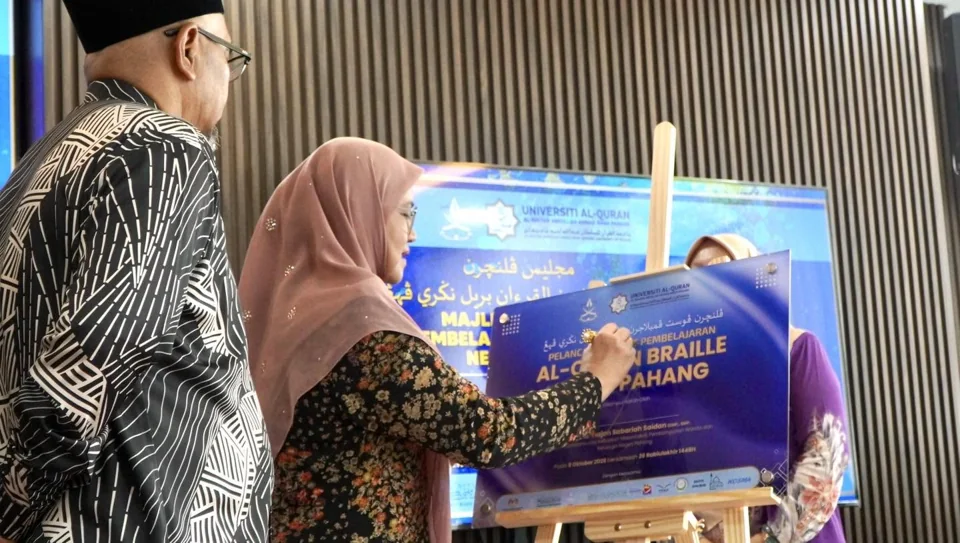
On 8 October 2026, the Pahang Braille Quran Learning Centre was inaugurated at Masjid Tepian Putra in Kuantan. The university participated alongside state representatives, government agencies, non-governmental organisations and members of the visually impaired community. The centre was introduced as a setting for Quran learning through Braille and as an initiative to widen access to religious education. The opening included an explanation of the educational programme, a learning demonstration and interaction with community members. The university’s account also described ambitions to develop teaching capacity and cooperation around Braille Quran education. The initiative connects its Quran-centred academic identity with an accessible form of community learning outside the campus.
Sources: Pahang Braille Quran learning-centre opening ↗
Cooperation with Dewan Bahasa dan Pustaka
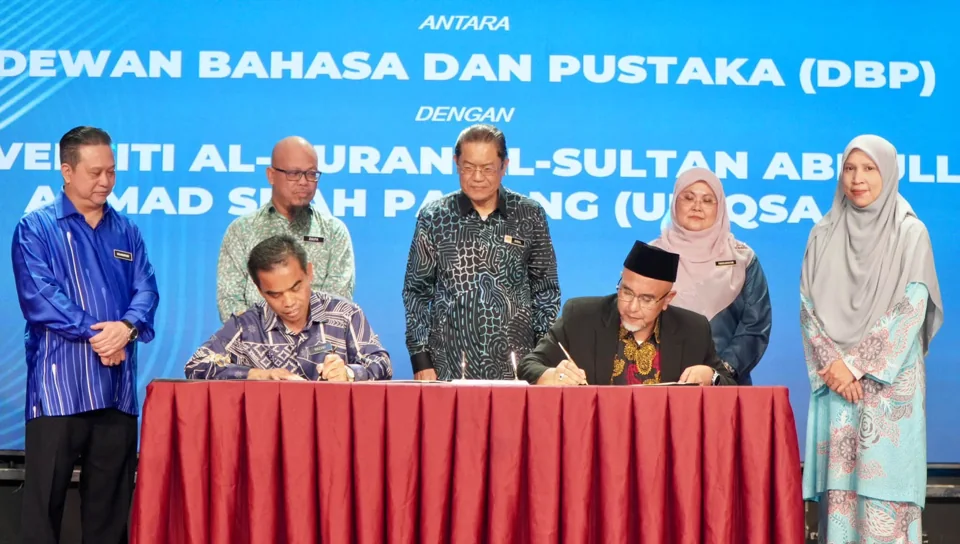
The university signed a memorandum of understanding with Dewan Bahasa dan Pustaka on 29 October 2026. The ceremony took place during DBP’s Digital Day at Wisma DBP in Kuala Lumpur. University and DBP leaders signed the agreement in an event intended to strengthen institutional cooperation, knowledge development and the advancement of language. The wider programme included discussion of artificial intelligence in creative work, research sharing and digital publishing themes. For UNIQSAAS, participation formed part of an effort to develop academic relationships and explore collaborative activity. This agreement adds a language and knowledge-sector partnership to the university’s Quranic, professional and community-oriented work.
Sources: DBP memorandum signing, 29 October 2026 ↗