Visa
About Air University
Air University in Alabama
Air University is the United States Air Force education institution headquartered at Maxwell Air Force Base in Montgomery, Alabama. It forms part of Air Education and Training Command and provides professional military education, specialised graduate study and continuing professional development. Its students include officers, enlisted personnel and civilian employees, with international participation also forming part of its educational work.
Established in 1946, Air University is an educational organisation encompassing multiple schools and centres. Maxwell and Gunter are important locations for resident education and the development of distance-learning programmes. The wider organisation also includes the Air Force Institute of Technology at Wright-Patterson Air Force Base in Ohio and the Air Force Test Pilot School at Edwards Air Force Base in California. Its institutional scope therefore extends beyond its Alabama headquarters.
The university also conducts research on education, military leadership and management. Its institutional description connects that research with curriculum development and information for senior Air Force leaders.
Sources: About Air University, updated August 2026 ↗
An expanding educational institution
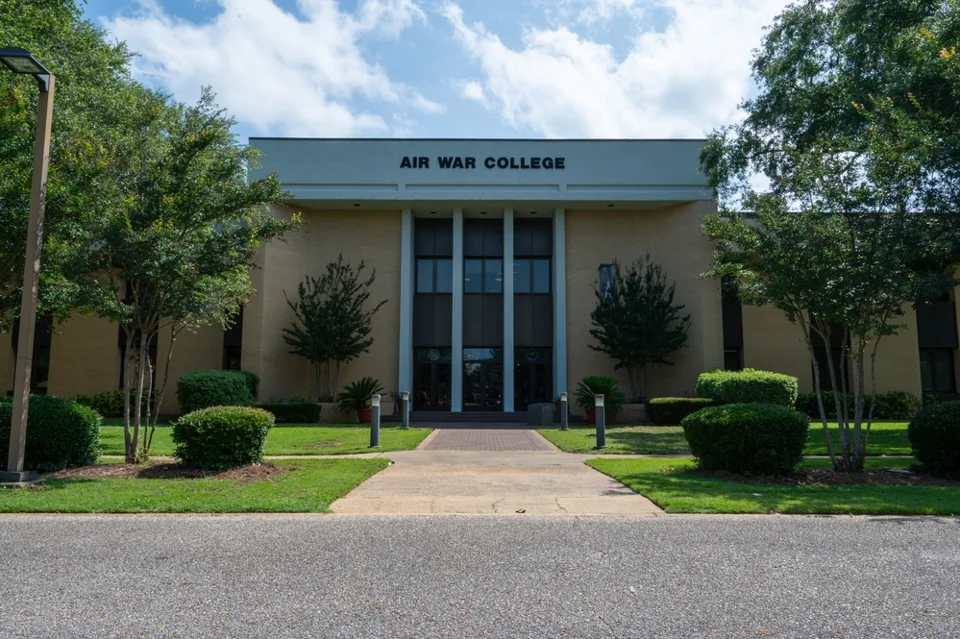
The university’s early organisation included Air Tactical School, Air Command and Staff College and Air War College. Over subsequent decades, its responsibilities broadened to encompass enlisted professional military education and advanced technical education. Its historical account describes professional continuing education delivered through workshops, symposia and formal courses, alongside academic degree provision within the university’s constituent institutions.
Educational methods also changed over time. A 2017 institutional history describes efforts to connect traditional leadership development with new forms of instruction, including distance-learning components completed before attendance in residence. That account presents curriculum review and changes in delivery as recurring features of Air University’s development. The result is an institution whose history involves both the addition of educational organisations and the revision of how working military professionals study.
Professional judgment through discussion and scenarios
Air Command and Staff College provides an example of the university’s approach to midcareer education. A March 2026 institutional release describes learning designed to help officers move from technical expertise towards broader professional judgment. Students encounter complex problems, incomplete information and competing objectives, with attention to the consequences of decisions rather than a single predetermined answer.
The same account emphasises learning across service and national backgrounds. Officers and civilian participants consider problems together, bringing different professional experiences into classroom discussion. Collaboration between schools and external partners helps connect education with the work students will undertake after study. This approach places critical thinking, communication and the ability to work with others alongside subject knowledge within the university’s educational purpose.
Sources: Educational approach and institutional alignment, March2026 ↗
Flexible learning for serving professionals
Agile professional military education combines study from participants’ duty locations with periods of concentrated collaborative work. In its June 2026 account, Air University describes an approach intended to let officers continue contributing to their organisations while completing educational requirements. A later capstone brings participants together to analyse problems and present recommendations.
The 2026 initiative included cohorts in the continental United States, Europe and the Indo-Pacific region. Participants came from active-duty and reserve components, civilian employment and international partner organisations. Senior-leader engagements addressed organisational culture, priorities and communication. These features show how the university’s provision can extend beyond a conventional campus residence while retaining discussion, peer contact and a shared concluding learning experience.
International academic exchange
International participation is also visible in exchanges between Air University and partner institutions. An Indian Air Force delegation visited on 31 March 2026, meeting representatives from Air Command and Staff College, the School of Advanced Air and Space Studies and the LeMay Center. The visit included the Air University Library.
Discussions compared approaches to education, research and professional development, including the use of current experience in coursework. Faculty highlighted the contribution of international students to classroom perspectives, while the visiting delegation discussed its own educational development. The exchange illustrates relationships that continue beyond an individual student’s attendance and create opportunities for institutions to compare teaching approaches and share professional experience.
Learning across military and civilian organisations
A June 2026 Air Command and Staff College initiative considered how military installations depend on surrounding civilian systems and organisations. Military professionals met experts in emergency management, governance, public safety and infrastructure planning. Their discussions examined responsibilities and coordination when disruptions affect more than one organisation.
The educational emphasis was on relationships among institutions with different authorities and obligations. Students considered how communication and shared understanding influence responses involving utilities, transportation and public services. This adds a civil-military dimension to the college’s professional education, connecting leadership questions with the wider communities and public systems around an installation.
Research connected across schools
Air University Advanced Research at Squadron Officer School began in 2019 as an opportunity for students to undertake additional research. The university’s July 2026 account describes projects developed with experienced mentors and external sponsors, bringing participants’ professional backgrounds into collaborative academic work.
The same release sets out further integration with university Research Task Forces through the Office of Sponsored Programs beginning with the fall 2026 class. It describes cooperation among Squadron Officer School students, Air Command and Staff College and Air War College. Research can therefore connect learners at different stages of professional education, while sponsors provide questions and continuing engagement beyond the period a student spends in a particular course.
Sources: Student research development, July2026 ↗