Visa
About Acton-Boxborough Regional High School
A secondary school in Acton
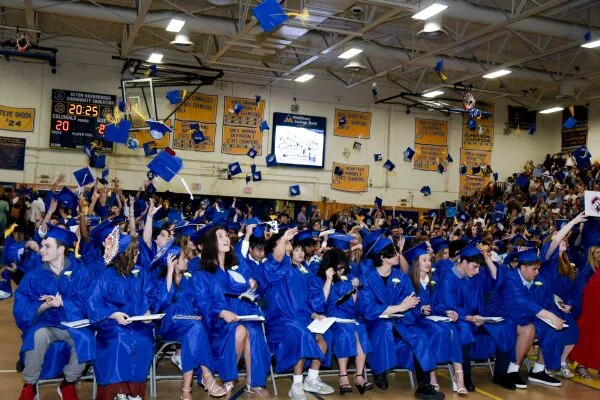
Acton-Boxborough Regional High School is a secondary school at 36 Charter Road in Acton, Massachusetts. Its official website places it within the Acton-Boxborough school district and connects families with the district's other schools, transportation information and registration services. The school's 2026–2027 welcome addresses the incoming Class of 2030 alongside new students entering grades ten, eleven and twelve. This is a high school community with academic departments, student activities, counseling and athletics serving the teenage years of education.
The school's mission brings together wellness, equity and engagement. It describes education as a process supported by caring relationships and collaboration. Its Vision of a Graduate identifies adaptability, communication, collaboration, intellectual curiosity and integrity as important characteristics, giving a shared direction to work across subjects and school life.
Sources: School identity, mission and 2026–2027 welcome ↗
English and thoughtful communication
The English department treats reading and language as ways for students to understand both themselves and the wider world. Its educational approach combines critical thinking, communication and awareness of other people. Students examine texts, conduct research and develop arguments about ideas and ethical questions. Written and spoken communication receive attention together, including the organisation of narratives and arguments, sentence construction, grammar and the choices that create an appropriate tone.
Classroom discussion is another part of this approach. Students practice listening as well as presenting their own views, exchanging ideas in formal and informal settings. The department also describes varied writing opportunities that encourage ownership of ideas and thoughtful academic risk. Connections between texts, personal experience and different communities support its emphasis on empathy.
Sources: English department ↗
Mathematics and problem solving
Mathematics at the school emphasises reasoning, problem solving, communication and proof. The department describes its curriculum as aligned with the Massachusetts Mathematics Curriculum Framework and its philosophy as consistent with the standards of the National Council of Teachers of Mathematics. Students are encouraged to understand mathematical structures and relationships as well as develop facility with individual techniques.
The departmental course outline includes algebra, geometry, precalculus and calculus. Its listed electives extend into statistics and probability, computer science, Java programming, consumer mathematics and accounting. Technology has a place when it helps mathematical work, while varied forms of assessment inform teaching and learning. The department's guiding principles also connect mathematical study with curiosity, confidence, inductive and deductive reasoning, and the practical application of concepts.
Sources: Mathematics department ↗
Science through evidence and inquiry
The science department places investigation at the centre of learning. Students work with qualitative observations and numerical data, evaluate scientific claims and use evidence to support conclusions. Hands-on activities and laboratory work help connect underlying concepts with experiments and observed relationships. Collaboration and the application of mathematical skills are explicit elements of the department's approach.
Its published subject areas include environmental science, biology, chemistry, physics and physical science. The elective outline also names anatomy and physiology, bioethics, marine biology, project engineering and explorations linking visual arts with science. The breadth connects scientific knowledge with different questions and forms of practice. Alongside learning subject content, students are expected to consider the usefulness of conceptual models and select models that suit the relationships they are investigating.
Sources: Science department ↗
History, society and citizenship
Social studies connects historical understanding with responsible participation in society. The department examines culture through social structures, economic systems and political organisation, considering American history within wider international contexts. Its objectives include identifying bias and viewpoint, distinguishing fact from fiction, and assessing both primary and secondary sources.
The published core outline comprises world history and two courses in United States history and government. The department also lists areas such as economics, international relations, psychology, political science, sociology, law and European history. Its educational aims extend beyond remembering information: students are encouraged to gather further evidence independently, respect different cultures, cooperate for the common good and develop an interest in continued learning. Environmental responsibility is also among its stated objectives.
Sources: Social studies department ↗
Language and creative expression
The world language department connects language proficiency with understanding how other people live and express ideas. Its approach includes listening, reading, viewing, speaking, writing and presenting, while treating culture as inseparable from language. History, literature, daily life and the arts all contribute to that cultural understanding. Students are encouraged to connect language study with other subjects and communicate with speakers locally and internationally.
The district's official visual arts department, linked from the high school's website, describes classrooms as studios in which students develop individual creative visions. Its philosophy combines instruction in different media with support for personal interests and cultural connections. The high school teaching team includes ceramics, studio arts, photography, digital arts, industrial design and woodworking, illustrating the range of creative practices represented.
Sources: World language department ↗ · Official visual arts department ↗
Service and participation
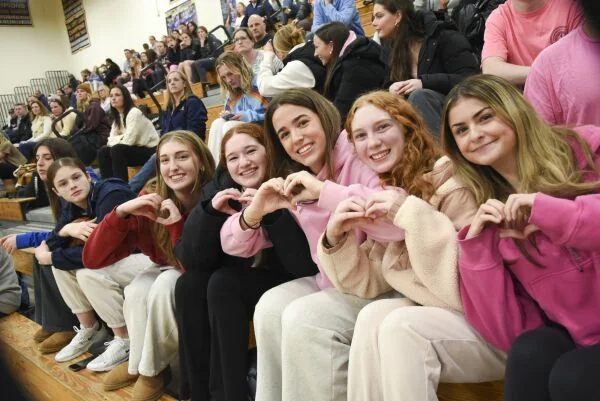
Community service is recognised as part of the school's culture. The official programme encourages and publicises students' volunteer efforts and helps students find opportunities. It explicitly explains that volunteering is not a graduation requirement, while noting that many students participate during their high school years. Students can use programme resources to find placements and report their service hours.
Beyond lessons, the school website connects students with clubs, drama, a library, radio and athletics. Its counseling team describes its support as caring, inclusive and centred on students' well-being. Together, these activities and services complement the academic departments and give students several ways to participate in their school community.
Sources: Community service programme ↗ · School identity, mission and 2026–2027 welcome ↗