Visa

About Academy of the State Customs Committee of the Republic of Azerbaijan
Higher education and customs training in Baku
The Academy of the State Customs Committee of the Republic of Azerbaijan, abbreviated ASCCA, combines higher education, professional training and research under Azerbaijan’s State Customs Committee. Established by presidential decree in 2012, it began operating in 2014 and held its first student graduation in the 2017–2018 academic year. Its address is on the Zabrat–Mashtaga highway in Baku’s Sabunchu district.
The academy’s educational remit extends beyond initial degree study to the development of customs personnel already in service. Its research purpose includes fundamental and applied work related to customs activity at national, regional and international levels. Degree subjects span economics, legal studies, information security, international trade and logistics, and customs-related postgraduate study. This combination places the movement of goods within a wider setting of law, economic relationships, information systems and professional administration.
Sources: Establishment and activities ↗
International trade and logistics
The international trade and logistics bachelor’s programme begins with fundamental economics subjects during the first two years. Students also study international business and logistics, developing an understanding of the principles, strategies, functions and techniques involved in trade. The programme’s interdisciplinary approach connects the operation of supply chains with the economic and organisational environment in which businesses work.
The published description identifies economics, finance and marketing alongside specialist international business courses. Completion includes a compulsory internship and the defence of a diploma project. Subjects, the internship and the final project are assessed on a 100-point scale. These elements combine coursework with practical preparation and an extended piece of student work, providing different settings in which students can apply and demonstrate their understanding.
Sources: International trade and logistics ↗
Legal study and classroom participation
The law programme starts with compulsory core courses, with greater scope for selecting particular legal topics later in the course. Its teaching combines lectures and seminars with group work, presentations, classroom debates and other interactive methods. Students can also attend additional seminars and lectures organised by the academy, extending the range of legal discussion beyond their scheduled classes.
The programme’s published aims include understanding legal principles, developing communication skills, addressing legal problems and considering the policies that shape institutional decisions. Its position within a customs academy gives legal education a connection with the broader subjects of administration, international exchange and economic activity taught by the institution. The course description emphasises both the acquisition of legal knowledge and the ability to work with that knowledge through discussion and analysis.
Sources: Law programme ↗
Information security education
Information security study concerns the protection of information and the systems through which it moves. The academy’s programme description covers information protection, cryptographic data protection, security systems and networks. It also identifies the protection of data exchanged between networks and the organisational rules involved in maintaining information security.
Specific subjects mentioned include electronic digital signatures, password security, virtual private networks and computer viruses. Wired and wireless corporate networks form part of the programme’s technological setting. These topics place computing alongside the legal, economic and administrative dimensions of the academy’s teaching. The programme is presented as academic preparation across several areas of information security, combining technical systems with the organisational responsibilities associated with protecting information.
Sources: Information security programme ↗
Teaching facilities and student services
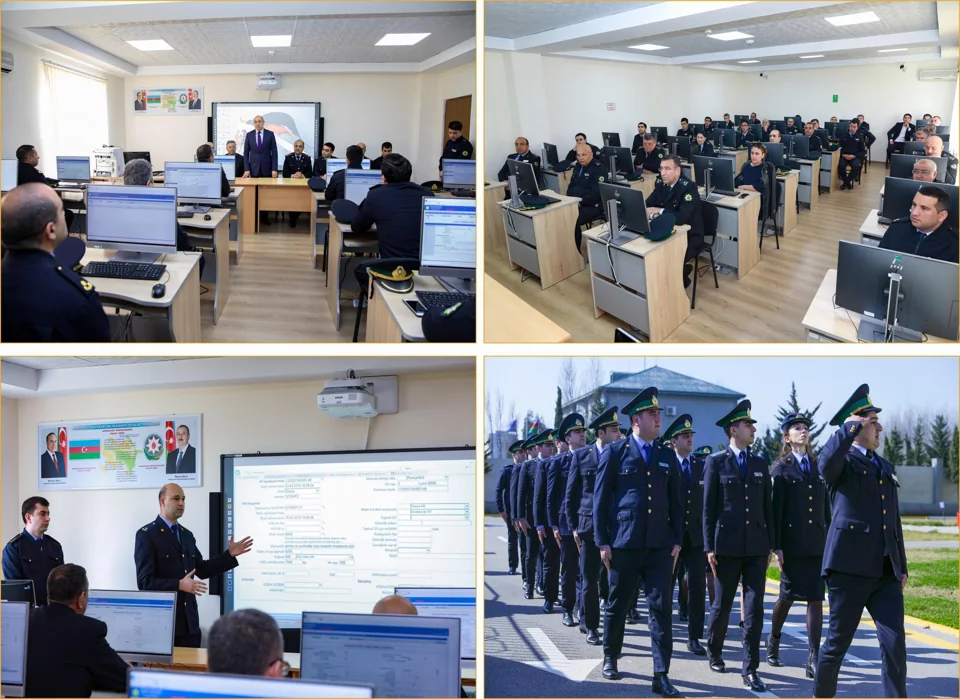
The academy’s educational building contains classrooms, a library, a reading room, a dining room and a conference room. Teaching rooms and laboratories use computers, smartboards and multimedia equipment. Its training laboratories are described as educational and methodological centres with local networks and computer facilities, supporting the practical teaching of relevant subjects.
A laboratory devoted to technical means of customs control provides a specialist setting connected with the academy’s professional field. Other campus facilities include a medical station, a mini-stadium and a gym. Internet access is available to students, teachers and staff. The dining facilities and medical support serve both the regular academy community and customs officers attending professional courses, reflecting the institution’s combined degree and continuing-training roles.
Sources: Infrastructure ↗
Reading and electronic information resources
The library’s online resource page brings together links to databases, electronic books and journals. It includes EBSCOhost, open-access journal collections, the International Monetary Fund’s electronic library, the World Bank’s Open Knowledge Repository and the Directory of Open Access Books. Other links lead to the Digital Public Library of America, Internet Archive, Azerbaijan’s national library catalogue and legal publications.
This collection of links offers a route into material from several fields rather than limiting reading to customs alone. Economics, law, education and general research resources sit alongside open-access books and digital collections. The page gives students and staff starting points for locating literature relevant to coursework, individual reading and research activity.
Sources: Library resources ↗
Professional development for customs personnel
The academy organises training, conferences, courses and seminars for the development of Azerbaijan’s customs officers. Its official professional development page connects this work with the academy’s statute and the State Customs Committee’s capacity-building arrangements. Such activities are intended to update professional knowledge and introduce developments relevant to customs work.
The academy also hosts the World Customs Organization’s Regional Training Center in Baku and a regional office of the International Network of Customs Universities. These connections place its training activity within international professional networks. Alongside degree education, they provide an institutional setting for sharing knowledge and developing customs-related learning across organisational and national boundaries.
Sources: Professional development training ↗