Visa

About Academy of Public Administration
A public administration academy in Baku
The Academy of Public Administration under the President of the Republic of Azerbaijan is a higher education and research institution in Baku. Its Azerbaijani name is Azərbaycan Respublikasının Prezidenti yanında Dövlət İdarəçilik Akademiyası, commonly abbreviated DİA. The academy was created by presidential decree on 3 January 1999 on the basis of the Baku Institute of Social Administration and Political Science. It began its educational activity on 1 September that year.
The founding decree set out an educational and research purpose: preparing specialists for public administration, improving their professional knowledge, organising research in the field and strengthening analytical and information support. The academy’s published contact address is 74 Lermontov Street in Baku’s Sabail district. Its structure includes degree education and the retraining of personnel already working in public service, linking university study with continuing professional development.
Sources: Establishment decree ↗
Political and administrative degree subjects
The Political Administration Faculty lists bachelor’s specialities in political science, international relations, state and public relations, law, and sustainable development. At master’s level, its published areas include international relations and diplomacy, political analysis and strategic research, sustainable development potential and high governance standards, administrative law and administrative procedure, and public policy. These subjects connect political institutions with questions of law, diplomacy and development.
The Administrative Management Faculty has operated since the academy’s establishment. Its listed subjects are state and municipal administration, management, economics and computer science. Students study through the Bologna credit system. This combination places organisational and economic study alongside computing within the academy’s administrative education. Together, the two faculties give public administration several disciplinary perspectives, ranging from international political relationships to the internal work of organisations and municipal government.
Sources: Political administration faculty ↗ · Administrative management faculty ↗
Retraining for serving personnel
The Leadership Retraining Faculty organises additional education at master’s level for civil servants under the arrangements described in its official presentation. Participants sent by the Presidential Administration study areas including state and municipal administration, sustainable development management and social work. The specialisations listed include the organisation and management of public service, management in state structures, sustainable development planning and work with young people.
The faculty describes programmes developed and delivered with the participation of academy academics, senior civil servants, practitioners and foreign experts. Its educational role therefore differs from an initial undergraduate route: it brings existing professional experience into further academic study. The subjects connect administrative responsibilities with planning, personnel and social questions, supporting the academy’s broader remit to develop knowledge relevant to public institutions.
Sources: Leadership retraining faculty ↗
Doctoral education and research preparation
Doctoral education includes programmes leading to the degrees translated as Doctor of Philosophy and Doctor of Sciences. The published information distinguishes full-time, part-time and dissertation-based routes. For the Doctor of Philosophy programme, it lists three years of full-time study and four years for part-time or dissertation-based study. The Doctor of Sciences programme is listed as four years full-time and five years through the other routes.
The academy’s doctoral information describes the role of the proposed supervisor in interviewing a candidate and communicating a decision to the admissions commission. It also points applicants toward electronic submission through Azerbaijan’s central education information system. A dedicated doctoral sector operates within the academy’s Science and Innovation department. These arrangements connect the organisation of advanced study with supervision, research planning and the formal procedures governing scholarly degrees.
Sources: Doctoral study ↗
Student research and extracurricular activity
The Student Scientific Society has operated since 2001. Its structure includes faculty-level societies and a society for master’s students. Research topics are aligned with the academy’s broader research directions, and students undertake their work with guidance from teachers in the relevant departments. Initial seminars address the content and writing of research, followed by staged consultation during the academic year and discussion of completed work at a concluding scientific conference.
The academy’s club directory covers academic and wider interests. It includes political science, business, law, diplomacy and research, economics, conversation, intellectual games, sport, psychology, information technology, sustainable development, books, young managers, art, debate, UNESCO and model United Nations activity. This range gives students settings in which to pursue subject interests and shared activities beyond their formal courses.
Sources: Student scientific society ↗ · Student clubs ↗
Learning resources and international connections
The electronic library page links readers to the academy’s own digital library and several external information resources. These include ProQuest, EBSCOhost, the Directory of Open Access Books, the Digital Public Library of America, Azerbaijan’s State Statistical Committee library and a national virtual library. The page serves as a starting point for locating different kinds of reading and information material relevant to study.
International cooperation includes agreements with universities and public administration institutions, joint research, conferences, seminars and exchanges. The academy identifies Erasmus international credit mobility relationships and cooperation with institutions including Tallinn University, Anadolu University, Ankara Social Sciences University and Pamukkale University. It also describes a Chinese Language and Culture Centre and educational exchanges involving Chinese institutions. These activities add language learning and comparative academic experience to an institution whose main focus remains public administration.
Sources: Electronic library ↗ · International cooperation ↗
An example of academic exchange
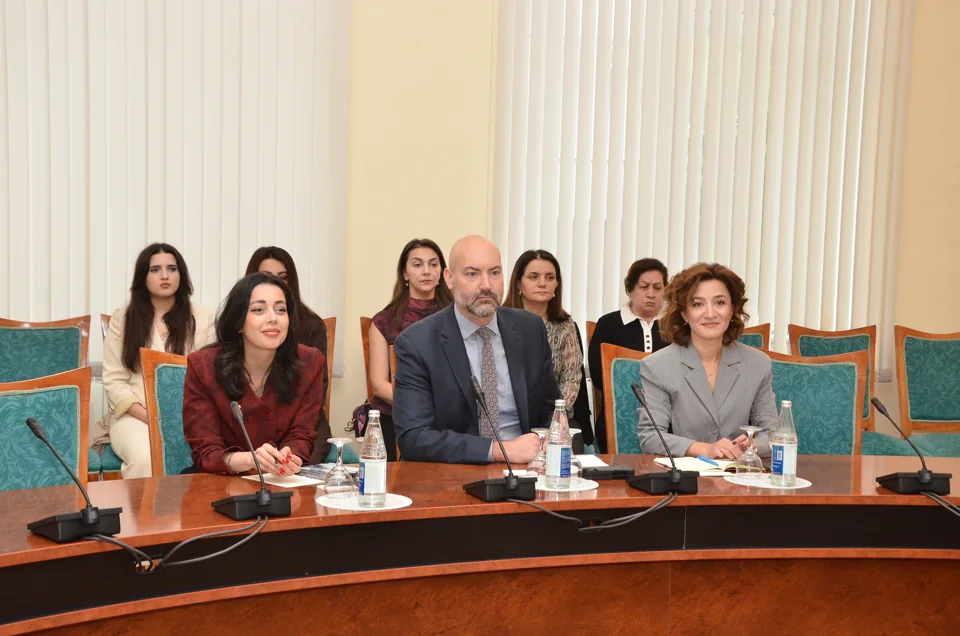
On 22 October 2026, the academy hosted an information meeting with representatives of the United States Embassy’s Public Diplomacy section. The discussion concerned education, English-language teaching and academic exchange opportunities. The academy’s report also described specialist English textbooks for civil servants and diplomacy. The event illustrates the connection between professional language education and the institution’s administrative and international academic interests.
Sources: Education and academic exchange meeting, 22 October 2026 ↗