Visa
About Academy of Fine Arts
A Finnish academy within Uniarts Helsinki
The Academy of Fine Arts in Helsinki, Finland, is one of the three academies of the University of the Arts Helsinki, commonly known as Uniarts Helsinki. It specialises in visual art education and artistic research. The academy offers fine art study in sculpture, painting, printmaking, and time and space arts, alongside programmes concerned with contemporary art history, theory, curating and writing.
Its earliest predecessor was the drawing school of the Art Society of Finland, opened in 1848. From 1939 it operated under the Finnish Art Academy Foundation as the Finnish Art Academy School. It became state-owned in 1985, a higher education institution in 1993 and a university in 1998. In 2013, the Academy of Fine Arts merged with the Sibelius Academy and Theatre Academy to form Uniarts Helsinki, while retaining its distinctive educational identity.
Sources: Academy overview ↗ · History of Uniarts Helsinki ↗
Independent artistic work and shared learning
The fine arts bachelor and master pathway combines artistic activity with theoretical studies. Individual aspirations, choices and guidance are central to its organisation. Students undertake independent work but also participate in group instruction, workshops, field trips and collaborative projects. Exhibiting work publicly is part of the educational process, with academy galleries offering opportunities to learn the practical requirements of exhibition production.
Bachelor students choose their subject area during their first year, while master applicants identify a subject area when applying. Time and space arts includes moving image, photography and site- or situation-specific art. Printmaking explores both established methods and forms extending beyond prints on paper. Joint studies bring together writing, art history, theory, philosophy, drawing and perception, and questions about the artist’s role in society. A tutoring teacher follows academic progress, while visiting artists contribute workshops, specialist teaching and supervision. This combination links individual practice with critical discussion and a wider artistic community.
Sources: Fine arts bachelor and master ↗
Artistic research and doctoral education
The Doctoral Programme in Fine Arts places the artist and artistic work at the centre of research. Its topics can concern artistic meaning, techniques and methods, as well as the conditions under which art is produced, received, taught and used. The programme develops artist-researchers who contribute to practice, research, curating, education and engagement with society.
The Doctor of Fine Arts degree carries 240 ECTS credits, corresponding to four years of full-time study. Teaching is concentrated into seven intensive seminar weeks during the academic year, partly organised with the university’s other doctoral programmes. A thesis can include artistic components and a written component, with the balance determined by the research project. Artistic components may take the form of exhibitions, curating, individual works, processes or experimental arrangements. They must be examined in advance and presented publicly.
Sources: Doctoral Programme in Fine Arts ↗
Mylly and the Sörnäinen campus
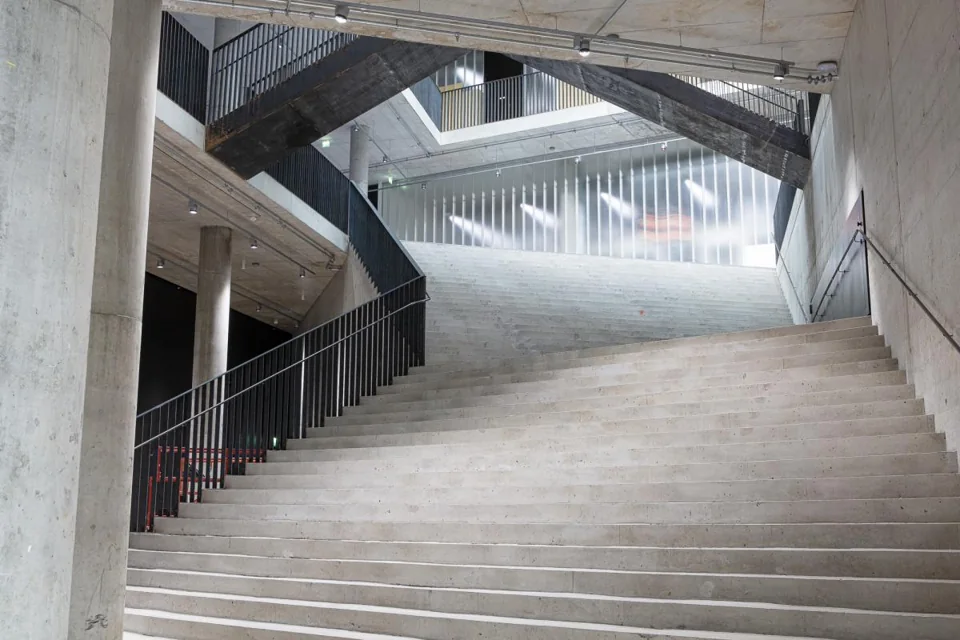
The academy’s main facilities are in Mylly on the Sörnäinen campus. Completed in summer 2021, the building stands beside the Theatre Academy’s Kookos building, with passageways connecting the two. Mylly takes its name from the milling company that previously operated on the site. It is also used by students working in lighting design, sound design and design for the performing arts.
JKMM Architects designed the building around adaptability, combining the site’s industrial history with contemporary facilities for art education. The academy’s account emphasises flexible spaces suited to the changing processes of making art. The building contains Kuva/Tila exhibition facilities and connects with campus services including the library and restaurant. This setting places visual art students close to other artistic disciplines while providing a physical environment designed for teaching, experimentation and presentation.
Sources: Mylly building ↗
Exhibitions at Kuva/Tila
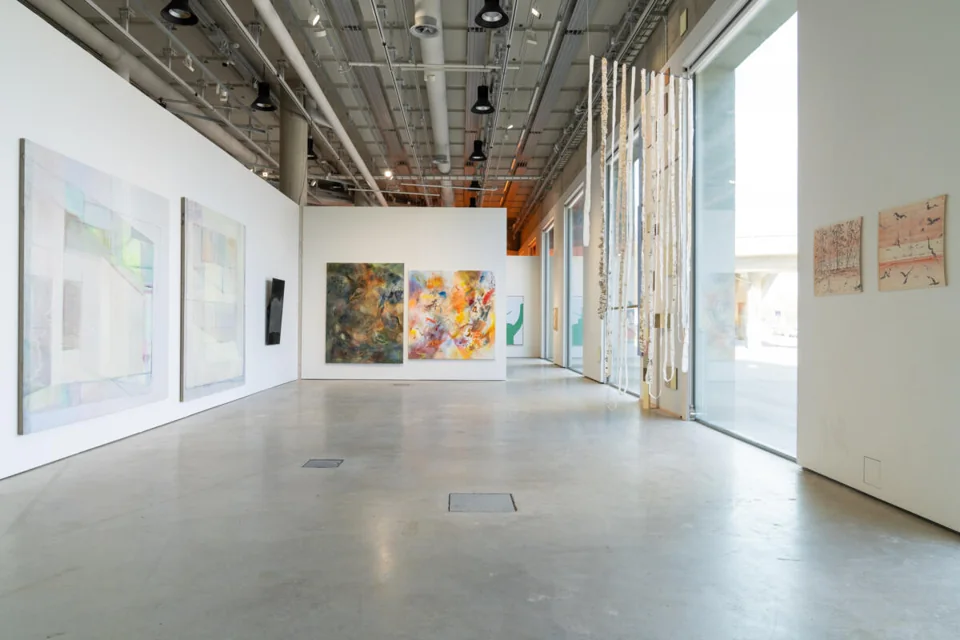
Kuva/Tila occupies the ground floor of Mylly at Sörnäisten rantatie 19. Its programme presents work by students at different stages of study, researchers, alumni and visiting artists. The gallery’s exhibitions and events have free admission, making academy activity accessible to audiences beyond the student community.
The exhibition area covers nearly 750 square metres, with a main space almost eight metres high. Seven large windows connect exhibitions visually with the street, while an adjoining black box provides a setting for video work and other projects requiring different presentation conditions. Exhibitions can sometimes extend to other floors. The gallery is wheelchair accessible and includes access to an information desk and accessible toilet. These facilities connect the practical education of artists with the public experience of contemporary art.
Sources: Kuva/Tila gallery ↗
International networks and development after graduation
A long-term partnership with the Saastamoinen Foundation supports international activity for academy students and alumni. Beginning in 2015, the collaboration connects art education with international artistic practice. Its 2025–2029 programme includes alumni residencies, mentoring for recent graduates, visiting professors, keynote lectures and research concerning analogue images, materiality and artist pedagogy.
Residency partners include Jan van Eyck Academie in Maastricht, ISCP in New York, LIFT in Toronto, and Cove Park and Scottish Sculpture Workshop in Scotland. The mentoring programme combines group sessions, individual guidance, studio visits and discussion with international professionals. Visiting professors also contribute public lectures. Research within the partnership also considers the life cycle and reuse of artistic materials, ecological working practices, and the relationship between analogue and digital image-making. This connects international cooperation with questions arising directly from artists’ materials and methods. These activities extend the academy’s educational community beyond regular study, offering contexts for artistic exchange, reflection and the continuing development of independent practice.