Visa
About Academy of Cryptography Techniques
Origins and institutional purpose
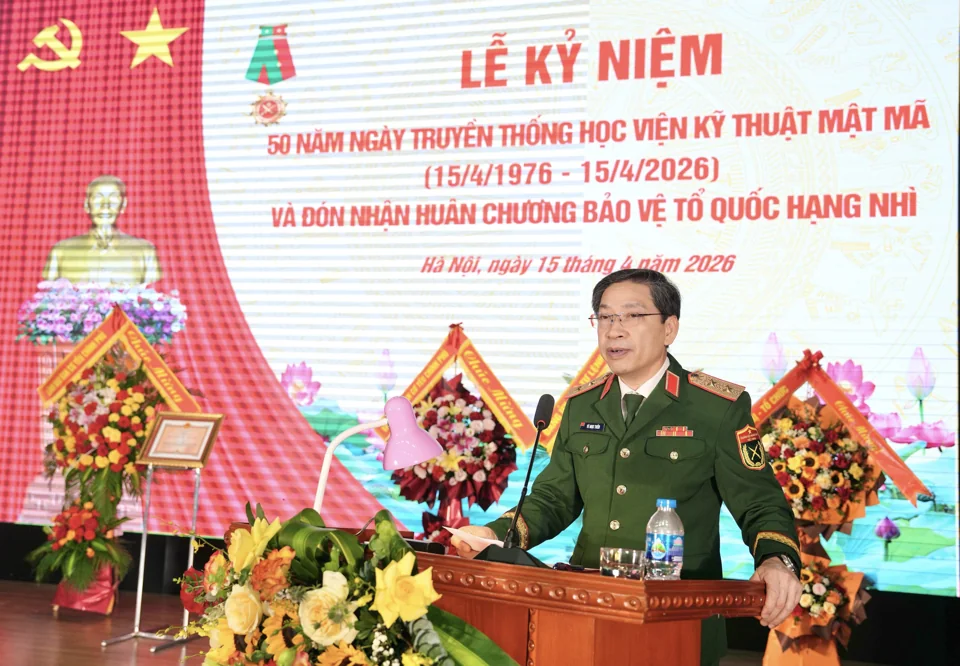
The Academy of Cryptography Techniques is a Vietnamese higher education institution known locally as Học viện Kỹ thuật mật mã. Its history begins with the Central School for Cryptographic Cadres, established on 15 April 1976. The institution became a cryptographic engineering university in 1985 and an academy in 1995. It marked the fiftieth anniversary of its founding in April 2026.
The academy's development links specialist cryptographic education with broader teaching in information security and computing. It began training information security engineers in 2004, extending its work beyond the cryptographic service to wider economic and social needs. Its anniversary account describes education from undergraduate to doctoral level and identifies research as a central institutional activity. The academy also reports educational cooperation involving trainees from Laos, Cambodia and Cuba. Its academic identity therefore combines a long-standing cryptographic mission with newer fields of digital technology.
Sources: Fiftieth anniversary and institutional history ↗
Locations and undergraduate programmes
The academy's Hanoi address is 141 Chiến Thắng Road in Thanh Liệt. It also has a southern branch in Ho Chi Minh City, with locations identified in its 2026 announcement on Cộng Hòa Road and in the southern new urban area of Bình Hưng. The official admissions information distinguishes study at these locations.
For 2026, Hanoi undergraduate provision includes Information Security, Information Technology, and Electronics and Telecommunications Engineering. The announcement describes engineering programmes lasting four and a half years. Its specialisations include secure information systems, secure software and cybersecurity engineering; mobile software engineering and applied artificial intelligence; and embedded systems and integrated circuit design. The southern branch's listed Information Security programme lasts four years and awards a bachelor's degree. These distinctions matter to the academy's structure, because the published duration and degree type differ between the two locations.
Sources: Official undergraduate admissions announcement, 2026 ↗
A structured information security curriculum
The Information Security overview sets out a progression from mathematical and computing foundations to specialised study. Early subjects include calculus, linear algebra, probability, programming, computer networks, discrete mathematics, data structures and databases. Operating systems, computer architecture, network administration and object-oriented programming follow within the published sequence.
Later study introduces cryptography, Linux and open-source software, machine learning for information security, and scripting. Common professional subjects include network security, secure protocols, malware, database security, secure web technologies, electronic authentication and information security management. Specialist routes then develop secure systems, secure software or network-security engineering. Digital forensics, security monitoring and incident response appear in the advanced curriculum. Internships and a graduation project provide culminating practical components. This sequence connects the academy's cryptographic background with the software, networks and operational processes involved in protecting information systems.
Software, mobile systems and applied AI
The Information Technology faculty publishes a detailed Mobile Software Engineering curriculum. It describes a four-and-a-half-year engineering programme and a 165-credit workload, including national defence and physical education credits. The published teaching plan combines general computing subjects with web development, software engineering, testing and practical placements.
Its later subjects include mobile programming, Internet of Things development, mobile software optimisation and applications of cryptography in software development. The plan also includes artificial intelligence, machine learning and choices involving cloud computing, computer vision and data technologies. The faculty's stated teaching priorities encompass both mobile software and applied AI. Research, product development and cooperation with enterprises are presented as related parts of its educational approach. This adds a software-development strand to the academy's specialist security provision, with attention to complete systems and practical products.
Electronics and the hardware side of computing
Electronics teaching supplies another part of the academy's technical foundation. The electronics faculty's institutional introduction describes teaching and research supporting cryptographic engineering, information security and software-related programmes. Its published account identifies electrical and electronic engineering, computer electronics and telecommunications systems as departmental areas.
The introduction also describes laboratory provision for electronics, foundational professional subjects and specialised embedded-system work. Its research interests include telecommunications, embedded systems and automatic control. Collaboration with other Vietnamese technical universities and research institutes is presented as a way to develop teaching materials and research capability. This faculty background helps explain the hardware side of the academy's current provision, whose 2026 undergraduate announcement names embedded systems and integrated circuit design. It places circuits, communications and physical devices alongside the institution's better-known software and information-security subjects.
Sources: Electronics faculty introduction ↗ · Official undergraduate admissions announcement, 2026 ↗
A venue for cryptography and security research
The academy hosted the third International Conference on Cryptography and Information Security, VCRIS 2026, on 29–30 October 2026. Its report describes an event bringing together Vietnamese and international researchers, with papers selected through double-blind review. The programme addressed both theoretical questions and technological applications.
Topics included cryptographic security analysis, post-quantum cryptography, side-channel analysis and the use of artificial intelligence to detect malware, intrusions, software vulnerabilities and deepfakes. Invited presentations discussed privacy in AI systems and quantum technologies. A demonstration of quantum key distribution and presentations of security-testing technologies added an applied dimension. The academy reported cooperation with mathematical, computing and information-security organisations in organising the conference. This event illustrates the institution's role as a meeting place for research across cryptography, software security, hardware and emerging computing technologies.
Sources: VCRIS 2026 conference report ↗
Student participation in research
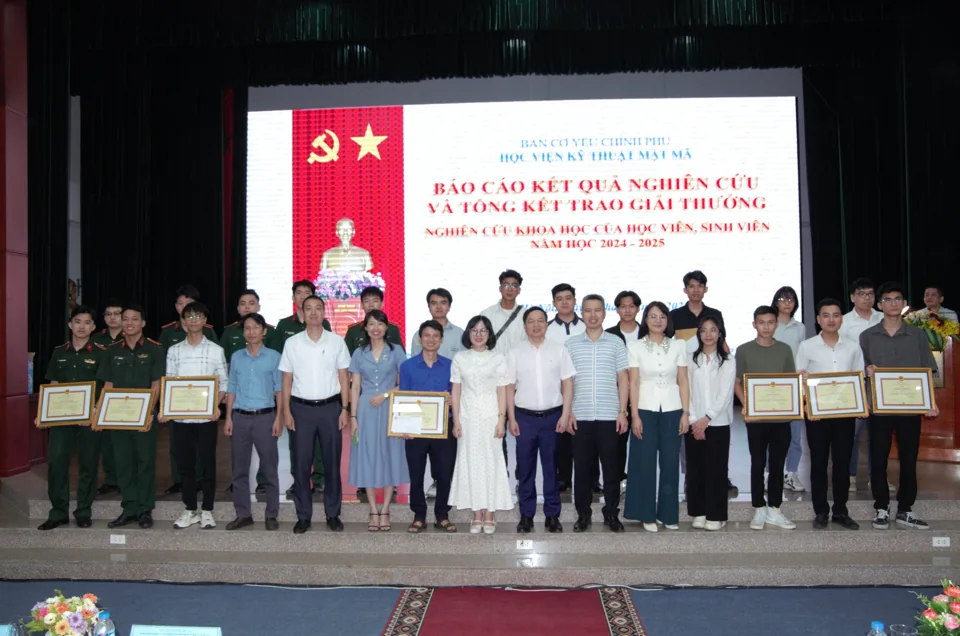
Research also appears in student activity. The Information Technology faculty's account of the 2024–25 academic year records student teams receiving second and third prizes in academy-level scientific research. The accompanying photographs show participants and award recipients at the reporting and recognition event. Alongside the internships and final projects described in programme documents, this activity gives students another setting in which to present academic work and participate in the institution's technical community.
Sources: Student research awards, 2024–25 ↗