Visa


About Academy of Art University
Art and design education in San Francisco
Academy of Art University was founded in 1929 by Richard S. Stephens, a practising artist. Based in San Francisco, the institution concentrates on creative subjects spanning art, design, film, communications and technology. Its educational account emphasises learning through making, with projects and the development of a portfolio forming central parts of the student experience.
The university connects established principles of art and design with contemporary equipment, software and production methods. Its approach also stresses collaboration across disciplines, combining artistic work with scientific and technological interests through the idea of STEAM education. Students can pursue undergraduate and graduate study as well as other learning routes, including non-degree and portfolio-building activity. The academy's setting in San Francisco places this educational work within a city associated with visual culture, design and technology, while its online provision extends participation beyond the physical campus.
Sources: About Us ↗
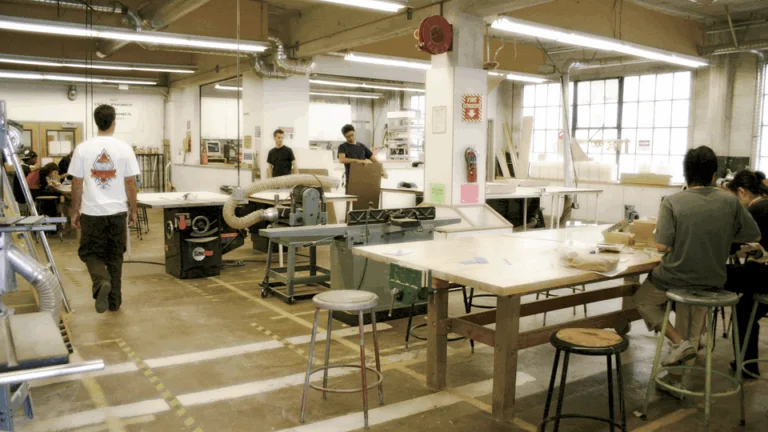
Studios and an urban campus
The academy occupies a network of buildings across San Francisco rather than a single enclosed campus. Its facilities directory identifies drawing and photography studios, fashion workspaces, computer laboratories, drafting spaces and an industrial design workshop. These spaces provide settings for different kinds of creative practice, from making physical objects to working with digital media.
The building at 79 New Montgomery Street accommodates teaching and administrative activity, a theatre, student space, broadcasting studios and a film post-production laboratory. Other university locations include residential buildings and gallery spaces. A shuttle service connects university buildings for students and staff. The facilities account also describes an automobile museum whose historical vehicle collection serves as reference material for industrial design students. Together, the specialised workspaces and dispersed buildings form an educational environment rooted in the city and in the practical requirements of creative disciplines.
Sources: Facilities ↗

Library collections and academic support
The Academy Library provides information for creative practice and academic research through both physical and online resources. Its description includes illustrations, digital archives, stock imagery, streaming databases, electronic books and textbooks. Group spaces and technology facilities support collaborative work alongside areas for quieter individual study.
Department Research Guides organise resources relevant to particular majors, helping students identify materials connected with their subjects. The library also publishes short video tutorials explaining how to use its services. Its frequently asked questions address topics such as finding books, logging into databases, locating journal articles and citing sources. Students who need individual help can submit a reference enquiry through Ask a Librarian, and remote assistance is available during the working week. These services connect access to collections with guidance on evaluating, locating and documenting information as part of art and design study.
Sources: Library ↗
Online studios, demonstrations and critique
The university's online courses use the same instructors and curriculum as its campus provision. Learning materials include written content, live and recorded demonstrations, and an online portal through which students submit work for critique. Feedback can be written, visual or spoken, with both instructors and peers contributing to the exchange of ideas.
The academy distinguishes on-demand study from live virtual classes. On-demand courses combine video, written and audio material, interactive presentations and virtual library resources, with discussion opportunities alongside the coursework. Live classes use videoconferencing to connect remote participants with San Francisco classrooms and creative activities in real time. The online description includes collaboration on projects, studio work and other practical learning. This structure carries the academy's emphasis on making and reviewing creative work into distance education rather than relying only on lectures or independent reading.
Sources: Online Education ↗
Learning to teach art
The School of Art Education combines teaching methods with opportunities to develop an individual artistic practice. Its curriculum identifies four broad directions: school teaching, museum education, community-based practice and educational entrepreneurship. Students consider these settings while learning how to design lessons, support different learners, assess progress and discuss visual material.
Fieldwork is built into the educational approach. The school describes a progression from observing classes and interviewing students to supporting learning, working with small groups and presenting lessons of the student's own design. Internships, capstone projects and supervised teaching provide further opportunities to connect theory with practice. Digital tools are integrated into both art-making and teaching, and students develop an online education portfolio. The school also offers opportunities to take courses in other art and design areas, connecting the development of teaching skills with continued creative learning.
Sources: School of Art Education ↗
Art history and visual culture
The School of Art History approaches visual culture through research, interpretation and critical analysis. Its academic description connects study of earlier periods with questions about how art communicates within different societies. Studio coursework complements historical and theoretical learning, giving students an additional perspective on the processes involved in producing artworks.
Published subject examples include art of the classical world, the Dutch Golden Age, Dada and Surrealism, methodology and theory, and traditional artistic materials and techniques. Students work with historical context, written arguments and presentations as they develop their analytical abilities. The programme also considers professional settings in which this knowledge can be applied, including museums, galleries, archives, education and publishing. Its online study model uses the same curriculum and academic staff as campus teaching, linking research-based understanding of art with the academy's wider emphasis on creative practice.
Sources: School of Art History ↗