Visa


About Académie des sciences d'outre-mer
A Paris learned academy with a historical international remit
The Académie des sciences d’outre-mer is a learned society in Paris concerned with overseas societies, histories and contemporary questions. Its origins lie in meetings held during 1922 and early 1923, following journalist Paul Bourdarie’s proposal for a specialist scholarly academy. Bourdarie worked with Africanist Maurice Delafosse and Collège de France professor Alfred Martineau to present the initiative to Albert Lebrun. A decisive founding meeting took place at the Alliance Française in July 1922.
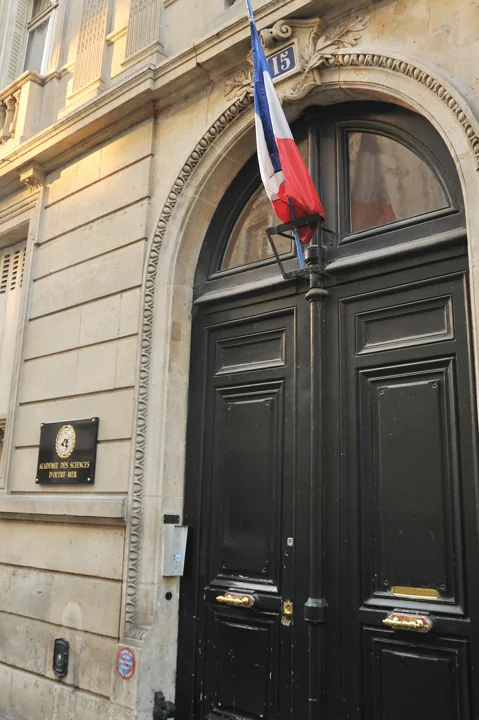
The institution was originally named the Académie des sciences coloniales. Its formal opening session was held at the Sorbonne on 18 May 1923, and it adopted the name Académie des sciences d’outre-mer on 7 June 1957. These dates distinguish the initial foundation, the ceremonial opening and the later change of name. Its history reflects the colonial context in which it began, while its continuing work includes scholarly meetings, publications, a research library and prizes. The academy’s premises are at 15 rue La Pérouse in Paris.
Sources: History ↗
Meetings and exchange of knowledge
The academy’s account of its operation describes sessions on the first and third Fridays of each month. Members and invited speakers present communications on subjects within its remit, and the resulting contributions are published in the academy journal Mondes et Cultures. Meetings therefore connect oral presentation and discussion with a continuing published record.
The academy also maintains relationships with foreign institutions and universities and organizes colloquia with other academies. Its scholarly activity extends across individual communications, collaborative events and reference publishing. These are activities of a learned institution bringing researchers and other specialists into discussion, with publication providing a means of circulating and preserving their work.
Sources: Scholarly meetings and operation ↗
The Félix Houphouët-Boigny Library
The academy’s library is open to the public and supports readers including researchers, university teachers, doctoral candidates, journalists, writers and students. Its holdings combine monographs and periodicals with manuscripts, historical maps, brochures and offprints. The collections are represented in the online Horizon catalogue and in Sudoc, the French collective catalogue used by university and research libraries.
The collection is particularly strong in sub-Saharan Africa, the Mediterranean, the Maghreb and Mashreq, South Asia, Indochina and India. Named holdings include material associated with Raymond Decary on Africa, Madagascar and the Indian Ocean, and the Lamant collection of dissertations and theses concerning Indochina. The academy also received the DILA heritage collection concerning Africa, overseas territories and colonies in 2014. A documentary charter adopted in 2019 defines the collection and acquisition criteria. The library received the name Félix Houphouët-Boigny in February 2020 and obtained the CollEx-Persée Collection of Excellence label in 2021.
Sources: Library presentation ↗

Digital collections and research resources
Numoutremer presents selected digitized material from the academy library, including valuable books, old maps, historical photographs, posters and thematic bibliographies. The library’s digital-resource page also organizes a selection of full-text books by geographical area, alongside general and overseas-related categories. This provides a route from the physical collections to material accessible online.
The same page directs readers to external research resources rather than presenting them as academy-owned collections. These include Asian studies publications and theses, the Indian Ocean iconographic collections, the CIRAD digital library on tropical and Mediterranean agronomy, Manioc for Caribbean and related territories, and Ulysse from the French overseas archives. Together, the selections help readers locate sources across different repositories, countries and forms of documentation.
Sources: Digital library resources ↗
Journals and the published record
Mondes et Cultures is the academy’s journal and carries accounts of its sessions, reception speeches for new members and scholarly communications. Its publication history extends back to the academy’s beginnings. The journal page provides contents for recent volumes and a chronological set of links to earlier issues, allowing readers to explore the institution’s accumulated scholarly output.
For the period from 1923 to 2007, the academy supplies tables that organize communications by author and include their titles, year and publication page. An author index and a table matching volumes to years accompany this resource. These finding aids make the journal useful both as a record of academy proceedings and as a source for tracing particular topics or contributors over time.
Sources: Mondes et Cultures ↗
Biographical reference publishing
Hommes et Destins is the academy’s biographical dictionary devoted to people associated with overseas history. Its published volumes include geographically organized collections on Africa, Madagascar, Asia, the Maghreb and Mashreq, and the Americas, as well as a volume on governors, administrators and magistrates. The series began with an Africa volume in 1975. The academy provides an index for finding biographies, and explains that out-of-print volumes remain available for consultation in its library. This links its reference publishing directly with its documentary services.
Sources: Hommes et Destins ↗
Prizes supporting scholarship and research
The academy’s prize portfolio recognizes work across several regions and fields. The Robert Cornevin Prize concerns African history, the Auguste Pavie Prize addresses Asia, Indochina or the Pacific, and the Robert Delavignette Prize concerns the Americas or the Antilles. The Monsieur et Madame Louis Marin Prize covers the human sciences, especially ethnology, anthropology and relationships between peoples.
Other distinctions concern the French language and Francophone culture, overseas territories and particular regional subjects. The research encouragement prize, established in 2015, recognizes university dissertations, theses or postdoctoral work. Its published conditions require sponsorship by an academy member, thesis supervisor or research leader. Alongside meetings and publications, these awards provide another way for the academy to identify, evaluate and bring attention to scholarly work.
Sources: Academy prizes ↗