Visa
About Académie de Versailles
An education authority for four departments
The Académie de Versailles is an administrative district of France’s national education system. It covers Yvelines, Essonne, Hauts-de-Seine and Val-d’Oise and forms part of the Île-de-France academic region alongside Paris and Créteil. Its work concerns a network of schools, educational services and partner organizations across these four departments. The academy’s presentation emphasizes the diversity of its communities, including both areas of priority education and communities with more advantaged social circumstances.
The rector represents the national education minister within the academy and oversees public education from nursery school to upper secondary school, together with responsibilities for private education under contract. The published remit includes educational policy, staffing and institutions, school allocation and relationships with local authorities and professional partners. A general secretary, departmental directors, technical advisers, inspectors and the rectorat administration support this work.
Sources: Academy presentation ↗ · Academy territories ↗
Departmental services and local networks
Each department has a Direction des services départementaux de l’Éducation nationale, or DSDEN. Alongside this departmental structure, the academy uses education basins to support cooperation around a learner’s pathway from early schooling to higher education. The academy describes these basins as settings for pedagogical exchange, complementary provision and solidarity between institutions. An inspector and an institutional leader jointly coordinate each basin.
The published territorial organization identifies seven basins in Yvelines, five in Essonne and six each in Hauts-de-Seine and Val-d’Oise. Examples include Versailles-Plaisir and Mantes-la-Jolie in Yvelines, Étampes and Massy in Essonne, Nanterre and Vanves in Hauts-de-Seine, and Cergy and Sarcelles in Val-d’Oise. These local networks connect the academy’s wider policy and service organization with the circumstances of particular communities.
Sources: Academy territories ↗
Guidance, allocation and dropout prevention
The Versailles branch of the regional information and guidance delegation, DRAIO, produces tools for institutions, families and pupils. It coordinates guidance and allocation procedures with departmental services and regional information-system services, including the Affelnet process for upper secondary education and Parcoursup for higher education. Its responsibilities also include studies and reviews of educational demand and the functioning of the system, contributing to changes in the regional training offer.
Dropout prevention forms another strand of the delegation’s work. It leads and coordinates the Mission de lutte contre le décrochage scolaire, follow-up and support platforms, and the FOQUALE network for training, qualification and employment. It also works with guidance inspectors to coordinate the academy’s information and guidance centres. This brings advice for individual pathways together with analysis and coordination across institutions.
Sources: Guidance delegation ↗
Artistic and cultural education
The academy’s artistic and cultural education orientations for 2026–27 set out three connected objectives: embedding cultural education in learning, supporting and developing the dedicated professional networks, and extending project-based approaches. The published guidance accompanies the annual academic call for projects, known as Projet ACTE. It includes practical documents for schools and secondary institutions.
The guidance covers applications to academic projects and programmes, opening artistic teaching provision, participation in cinema education, use of cultural resources and contact with the academy’s cultural network. It also describes strategic cooperation with the Île-de-France regional cultural affairs directorate and local authorities. Priority settings identified in this work include rural communities, priority education, vocational education and learners with disabilities. Teacher development and the organization of local networks are part of this effort to extend participation.
Sources: Artistic and cultural education orientations 2026–27 ↗
Inclusion in vocational pathways
The academy’s vocational education resources describe support for young people with particular educational needs across vocational upper secondary schools, public apprenticeship centres and medico-social institutions providing nationally recognized training. The approach covers orientation, reception and education, followed by support for progression into employment or further study.
Published resources identify inclusive-education resource teachers, vocational-school teachers acting as links with medico-social institutions, and the Handipro support arrangement. The materials help educational teams identify needs, adapt teaching and use differentiated approaches. The emphasis is on the learner’s whole pathway and on practical resources for the professionals supporting it. This connects inclusive education with the transition between school, professional training and later opportunities.
Sources: Inclusive vocational pathways ↗
Training for electricity networks and energy transition
PRISME is a five-year partnership project beginning in November 2025 that concerns skills for electricity networks. It is led by Université Paris-Saclay through the Sustainable Energy Campus of Trades and Qualifications. The Île-de-France academic region and the Paris, Versailles and Créteil academies contribute to deploying training within schools.
The published objectives include adapting vocational baccalauréat, higher technician and university technology programmes, developing additional post-baccalauréat routes, and increasing awareness of the sector. Partners include universities, engineering institutions, electricity businesses and employment organizations. Planned outreach uses digital tools, virtual reality, workplace immersion and visits. The project illustrates how the academy participates in a broader educational and economic partnership while individual institutions deliver the associated qualifications.
Sources: PRISME partnership ↗
Historical inquiry and citizenship
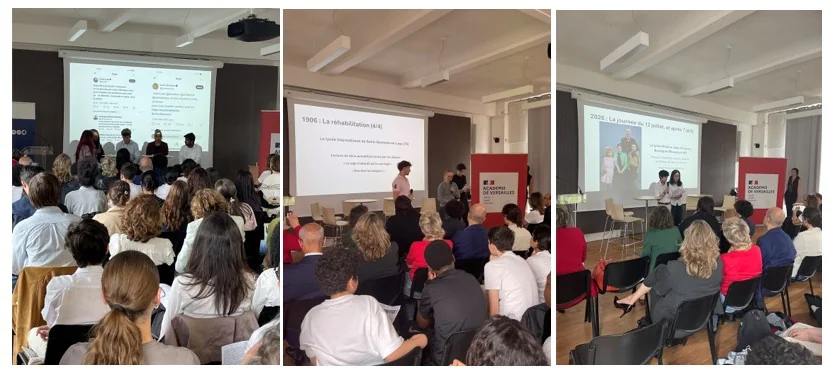
The academy’s 2026 project J’en fais mon affaire linked school learning with the history of Alfred Dreyfus. On 5 June, pupils and teachers from fourteen institutions gathered at the Versailles rectorat to present work tracing the affair and its contemporary significance. Contributions included reconstructed newspaper front pages, literary interpretation, readings, visual art and debate. The project brought together primary and secondary learners and was developed with the Museum of Jewish Art and History and Maison Zola–Musée Dreyfus.
Sources: Dreyfus educational project ↗