Visa
About Académie de Montpellier
A territorial education authority
The Académie de Montpellier is a territorial education authority within France’s national education system. Its area covers five departments: Aude, Gard, Hérault, Lozère and Pyrénées-Orientales. It coordinates educational administration across this territory, working through the rectorat and departmental education services. Its headquarters occupy the Palais universitaire in Montpellier’s historic centre, where the Hérault departmental education administration is also based.
The rectorat’s responsibilities include school organisation, administrative and pedagogical oversight of schools, teacher management, examinations and recruitment competitions, and the management and monitoring of continuing training and apprenticeship activity. It also oversees establishments in the private sector that operate under contract. Departmental directors implement national education policy locally, allocate teaching resources and manage primary-school personnel. The academy’s role is therefore expressed through the operation and support of many institutions across its territory.
Sources: The academy and its administration ↗

Working within the Occitanie academic region
Montpellier and Toulouse together form the Occitanie academic region, whose headquarters are in Montpellier. This regional layer coordinates educational policy in fields including training, guidance, research and innovation. It works through the existing rectorats while retaining attention to the different needs of local territories and departmental services.
The regional service organisation follows a two-site approach, with responsibilities and staff presence distributed between Montpellier and Toulouse. The published structure includes services concerned with higher education and research, vocational education and apprenticeship, information and guidance, digital education, international cooperation, youth engagement and sport. This arrangement connects academy-level school administration with responsibilities that benefit from coordination across the larger Occitanie region.
Sources: Occitanie academic region ↗
Supporting rural educational pathways
The Territoires éducatifs ruraux programme addresses the educational opportunities available to children and young people in rural areas. Its presentation identifies distance from training opportunities and difficulties accessing guidance information as factors that can limit ambitions for further study. The response is organised around local strategies covering learning within school and the wider educational environment.
Each rural educational territory includes at least one collège and its associated primary schools, with a geographical scope reflecting the surrounding community. The academy’s December 2024 presentation identifies examples across all five departments, including Chalabre–Couiza in Aude, Cèze Cévennes in Gard, Grand Orb in Hérault, territories in Lozère and Agly Fenouillèdes in Pyrénées-Orientales. The programme connects schools with their local context rather than approaching rural education through classroom provision alone.
Sources: Rural educational territories ↗
Resources for newly arrived and travelling pupils
CASNAV is the academy’s specialist resource centre for the schooling of newly arrived pupils who speak other languages and children from travelling or itinerant families. It combines support for schools, expertise for educational leaders and cooperation with institutional and community partners. Its remit extends across the academy’s five departments.
Its staff include teachers and trainers specialising in French as a language of schooling. Their work considers pupils’ initial assessment, previous learning and individual circumstances when developing educational responses. The official presentation identifies inclusion in ordinary classes as the main form of schooling, with specialist modules providing part of the school timetable where appropriate. This approach links language and educational support with participation in the wider school community.
Sources: CASNAV presentation ↗
Priority education and collective teaching work
Priority education is organised through networks bringing a collège together with nearby nursery and primary schools. Networks designated REP or REP+ receive support according to the social and educational circumstances of the pupils they serve. The academy’s approach combines adapted teaching methods with staff development and coordination among schools, families and other partners.
Its September 2026 information describes smaller classes at key early stages of schooling, intended to strengthen foundational French and mathematics learning. Teacher training accompanies these organisational changes. The framework also emphasises explicit teaching, supportive but demanding learning environments, cooperation with parents, collective work among educational teams and sustained support for personnel. The network provides a setting for teachers to consider practice together and respond to local needs.
Sources: Priority education ↗
Connections with higher education
The Cordées de la réussite programme supports pupils from the later years of collège through the end of lycée as they develop plans for further study. Each partnership brings together a higher education institution or a lycée with postsecondary provision and participating secondary schools. Economic, cultural, community and local government partners can contribute to the activities.
Support includes presentations about study pathways, visits to higher education institutions, student tutoring and opportunities to meet people from professional and social settings. Other activities develop communication, confidence and collaborative skills through public speaking, group projects or theatre. Cultural and scientific encounters widen pupils’ experience. The academy’s presentation places particular emphasis on schools in priority education, disadvantaged neighbourhoods and remote rural areas.
Sources: Cordées de la réussite ↗
A shared educational project
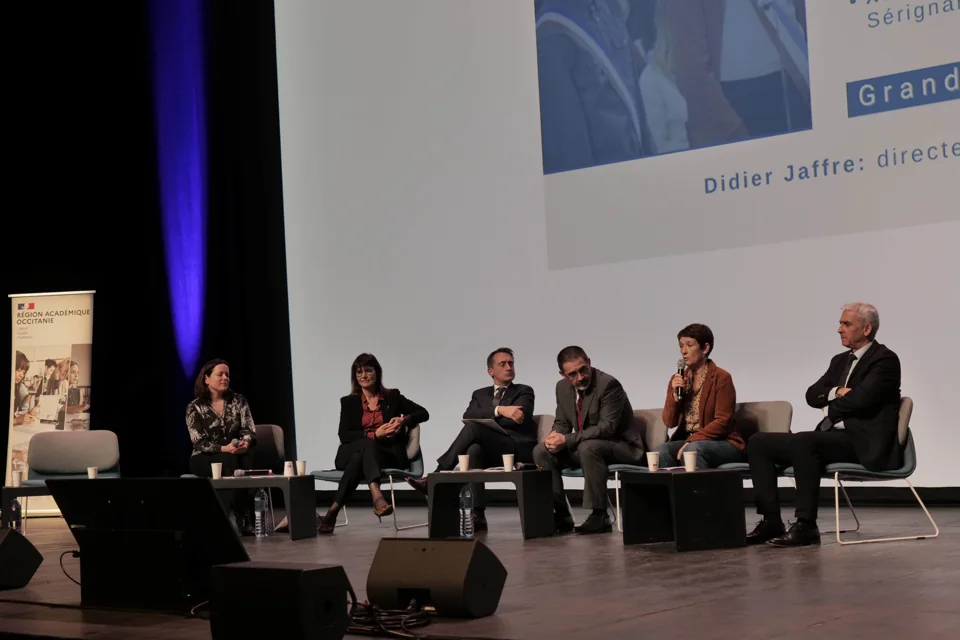
The academy’s 2024–2027 project was launched in January 2024 at the Corum in Montpellier with school leaders, inspectors and administrative staff. Its four themes concern shared values, pupil achievement, partnerships and the commitment of education personnel. The framework links pupils’ wellbeing with learning and staff working conditions with the fulfilment of educational responsibilities.
Its priorities include foundational knowledge, ambitious guidance, persistence in education, inclusive schooling and cooperation with parents and local partners. It also addresses professional development, innovation, equality and staff wellbeing. The project provides a common direction for work undertaken across the academy’s varied schools, services and territories.
Sources: Academic project 2024–2027 launch ↗