Visa
About Academia Engiadina
An educational campus in the Upper Engadin
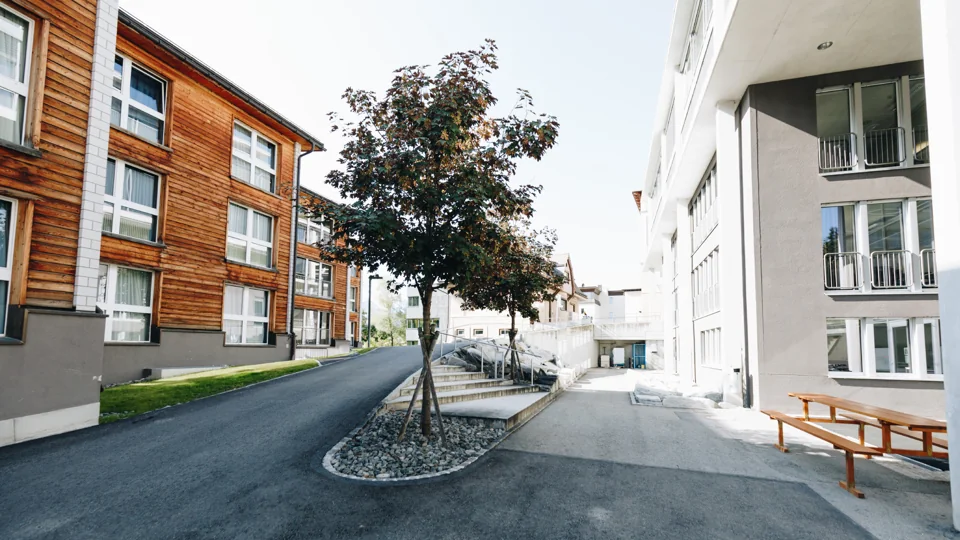
Academia Engiadina is an educational institution in Samedan, in Switzerland's Upper Engadin. Its official address is Quadratscha 18. The organisation describes itself as a non-profit company with a regional educational role, bringing together learning opportunities for children, young people and adults. Its range extends from children's educational activities through secondary schooling and vocational preparation to higher professional education and continuing learning.
The institution presents education as a progression in which learners can take successive steps according to their interests and circumstances. Its stated values include humanity, cooperation, transparency, responsibility and creativity. These principles place individual development alongside the quality of teaching. Its setting in the Engadin also connects campus life with a distinctive mountain region and the communities it serves.
Sources: About Academia Engiadina ↗
Gymnasium and academic preparation
The Gymnasium provides a general academic pathway toward the Swiss Matura. Its official description emphasises choices among specialist, supplementary and optional subjects, allowing students to develop interests while considering future study. The school connects this broad academic preparation with later routes into higher education and professional life.
The Gymnasium also describes imPULS, a school model intended to strengthen personal responsibility and self-organisation through a more flexible learning structure. This gives independent learning a place alongside subject teaching. Science and technology education is another stated priority, with mathematics, computing, natural sciences and technology grouped under the MINT approach. Music, choir, band and theatre appear among the examples of wider interests students can pursue. Together, these features present academic study as a combination of subject foundations, individual choices and cultural activity rather than a narrowly prescribed preparation for one occupation.
Sources: Gymnasium ↗
Combining school and competitive sport
The sports secondary-school provision is designed for young people balancing competitive sport with either Gymnasium or specialised secondary-school study. The institution describes individual timetables, training windows, authorised absences for competitions and training, and the possibility of extending the educational period. Students remain integrated into ordinary school classes rather than being completely separated from the wider school community.
Coordination with training centres and sports partners is part of the model. The school also identifies support for academic, sporting and personal concerns. Campus sports resources include a strength-training room, sports halls, a beach-volleyball area and other exercise facilities. Boarding is presented as an option for students who need accommodation during the school week. The central educational point is the attempt to adapt scheduling and support while preserving participation in regular secondary education.
Sources: Sports secondary school ↗
A bridge toward vocational training
The vocational preparation year provides a bridge between compulsory schooling and an apprenticeship or further school education. Its published model combines four days of school with a practical day in a workplace each week. The workplace element is described as an introduction to everyday working life, not simply a direct recruitment exercise for an apprenticeship. A central aim is to help young people identify strengths, recognise areas for development and define a realistic next educational step.
The programme can also support preparation for an entrance examination to another school. For learners whose first language is not German, the institution describes intensive language teaching and immersion as part of the available preparation. Students use campus resources such as computing rooms, the media library, sports facilities and specialist teaching rooms. The programme also connects with project weeks and cultural activities. Cooperation with the vocational information centre in Samedan adds another source of guidance as students consider possible occupations and training routes.
Sources: Vocational preparation year ↗
Continuing education for adults
Academia Engiadina's continuing-education centre serves people developing professional skills, returning to learning or pursuing personal interests. Its published offer includes languages, business and digital topics, as well as private and company courses. The centre draws on teachers from the secondary school and the Higher Professional School for Tourism and Management alongside external specialists. This combines resources from different parts of the educational campus.
The course listings include German, Italian and Spanish at different levels, digital office skills, smartphone video production and practical introductions to artificial intelligence. Marketing and public-relations learning is also signposted through the tourism and management school. These examples illustrate the range rather than a permanent timetable: individual course dates and availability change. Language examinations are included within the published provision. The centre's role is therefore wider than initial full-time education, offering shorter and more focused ways to develop communication, technical and professional capabilities across adult life.
Sources: Continuing education ↗
Astronomy and public science at Viadalat
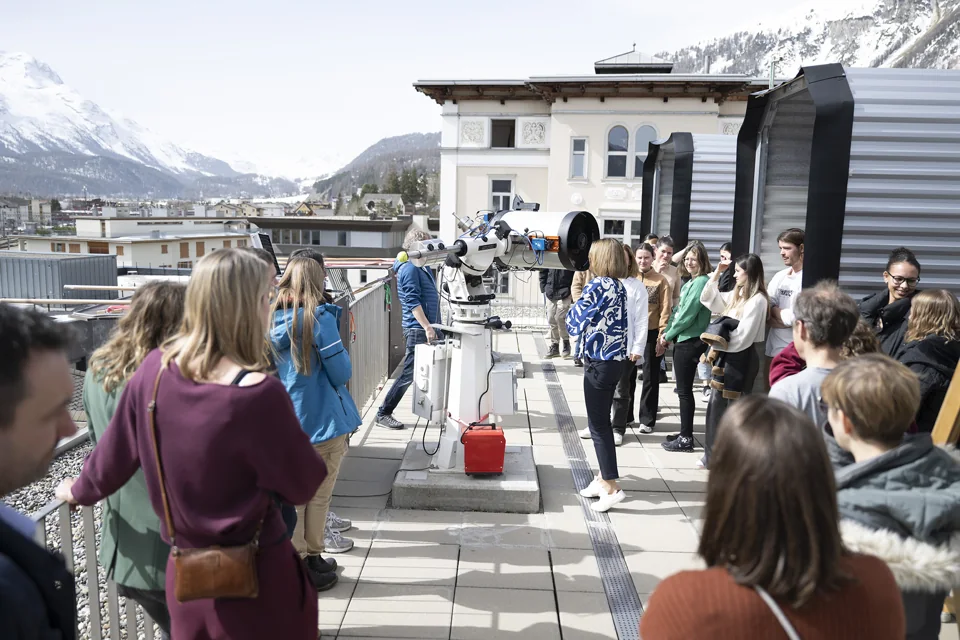
Since 2023 Academia Engiadina has operated the Viadalat observatory on the roof of Chesa Cotschna. The name refers to the Milky Way in Romansh. Its official description presents the observatory as an educational resource for pupils, students, families, amateur astronomers and the wider public. Observing the sky is connected with opportunities to develop curiosity about natural science.
The published programme includes astronomy lectures followed by observations, themed evenings for young people, and guided visits adapted to schools, groups or individuals. Meteor observation, astrophotography and an astronomy library form further parts of the described activity. Children's university sessions introduce younger learners to topics such as stars, the Moon and space exploration. The observatory also identifies exchange with universities, research groups and specialists. These activities make the campus's public educational role visible: it provides a place where formal schooling, practical observation and wider community interest in science can meet.
Sources: Viadalat observatory ↗