Visa
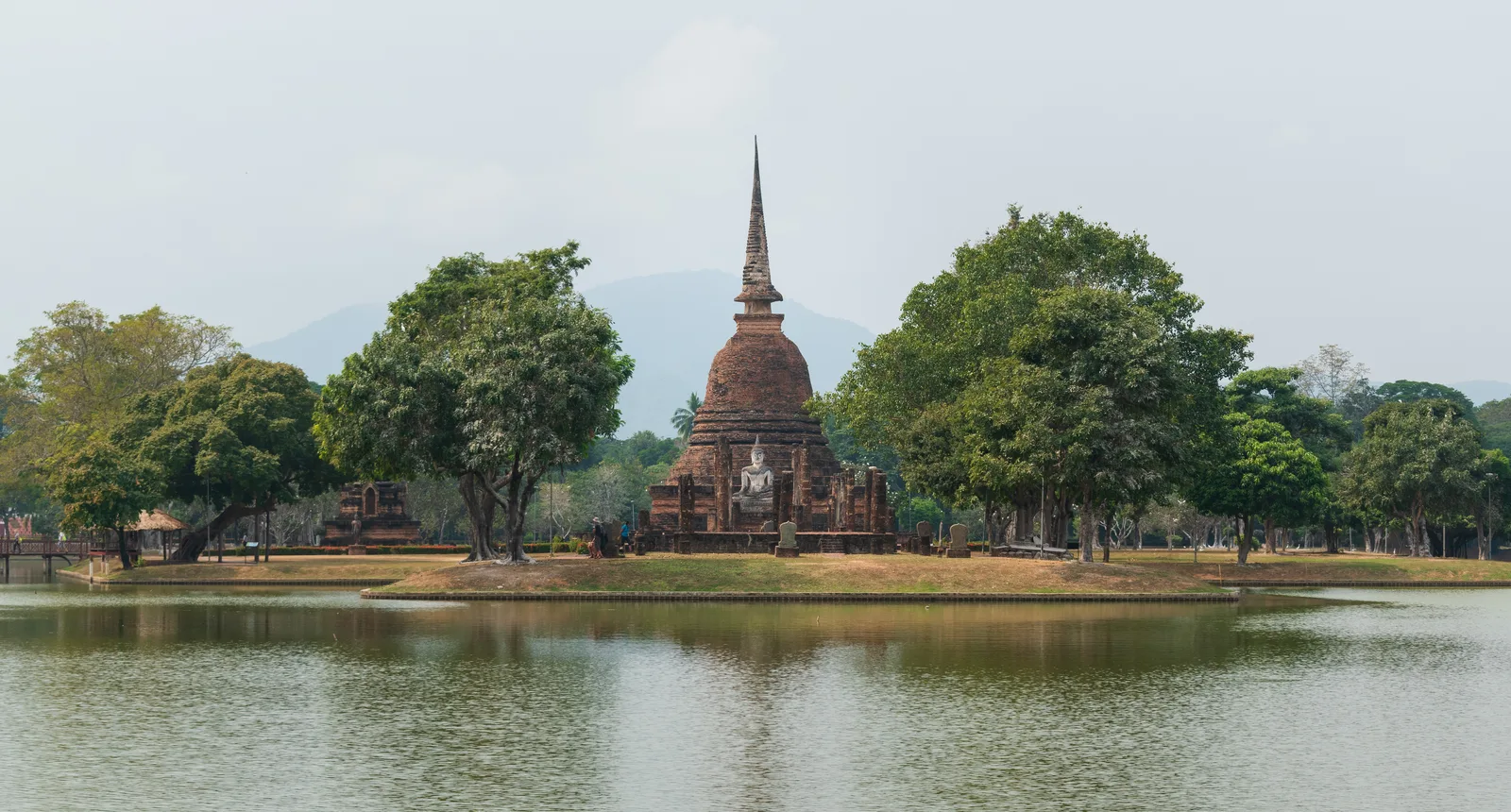
Start with the distance between town and temples
Sukhothai works best when you understand that the modern town and the famous ruins are separate places. The historic park lies around 12 kilometres west of the modern centre, according to the Thai government’s introduction. Choosing accommodation on the wrong side of that gap can turn an easy early-morning visit into a daily transport arrangement.
The attraction is a landscape of brick chedis, Buddha images, ponds and surviving temple structures, rather than a single monument. Allow two nights for an introduction that includes the main park and one outlying area. Three nights give more room for the museum, slower cycling or a separate regional excursion. People considering a move should add time in the modern town for practical errands. A pleasant resort beside the ruins tells you something about a holiday; it tells you less about the commute, services and routines of an ordinary working week.
Look beyond the postcard history
Sukhothai’s significance extends beyond its photogenic Buddha images. The World Heritage account places the historic town alongside Si Satchanalai and Kamphaeng Phet, together representing an important period of Siamese architecture, art and urban development. The listing dates from 1991. These are three associated historic towns, not three neighbouring sections of one park that you can cover on foot before lunch.
Water is part of the story. Reservoirs, ponds, canals and moats served agriculture, everyday supply, religious practice and defence. Notice those spaces between monuments rather than treating them as empty ground. Ceramic production and exchange also help explain the wider kingdom. Avoid reducing this complex history to an uncomplicated claim that all Thai culture began here. The remains reflect influences, adaptations and successive changes, which makes comparing different buildings more rewarding than simply counting how many temples you have visited.
Decide between Mueang Kao and modern Sukhothai
Mueang Kao, around the old city and historic park, is the practical choice if the main purpose of your stay is archaeology. Being nearby makes it easier to start early, return for a break and leave the second half of the day flexible. Check the exact gate and route from the property: “near the historical park” can describe a considerably broader area than a short walk to its central entrance.
Modern Sukhothai is worth considering if your plans involve bus connections, errands or a longer stay focused on daily life. Price the repeated journeys to the park before choosing a room solely for its nightly rate. Neither location is automatically best for everyone. Ask where you will eat after dark, how you will collect a bicycle or meet a driver, and whether the accommodation can explain the return arrangements without relying on a service that only runs at certain times.
Give Wat Mahathat the first unhurried visit
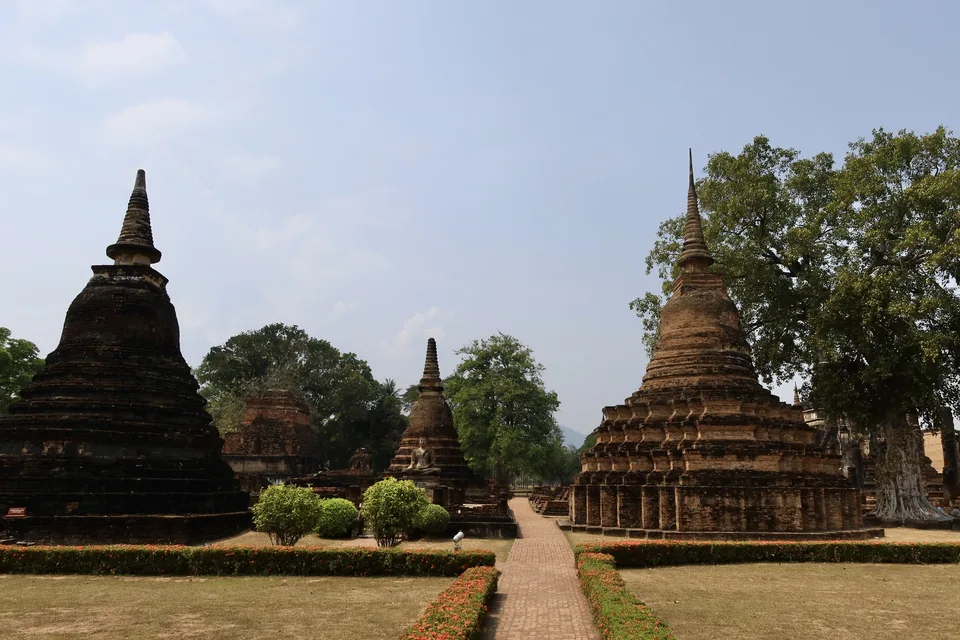
Wat Mahathat is a useful starting point for understanding the central area. The Fine Arts Department’s explanation distinguishes its prominent lotus-bud principal chedi from the surrounding shrines, halls and other chedis. Look at the different forms and the relationship between standing Buddha images and the surviving architecture. They offer more to notice than one preferred camera angle.
Try to keep the first visit relatively open-ended. Walk a little, stop to read the interpretation and then decide how much of the central area you want to cover before the heat builds. A photograph of bell-shaped chedis elsewhere in the complex should not be mistaken for the lotus-bud principal monument. That small distinction is useful throughout Sukhothai: individual buildings within a temple can differ in form and period. Resist the assumption that everything visible today was built together or has survived without restoration.
Compare Wat Sri Sawai with the lakeside setting of Wat Sa Si
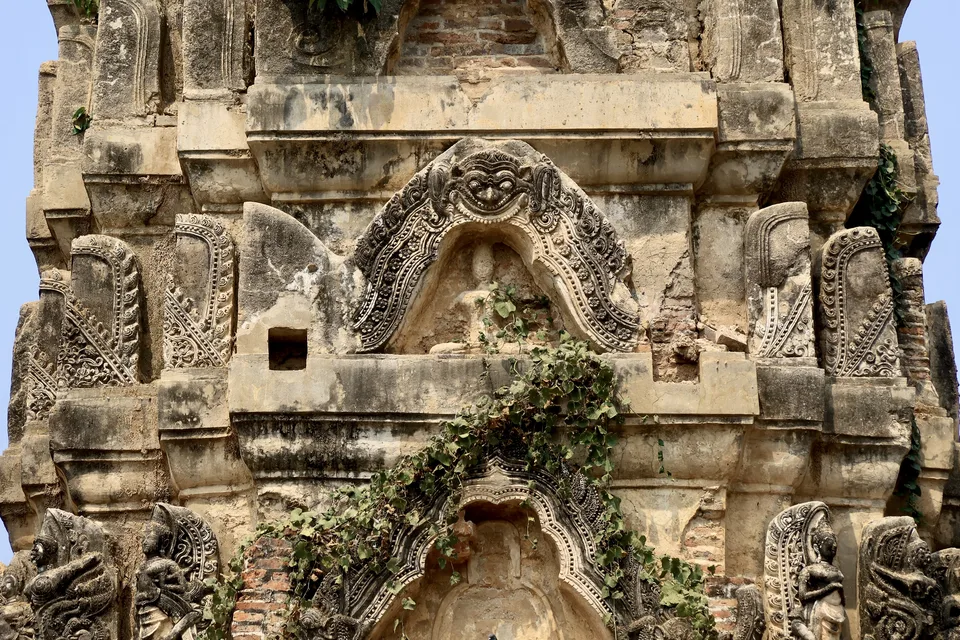
Wat Sri Sawai offers a different architectural vocabulary. Its three prangs stand south of Wat Mahathat. The department’s archaeological description explains the evidence for a Hindu sanctuary that later became a Buddhist site, including sculptural finds and the addition of a hall. Take time with the surviving stucco rather than expecting every temple to repeat the same familiar chedi shape.
At Wat Sa Si, the setting is part of the experience: temple remains occupy a pond-surrounded position, with a bell-shaped chedi and water providing a quieter composition. It makes a sensible pause between more concentrated visits. Observe the present walkways and any barriers instead of crossing a ruin for a clearer photograph.
Make a separate northern outing for Wat Si Chum
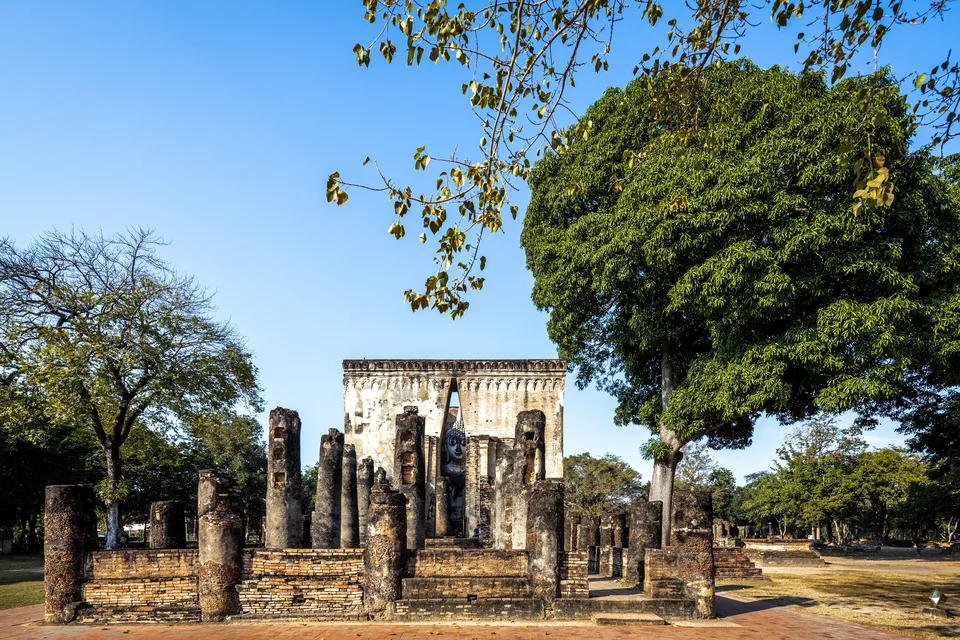
Wat Si Chum lies outside the old walls toward the northwest. Its large seated Buddha occupies a tall enclosure, making the relationship between image, doorway and surrounding masonry the defining experience. The official account of monuments outside the walls also identifies Wat Phra Phai Luang to the north, another site useful for understanding development beyond the familiar central circuit.
Treat this as a planned extension to the central visit, rather than assuming your first ticket covers every outlying monument. Check the relevant zone and opening hours before setting off. If travelling by bicycle, consider the roads between sites as well as the paths within them; confidence on a quiet park path does not automatically translate to comfort among other traffic. A driver may be a better choice for a group with mixed cycling ability, provided the stopping time and return destination are agreed in advance.
Choose the western temples according to the climb
Wat Saphan Hin gives the western area a different physical character. The Fine Arts Department describes a stone-paved approach of roughly 300 metres up to the hilltop site and its standing Buddha. That is the path’s length, not a 300-metre vertical ascent. Even so, the climb deserves appropriate shoes and consideration in hot or wet weather.
Choose this outing because you want the hillside setting and have the energy for it, not because every Sukhothai itinerary must contain the same number of temples. Allow time to descend carefully. Do not build a sunrise plan around photographs taken there without first checking access: the department lists different hours for the western Aranyik area from those of the central park. People who prefer level ground can spend that time revisiting selected central monuments or taking a longer indoor break, without missing an essential stage of a compulsory route.
Use the museum to connect objects with the ruins
The Ramkhamhaeng National Museum provides another way to understand what you have been seeing outdoors. Its official history explains that the collections include archaeological material recovered during work at Sukhothai and nearby ancient towns, alongside objects transferred from the earlier collection at Wat Ratchathani. The museum opened in 1964, following the growth of archaeological investigation and conservation.
A visit is particularly useful if you want to compare complete objects and interpretation with the fragmentary structures outside. Arrange it as part of a day with breathing room rather than an automatic final stop shortly before closing. Confirm the museum’s current admission and opening arrangements separately: a ticket or published schedule for the historical park does not establish the museum’s rules. For a family or anyone tired of cycling, this change of format can be more worthwhile than adding another exposed monument to an already demanding afternoon.
Book the accommodation that supports your day
Guesthouses, hotels and resort-style properties can all make sense, depending on location and facilities. Compare the actual room, breakfast arrangements and cancellation terms. Around Mueang Kao, a pool or shaded place to rest may be useful if you intend to split sightseeing between morning and late afternoon. Check whether bicycles are included, rented separately or merely available from another business nearby.
For a longer stay, ask about laundry, a refrigerator, cooking facilities if needed and the working space actually provided. A room advertised for remote work is not proof of a reliable connection for your particular tasks; test the connection before making a longer commitment. Travellers needing step-free access should ask about the entrance, bathroom and route to meals, not just the presence of a ground-floor bedroom. Confirm the full price for your dates, especially during festivals, rather than relying on a general claim that the town is inexpensive.
Arrive with the final transfer arranged
Bangkok Airways’ airport information places Sukhothai Airport in the Sawankhalok area, separate from both the modern town and the historical park. Check current flights through the airline and arrange the onward transfer for the address where you will actually stay. Agree the fare, passenger capacity and luggage arrangements before arrival; this guide does not assume a fixed current shuttle price that the operator has not confirmed.
For buses, Sukhothai Thani’s contact information distinguishes the modern bus terminal, Mueang Kao and the different Phitsanulok terminals. That distinction matters when choosing a ticket or planning a connection. Confirm the named boarding and alighting points, rather than booking simply for “Sukhothai”. An arrival in the modern town is not an arrival at the ruins. Leave room for road delays and the final local journey, particularly if a late arrival would make finding transport or the accommodation entrance more difficult.
Separate park cycling from the journey across town
Bicycles are a useful option for visitors who are comfortable riding and want flexibility between monuments. Inspect brakes, tyres and fit before accepting one, and ask what happens if it develops a fault away from the rental shop. Bring water and plan pauses. A circuit that looks short on a map can feel much longer when several exposed stops and repeated dismounts are added.
The park’s service information identifies private bicycle rental, trams and three-wheeled vehicles as different ways to visit. A rental charge is separate from admission and any applicable vehicle fee. Confirm the current route and charging basis directly with the service provider; a sightseeing tram is not necessarily a public bus connecting your hotel with the modern town. For a hired driver, agree whether the price covers waiting, several zones and the return trip. Avoid assuming an app will always supply a vehicle at every outlying stop.
Try Sukhothai noodles with the ingredients in mind
Food is a useful reason to spend time beyond the monument circuit. The Tourism Authority’s Sukhothai food coverage describes the local noodle tradition through sweet-sour flavours, pork, roasted peanuts and chilli. Local versions of pad Thai may include long beans. These give a starting point for ordering without pretending that every bowl or kitchen follows an identical recipe.
Ask about ingredients if you have allergies or dietary requirements. A vegetable-heavy dish may still contain animal stock, fish-based seasoning or peanuts. Decide where to eat before becoming hungry at an outlying ruin, and check whether a place serves meals into the evening. For shopping, compare the maker, materials and packing needs of ceramics and textiles rather than buying solely on an “authentic” label. Leave fragile purchases until you can carry them safely; a bicycle basket and a long onward bus journey create different practical requirements from taking something directly back to a hotel.
Understand the admission budget before choosing zones
The park’s official government admission dataset lists foreign admission at ฿200 for the central area, ฿120 for the northern area and ฿120 for the western area. A combined ticket is listed at ฿400. Thai-national rates are different. Older official web pages still display the previous foreign rates, so the newer dataset is the basis for these figures.
For a foreign adult intending to see all three charged areas, the combined listed price is ฿40 below three separate tickets. That arithmetic does not establish that a combined ticket is valid indefinitely or on multiple days: confirm its conditions when purchasing. Keep bicycle rental, any vehicle entry fee, the museum, transfers and festival performances outside this calculation. Price meals and accommodation against your dates. A one-day temple budget and the full cost of a three-night visit are different questions, particularly when repeated journeys between modern and old Sukhothai are involved.
Plan around heat and rain
For a trip dominated by walking and cycling, choose dates and daily hours with comfort in mind. The cooler part of the year is an appealing starting point, while the hotter months call for shorter outdoor sessions and a proper midday break. Thailand’s meteorological guidance describes intense heat in upper Thailand during April and increasing monsoon influence during the transition toward the rainy season.
Use the Thai Meteorological Department’s Sukhothai page for the forecast nearer departure. A broad seasonal description cannot tell you whether a particular afternoon will be dry. Rain can make stone surfaces and the western hill approach less comfortable, while a hot day can make a planned full circuit unreasonable. Bring suitable footwear, drinking water and sun protection, and keep the museum or another indoor break available. Check air quality and any weather warnings as part of the day’s decision rather than assuming a cool-looking photograph establishes current conditions.
Decide whether to visit during Loi Krathong
The park’s 2026 Loi Krathong and Candle Festival announcement gives dates of 15–24 November at Sukhothai Historical Park. This is a different visit from a quiet day among the ruins: accommodation, transport and the timing of an evening return need more advance thought. Decide whether the festival itself is your priority before choosing travel dates.
Check the organiser’s current programme and ticket arrangements for particular performances. Ordinary park admission should not be assumed to include a reserved evening show. Book accommodation and the return journey with the same care as an event ticket. If your priority is slow archaeology and flexible cycling, consider visiting outside the busiest event period. Festival dates also need to be checked anew for later years; the November 2026 schedule is not a permanent annual calendar.
Spend two full days without chasing every ruin
Use the first morning for Wat Mahathat and a selective central circuit, with Wat Sri Sawai and Wat Sa Si providing useful contrasts. Stop for lunch and a rest instead of trying to convert the entire afternoon into more cycling. Fit the museum according to its confirmed opening arrangements and your interest, then keep the evening close enough to the accommodation for an easy meal.
On the second day, make a northern outing to Wat Si Chum and consider Wat Phra Phai Luang. Add the western area only if transport, conditions and energy fit; otherwise give those northern sites more attention. If you have a third full day, choose a separate regional excursion or a deliberate slower day in town. Keep departure day practical: collecting luggage and reaching the correct bus stop or airport transfer meeting point should take priority over one final distant temple that leaves no margin for delay.
Test daily life before signing a longer lease
Someone considering Sukhothai as a home should evaluate more than the scenery. Spend time near the prospective address during an ordinary weekday and after dark. Test the real journey to work or study, the grocery run, laundry and the route home in rain. A convenient holiday bicycle arrangement may not be suitable for a year-round household, especially with children or substantial shopping.
Ask for written lease terms covering the deposit, utilities, meter readings, internet, repairs, notice and any restrictions on household members. Check cooling, ventilation, insect screens and the condition of doors and windows. Establish how water supply, rubbish collection and deliveries work at that particular property. Photograph the handover and retain receipts. Start with temporary accommodation if you need time to inspect homes and complete immigration arrangements; an attractive monthly headline price does not establish the total cost or the suitability of the place for your circumstances.
Arrange services around your household’s needs
The Ministry of Public Health’s Sukhothai Hospital registry entry confirms a government general hospital, but that is not a guarantee of a particular specialist, language service or appointment at the time you need it. Before a move, check access to your prescriptions, routine care, dental treatment and any specialist support. Visitors and prospective residents should arrange insurance appropriate to their own status and activities.
For remote work, test mobile coverage and the home connection with the actual equipment and applications you use. Ask about installation lead times rather than assuming a short-stay property’s Wi-Fi can simply be transferred to a residential lease. Families should investigate school provision, admissions, language and the daily journey before selecting housing. Budget for initial household purchases and transport as well as recurring rent. These checks are more useful than treating a provincial town as though it offered every service and employment option of a major international city.
Check current visitor entry and arrival requirements
Thailand’s Foreign Ministry confirms that the 60-day visa-exemption scheme was revoked from 15 September 2026. The revised arrangements depend on nationality and passport, with different exemption periods and visa requirements. Do not rely on a 2024 chart or assume every traveller now receives the same 30-day stay. Check the current consular summary and the Thai mission responsible for your application circumstances.
Separately, complete the free Thailand Digital Arrival Card within the official three-day window, including the arrival date, when required for your entry. It is an arrival form, not a visa or permission to work. Transit without passing immigration and other specified exceptions follow their own rules. Keep the authorised period shown on entry in mind when arranging accommodation and onward travel. A domestic journey to Sukhothai does not create a new immigration allowance or replace the conditions under which you entered Thailand.
Treat work, study and relocation as separate decisions
For local employment, examine the appropriate work-related visa and permission requirements with the employer and responsible authorities. For longer education, use the relevant education route and confirm that the institution and course support the permission required. A visitor stay, a rented home and a course booking should not be treated as interchangeable evidence of a right to remain.
Some eligible remote workers may consider the Destination Thailand Visa. Its five-year validity and multiple-entry structure do not mean a five-year uninterrupted stay: the published framework normally allows 180 days per entry, with extension conditions. The linked embassy’s document requirements apply to its jurisdiction and should not be assumed identical everywhere. Choose the route that matches your actual activity before making a long commitment. Permanent residence, tax obligations and healthcare eligibility require their own assessment; none is automatically established by enjoying a successful extended holiday in Sukhothai.
Choose the next destination for a different experience
Si Satchanalai can extend the archaeological story, but it is a separate historic town requiring its own transport and visiting plan. Do not confuse its historical park with a national park sharing the same place name. Kamphaeng Phet is the third town in the UNESCO property and is another location to consider rather than an extra central Sukhothai zone.
Phitsanulok may be useful to investigate when comparing onward connections, while Chiang Mai offers a different base for a longer northern Thailand trip. Check current services and choose enough time for the transfer instead of assembling several distant places into one nominal sightseeing day. VisaWand’s Thailand country guide, Thailand location directory and Thailand destination page serve different planning purposes; the directory does not promise a completed guide for every listed settlement. For individual advice, review consultant listings and confirm the service scope and fees directly.
Official planning resources
Reviewed 28 October 2026. Use the official resources linked throughout this guide for admission, transport, housing and immigration decisions. Prices, services and rules can change; confirm the details relevant to your dates. Photography illustrates the locations and is not a live view.
View all official resources
- Fine Arts Department park history and geographical setting
- UNESCO Sukhothai serial heritage property
- FAD Wat Mahathat
- FAD Wat Sri Sawai
- FAD Wat Sa Si
- Fine Arts Department outer monuments
- FAD Wat Saphan Hin
- Ramkhamhaeng National Museum history
- Bangkok Airways Sukhothai Airport
- Sukhothai Thani Wintour contact points
- Fine Arts Department park services
- Tourism Authority Thai food map Sukhothai
- Sukhothai Historical Park official admission CSV
- Thai Meteorological Department Sukhothai forecasts
- FAD Sukhothai Loi Krathong and Candle Festival2026
- Ministry of Public Health Sukhothai Hospital registry
- MFA visa changes effective September2026
- Consular2026 ordinary passport exemption summary
- Immigration Bureau TDAC FAQ
- Royal Thai Embassy London work-related visa guidance
- Royal Thai Embassy London education visa guidance
- Royal Thai Embassy London DTV
Plan the next part of your journey
Explore the Thailand guide, browse other cities or compare consultants for your travel and relocation questions.