Visa
A lakeside city with more than a postcard view
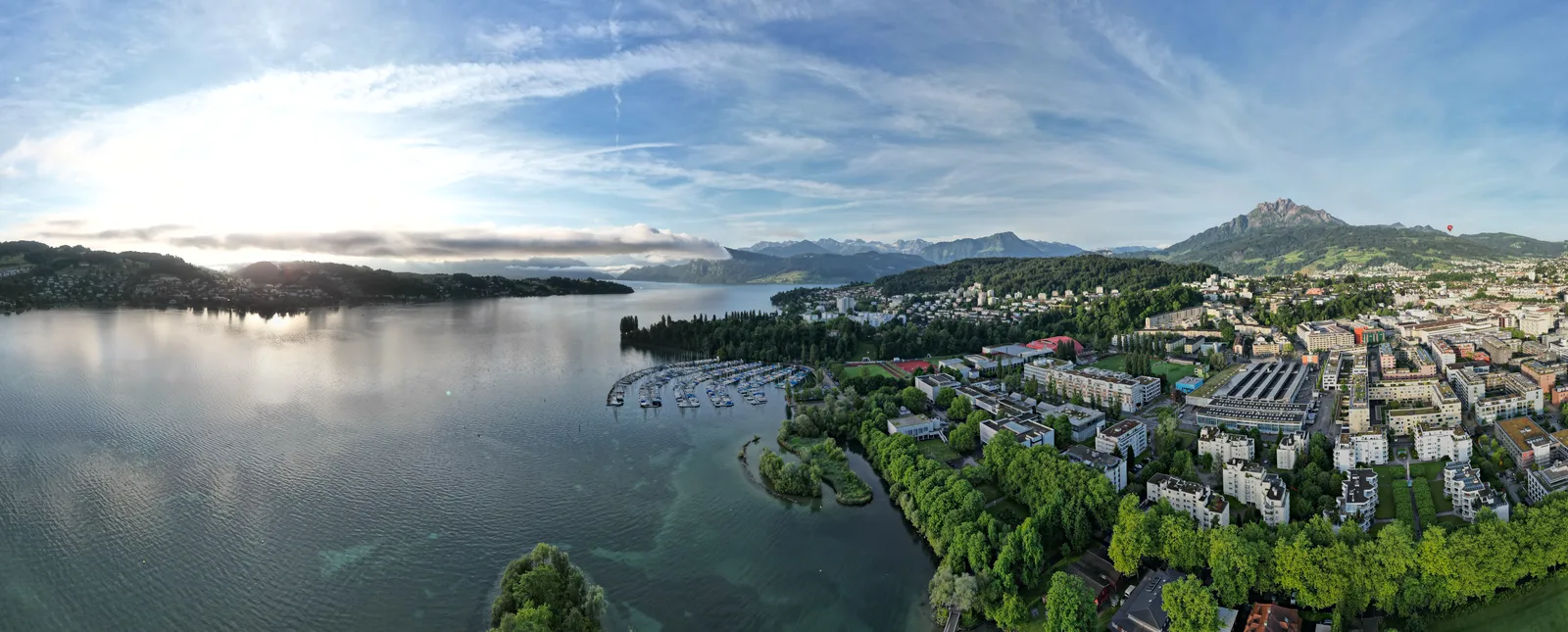
Lucerne makes a persuasive base for a first visit to central Switzerland. The lake, River Reuss and surrounding mountains give the city its setting, while the station, old town and waterfront allow a satisfying first day without a car. The appeal is the combination: covered bridges in the morning, an art collection after lunch and a boat journey when the timetable and weather cooperate.
Allow several nights if mountain excursions matter to you. A single overnight stop leaves little flexibility when a summit disappears into cloud or a railway closes for maintenance. A longer visit also reveals the practical city behind the photographs, with residential streets, markets, schools and commuting routines. Moving here requires a different budget and administrative plan from spending a holiday here.
Lucerne is the English name; Luzern is the German name used on transport and local administration. VisaWand's existing destination address uses Luzern. Keep that spelling in mind when searching tickets, accommodation addresses and municipal services.
Read the bridges as history, including reconstruction
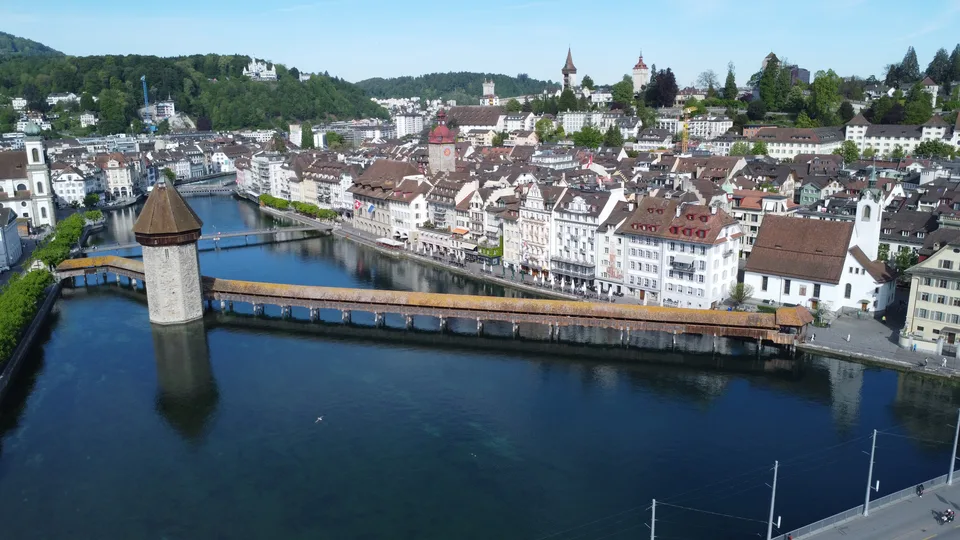
The Chapel Bridge is the obvious starting point, crossing the Reuss between the theatre side and the old town. Its roof, painted panels and neighbouring Water Tower form the familiar composition, but the bridge also tells a story of loss and reconstruction. A major fire struck on 18 August 1993; the rebuilt crossing reopened on 14 April 1994.
That history changes how you look at it. Today's structure should not be described as an entirely untouched medieval survival. The Water Tower predates the bridge, and the paintings belong to a separate historical programme. Walk through slowly enough to notice the panels, then look back from the riverbank to understand the crossing's relationship with the town.
Use the riverside walk to orient yourself before committing to a museum or excursion. The most useful first impression comes from connecting the station, bridge and old town on foot, rather than collecting isolated photographs and repeatedly retracing your route.
Choose your base around your actual journeys
The old town suits a stay centred on walking, river views and historic streets. Before booking, ask how close a taxi can get to the entrance, whether there is a lift and which direction the room faces. A picturesque address can be less convenient when you arrive with heavy luggage or need an early departure.
Across the river, Hirschmatt and Neustadt offer shops, restaurants and accommodation around a more everyday urban setting. The official city guide introduces these areas alongside the historic centre. Staying near the station makes repeated rail excursions easier; choose the exact property by walking distance, rather than assuming every listing described as central offers the same convenience.
The Bruch quarter adds independent businesses, workshops and places to eat beyond the principal sightseeing circuit. Consider Kriens when accommodation and your planned routes make sense together, checking the actual connection to Lucerne and the relevant mountain station. Compare the whole stay: room, transport, breakfast, cancellation terms and any visitor levy.
Climb the Musegg Wall while access is available
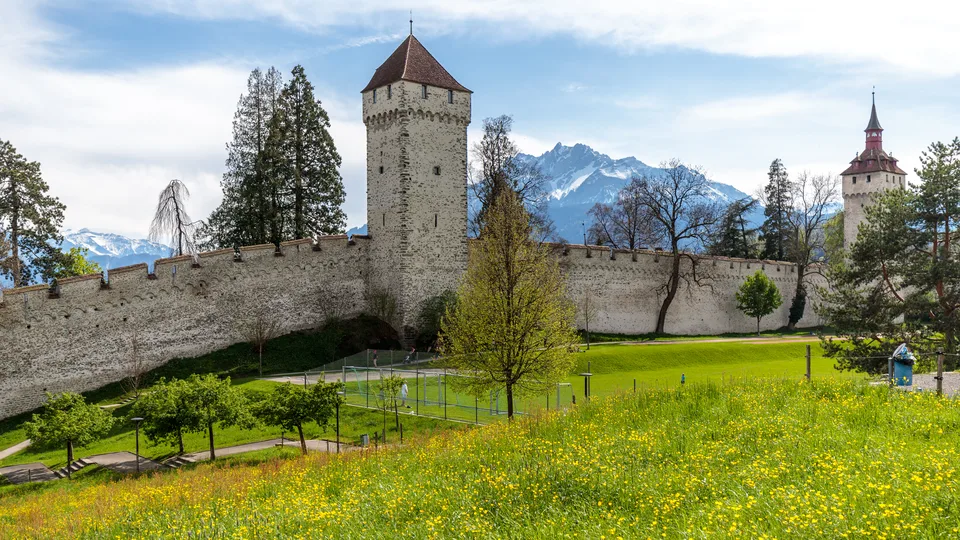
The Musegg Wall's visitor rules deserve attention before you climb. Public access normally runs from 1 April through 1 November, daily 08:00-19:00, and is free. The accessible circuit includes specified towers and sections; the presence of nine surviving towers does not mean all nine are routinely open to visitors.
This is a worthwhile change of perspective after the riverside, with the defensive wall offering a different relationship to the city and its mountain backdrop. It is also a physically different outing. Narrow passages and steep wooden stairs require care and a reasonable head for heights. The wall walk is unsuitable for wheelchairs and prams.
Snow and nighttime bring closures even within the usual season. Families should decide whether everyone is comfortable with the stairs before starting. If access is closed or unsuitable, retain the exterior walk as an option and put the time saved into a museum or the waterfront.
Give the Lion Monument its historical context
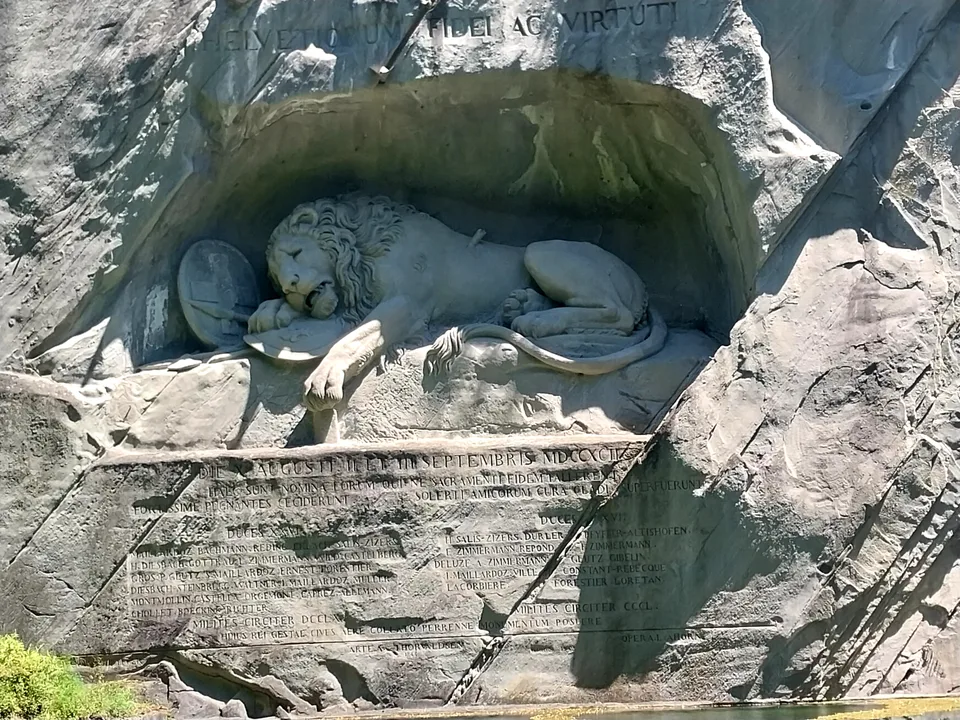
The Lion Monument commemorates Swiss Guards killed during the 1792 attack on the Tuileries in Paris. Inaugurated in 1821, the rock carving rewards a quieter visit than a quick group photograph. The park is free to enter; the neighbouring Glacier Garden is a separate paid attraction.
Read the interpretation rather than treating the sculpture only as a symbol of timeless heroism. The city's monument website places it within the political ideas and contested historical memory of its period. That context makes the visit more useful, particularly for families discussing why public monuments were commissioned and how their meanings change.
Buses 1 and 19 serve Lowenplatz. This area combines naturally with the Glacier Garden, but admission to one place should never be confused with admission to the other. Allow time to pause at the carving before moving into another attraction.
Choose museums by interests and ticket products
The Swiss Museum of Transport can occupy much of a day for visitors interested in mobility and technology. At the checked tariff, museum admission costs CHF37 for adults. The CHF62 adult day pass is a different product, adding specified experiences and daytime screenings. Compare those inclusions before buying; the cheapest ticket and the broadest ticket answer different needs.
Age rules also differ between products: children under six enter the museum free, but the day pass carries a charge. On Sunday 25 October 2026, the museum warns that the SwissCityMarathon will affect access and restrict operations. Check the notice if your visit falls on that date.
For a smaller art-focused visit near the station, the Rosengart Collection brings together Picasso, Klee and other modern artists. Adult admission is CHF20. Its opening calendar changes by season, including Monday closures during part of early 2027. Wheelchair access is available, while pushchairs are not admitted.
The Glacier Garden offers another distinct outing near the Lion Monument, with adult admission CHF24. Its published hours are 10:00-18:00 in April-October and 10:00-17:00 in November-March. Explicit exceptions matter: 24 and 25 December 2026 are closed, as is 26 January 2027. Follow those dated notices over broad year-round marketing language.
Separate the three kinds of visitor pass
The Visitor Card Lucerne is provided to qualifying overnight guests paying the visitor tax; it is personal and cannot simply be purchased as a substitute for accommodation. For guests staying in Lucerne or Kriens, it includes second-class buses and trains within zone 10. Boats are excluded. Arrival and departure days are included, with a maximum validity of fourteen days per stay.
Ask your accommodation how the card will arrive and keep the booking confirmation available for the initial journey within the eligible zone. This benefit does not cover the train from Zurich Airport. Nor do discounted mountain attractions become universally free because you hold the card.
The Museum Card is another product, advertised from CHF39 for two consecutive days and one admission to each participating museum. Check opening days before choosing the start date. Its Transport Museum inclusion does not turn it into that museum's comprehensive day pass. A regional travel pass is a third calculation: compare the precise journeys included against tickets you would actually use.
Arrive by rail and check the final connection
For an international flight into Zurich Airport, rail is a practical onward option. SBB lists the Zurich Airport-Lucerne connection, while noting that some departures require a change at Zurich main station. Use the dated SBB journey planner for your arrival time, luggage needs, current disruption information and fare.
Search for Luzern as the destination and leave a sensible margin after landing. A basic route diagram establishes that a connection exists; it does not guarantee that your particular flight meets a direct train. Avoid buying a restrictive onward ticket solely around an optimistic baggage-collection estimate.
Once in Lucerne, check the walk or bus to your accommodation before leaving the station. For a late arrival, confirm reception arrangements and the final local service. A lower room rate farther away can become less attractive when the last connection has already departed.
Understand zones before boarding local transport
Passepartout single tickets generally combine a defined area with a validity period. Within those limits, the network ticket allows travel across participating buses and trains; specific short-distance products have their own conditions. Enter your actual destination when buying instead of assuming a familiar-looking stop belongs to the same fare zone.
Compare individual tickets, a day ticket and any accommodation benefit against the day's plan. Buy or activate the correct ticket before travel as required by the chosen sales channel, and keep it available for inspection. For regular commuting, calculate the pass against your genuine working pattern rather than automatically choosing an annual commitment.
A fare adjustment takes effect on 13 December 2026. Those announced prices should not be presented as the current October tariff. Check the operator's current sales system for your travel date, especially if planning a longer stay across the timetable change.
Treat the lake as transport with a timetable
A boat journey can be the centrepiece of a day, but Lake Lucerne's operator timetable determines which outing is realistic. The autumn 2026 schedule ends on 18 October; the winter schedule begins on 19 October. Reduced seasonal patterns do not mean every service stops, but a summer itinerary cannot simply be carried into November unchanged.
Choose a destination and a workable return before boarding. A leisurely outward sailing followed by a late connection can leave much less time ashore than a map suggests. Check whether your ticket is for scheduled transport, a particular cruise or a combined excursion.
Ordinary local visitor transport benefits do not automatically include boats. Some national and regional passes are accepted, while other cards give a reduction. Read the operator's product list, including class and route limitations. Restaurant table reservations and ordinary seating on a scheduled boat are separate arrangements.
Make mountain plans around maintenance and visibility
Pilatus requires special attention in autumn 2026. The operator's calendar closes the Kriens gondola and summit cableway from 19 October through 27 November. During that period, the cogwheel railway from Alpnachstad is the available mountain railway approach; its published season continues through 29 November. The Lucerne-Alpnachstad boat connection ends on 18 October.
Consequently, the familiar boat-and-cableway circuit is not a year-round promise. Build the date-specific journey with the train alternative, check return services and consider the operator's recommended cogwheel reservation on busy days.
Rigi is another candidate, but its maintenance calendar also affects individual routes. Weggis-Rigi Kaltbad closes on weekdays from 16 to 27 November 2026, with weekends open. Choose the operating approach rather than abandoning the entire mountain or assuming every lift runs. Keep a city alternative for a day when conditions make the mountain journey poor value.
Eat locally without making every meal an event
Lucerne's traditional Chugelipastete is a useful dish to recognise on a menu. The tourism board's culinary description identifies a puff-pastry shell with a rich filling including veal, pork, mushrooms, raisins and cream sauce. It is a substantial meat dish, and neither a vegetarian option nor simply a sweet pastry. Ask about ingredients when dietary restrictions matter.
Markets offer a different way into the city's food. The weekly market normally operates Tuesday and Saturday mornings, 06:00-noon, around Rathausquai, Unter der Egg and Bahnhofstrasse, with the Saturday Helvetigartli market adding another location. Check holiday exceptions before building breakfast or shopping plans around it.
For an apartment stay, compare kitchen facilities with your likely routine. A fridge and useful cooking equipment can matter more than a decorative kitchenette. Keep room in the budget for the meals you particularly want, while using groceries and simpler lunches to control the rest.
Build a budget from choices you can price
Start with the largest commitments: accommodation, airport transfers and major excursions. Then add the attractions you would independently choose. One adult paying separately for the Transport Museum, Rosengart and Glacier Garden would spend CHF81 at the checked ordinary museum tariffs, before transport, meals or optional experiences. That is a comparison basket, not a recommended compulsory circuit.
Use that basket to evaluate passes without allowing a discount to dictate the whole visit. Check participating attractions, consecutive-day rules, closures and child prices. A pass can offer poor value when you only want one museum or spend its second day outside the city.
For shopping, distinguish ordinary errands from souvenir browsing. The station's daily market-hall offer is useful when regular market hours do not fit. Before booking a room or buying an excursion, check the total payable amount and cancellation terms; a quoted starting price is not a reliable estimate for every date or household.
Choose the season for the experience you want
For wall access, the published April-to-early-November season is a useful starting point. For a boat-and-mountain combination, seasonal timetables and maintenance dates narrow the choice further. Visitors whose main interests are galleries, historic streets and meals have more freedom to travel when outdoor options are limited.
Keep the city day and mountain day interchangeable. Consult the forecast and operating information close to departure, pack layers and rain protection, and avoid assuming that conditions beside the lake describe conditions at a summit. A forecast for the next few days is not a climate average or a guarantee of a clear view.
Winter planning should begin with what remains open on your precise dates, including museum holiday exceptions. Summer planning should still leave room for an indoor alternative. The best month depends on your priorities and available services; no single season can guarantee the complete postcard experience.
A realistic three-day starting plan
For day one, start with the station, Chapel Bridge and old town, then take an unhurried lunch. If the wall is open and suits your mobility, make Musegg the afternoon outing. Otherwise choose Rosengart and a riverside walk. This leaves time to understand the city before spending a full day away from it.
Use day two for one major excursion, choosing a lake journey or a mountain route whose transport is operating. Confirm both directions before setting off. Avoid treating Rigi and Pilatus as compulsory stops to squeeze into the same day; each deserves room for the journey itself.
On day three, combine the Lion Monument and Glacier Garden, or give the Transport Museum the larger block of time it merits. Substitute according to interests and opening days. These are editorial suggestions, not a timed tour: move the excursion to the clearest suitable day and retain flexibility around arrival, departure and family energy.
Test everyday life before committing to a lease
A relocation visit should include ordinary journeys. Travel from a prospective address to work or study at the time you would normally commute. Check groceries, laundry arrangements, storage, noise, stairs and the final evening service. View the property itself rather than deciding from a lakefront photograph or a broad neighbourhood label.
The city's newcomer information points residents towards housing resources and practical services. University applicants can also consult the University of Lucerne's housing information, checking eligibility and availability directly. A housing directory is a starting point, not a reserved room or proof that an advertised property remains available.
Read the official Swiss rental guidance before signing. A contractual rental deposit can be up to three months' rent. Establish the term, notice conditions and additional charges in writing, and read shared-house and laundry rules. No representative current rent is asserted here: compare actual, suitable listings and the complete household cost.
Register and organise household services
Lucerne's registration instructions require newcomers to register within fourteen days. The documents and method depend on the situation; prepare identification, tenancy information and relevant permit and insurance documents. The online domestic moving service should not be assumed to cover every first arrival from abroad.
Build a household checklist around the address. Ask which internet connections actually reach the building, how waste and recycling collections work, and which charges are included in the tenancy. The city provides multilingual disposal information and collection guidance. Confirm arrangements before ordering services or leaving bulky items outside.
Families should contact the municipal school service about enrolment and support, and investigate childcare separately. Availability, charges and income-related assistance need individual checking. Do not assume that an international household automatically receives English-medium schooling or that wraparound care is included in the school place.
Arrange healthcare as a resident
Under Swiss federal health-insurance rules, residents generally have three months to obtain compulsory insurance. Timely enrolment normally backdates both coverage and premiums to the start of the obligation, so leaving it until the deadline does not make the intervening months free. Each family member needs their own cover.
Exceptions depend on circumstances, including international coordination rules and qualifying student arrangements; an exemption may require an application and equivalent insurance. Confirm the applicable rule rather than substituting a tourist policy for resident cover. Basic insurance and supplementary products have different acceptance rules.
The city's health information advises finding a general practitioner and, where needed, a paediatrician. Check whether a practice accepts new patients before you need an appointment. For a life-threatening emergency, call 144; organise routine care through the appropriate practice and insurer arrangements.
Keep tourism, employment and long-term residence separate
Use SEM's entry guidance to check nationality-specific requirements. Ordinary Schengen short stays are generally limited to ninety days in any 180-day period across the area; visiting another Schengen country does not reset that allowance. A permitted holiday does not itself authorise employment or permanent settlement.
Swiss employment rules distinguish EU/EFTA citizens from third-country nationals. EU/EFTA employees generally register locally within fourteen days and before starting work, with separate notification arrangements for some shorter employment. Third-country admission is more restrictive and normally involves an employer-led permit process. A residence permit from an EU country does not automatically confer Swiss working rights.
Study, family reunification and longer residence require their own assessment and, where applicable, a national visa and cantonal residence permission. As checked on 15 October 2026, SEM says ETIAS applications are not yet being collected. Recheck official requirements before travelling. A consultation can help organise questions, but the authorities decide applications.
Compare Lucerne with your wider Swiss journey
If Lucerne is one stop in a longer trip, compare onward rail journeys before choosing the number of nights. Zurich offers another urban base; Bern and Basel may also fit a route built around Swiss cities rather than repeated mountain excursions. Check the dated connections and accommodation costs for the combination you actually intend to travel.
For a lakeside alternative, investigate Weggis or Vitznau alongside the boat timetable and mountain access. They answer a different accommodation question from staying beside Lucerne station. A quieter setting can be appealing, but evening connections, dining choices and luggage transfers deserve the same attention as the view. Keep enough time in one base to enjoy it.
Official planning resources
Reviewed 15 October 2026. Use the official resources linked throughout this guide for admission, transport, housing and immigration decisions. Prices, services and rules can change; confirm the details relevant to your dates. Photography illustrates the locations and is not a live view.
View all official resources
- Lucerne Tourism: Chapel Bridge
- Lucerne Tourism: Visitor Card
- Glacier Garden: opening hours
- Glacier Garden: visitor introduction
- Swiss Museum of Transport: tickets
- Swiss SEM: working in Switzerland
- SGV: lake timetables and passes
- Musegg Wall: official opening and barriers
- Rosengart Collection: official visitor information
- Rosengart Collection: collection introduction
- Lucerne Tourism: markets
- Lucerne Tourism: Bruchquartier
- Lucerne Tourism: 2026–27 city guide
- Lucerne Tourism: regional cooking
- Passepartout: single tickets
- Passepartout: fare changes from December 2026
- Swiss Federal Office of Public Health: compulsory insurance
- City of Lucerne: housing and household services
- City of Lucerne: registration
- City of Lucerne: healthcare
- City of Lucerne: schools and childcare
- University of Lucerne: student housing
- Swiss public portal: rental agreements
- Lucerne Tourism: Lion Monument
- City of Lucerne: Lion Monument interpretation
- SBB: Zurich Airport–Lucerne direct connections
- Lucerne Tourism: Museum Pass
- Pilatus: railway and cableway operating calendar
- Rigi: maintenance and operating information
- SEM: entering Switzerland
- SEM: entry and visa questions
- SBB: journey planner and tickets
- SBB: Swiss long-distance route network
Plan the next part of your journey
Explore the Switzerland guide, browse other cities or compare consultants for your travel and relocation questions.