Visa
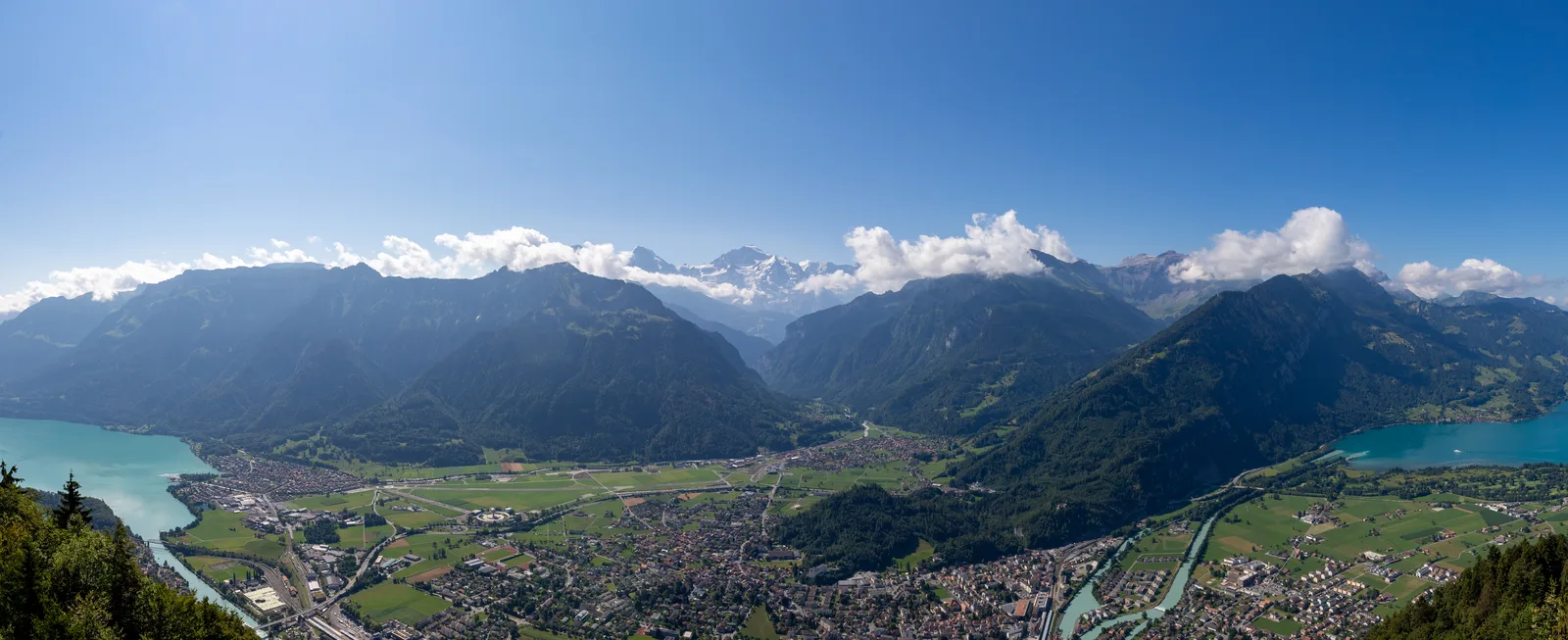
A small town with a very large landscape
Interlaken is best understood as a base between lakes and mountain valleys. The town itself offers promenades, gardens, shops and a remarkable backdrop, but many of the experiences visitors associate with its name lie elsewhere: on Lake Thun or Lake Brienz, above Wilderswil, or farther into the Jungfrau region. That distinction helps you decide how long to stay and where to spend your money.
The setting also explains the appeal of a longer visit. You can alternate an ambitious excursion with a modest riverside walk, or keep several days flexible while waiting for suitable mountain conditions. A rushed overnight stop provides less room for either. Interlaken suits travellers who enjoy planning journeys as part of the experience, rather than expecting every major attraction to be within walking distance of their hotel.
Understand Interlaken, Matten and Unterseen
The municipality's published facts identify Interlaken, Matten and Unterseen as three politically independent communes. They form a closely connected area on the Bödeli plain, but an accommodation listing using the Interlaken tourism name may have an address in a neighbouring municipality. Check the postcode and commune before choosing a hotel, contacting a school or arranging registration.
Interlaken reports 6,291 residents as of 1 January 2026. That dated municipal figure is more useful than treating an older directory population as a current census. This is a small town serving a much wider visitor region, with facilities and excursions distributed across several communities.
Follow the change from monastery to resort
The municipal history traces Interlaken's monastery to the early twelfth century. The Augustinian foundation helped shape the surrounding land, while its former buildings later became associated with Bernese administration. The area's resort identity developed through a different chapter, as increasing boat and railway access brought more travellers and encouraged the growth of hotels.
Even the municipal name has a history. The present commune separated from Matten in 1837 as Aarmühle; the official change to Interlaken was approved in December 1891. Knowing this helps explain why the town's story is not simply that of an unchanged medieval settlement.
Start with Höheweg, Höhematte and the river
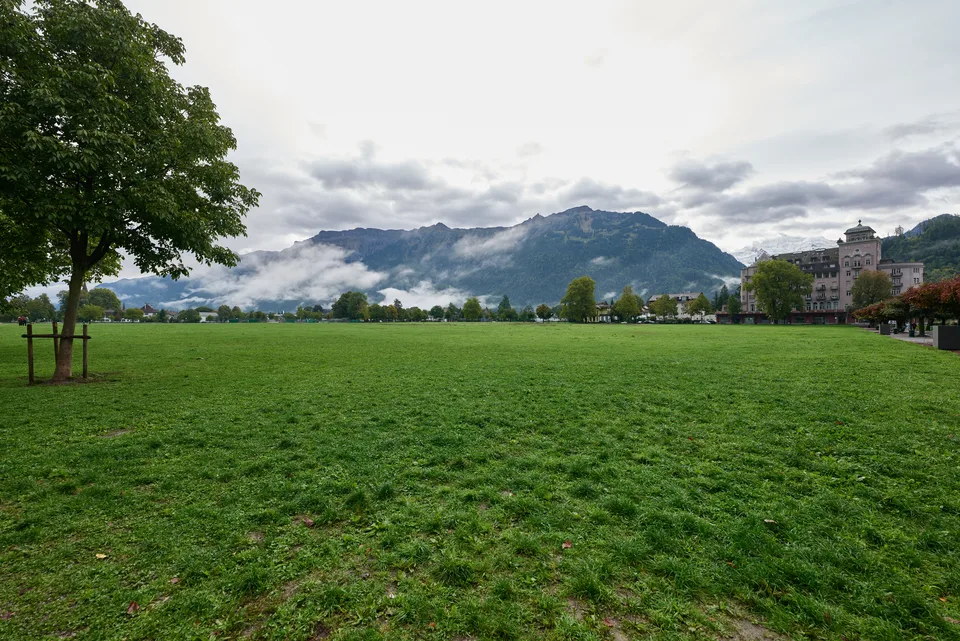
The Höheweg promenade provides an easy introduction to Interlaken's visitor life: shops, restaurant terraces, benches and connections towards both stations. Beside it, the open Höhematte gives the surrounding landscape room to dominate. The tourism board's Höhematte information explains the protected setting and its relationship with the Jungfrau view.
Treat the mountain panorama as a possibility rather than a promise. Cloud can transform the same walk, and the meadow remains useful as an open space even when distant summits disappear. Paragliders may land here when flights operate; stay clear of the landing activity and follow instructions rather than walking into it for a photograph.
Continue towards the Aare for a quieter change of scene. The combination works well on an arrival afternoon because you can shorten it without losing a prepaid excursion. The promenade is described as wheelchair accessible, but confirm individual hotel entrances, toilets and any onward route separately.
Walk into neighbouring Unterseen
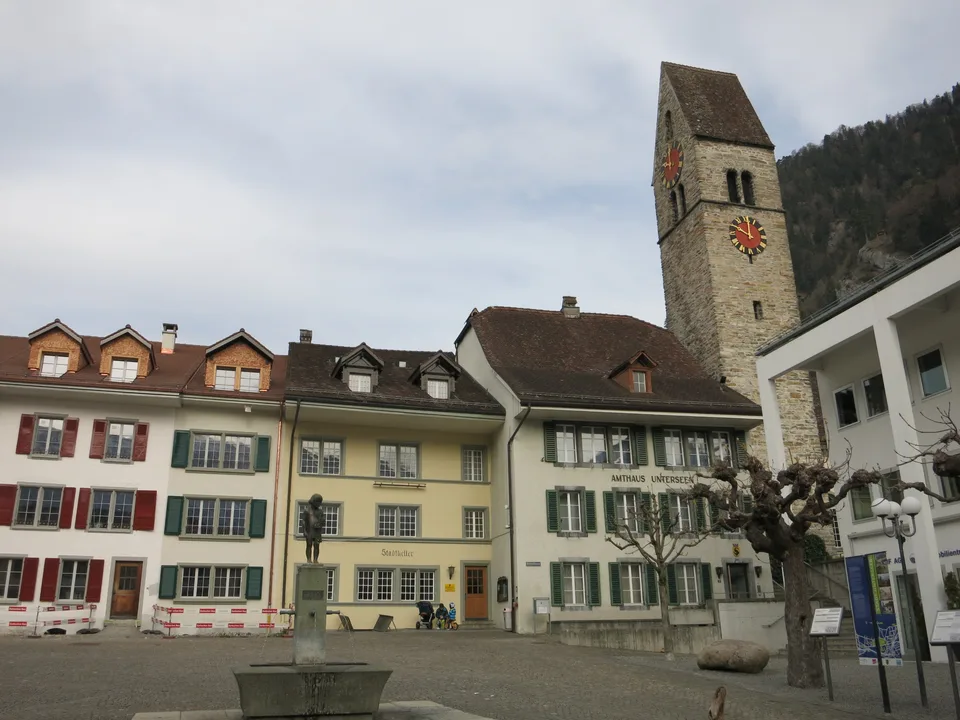
For historic streets and a compact square, cross towards Unterseen. The official old-town walking suggestion links the Aare crossing, Unterseen, Marktgasse, Höheweg and the former monastery area. It provides a sensible way to connect places that can otherwise appear as disconnected pins on a sightseeing map.
Unterseen is the neighbouring commune, so describe it accurately when discussing accommodation or services. Its old-town character makes an appealing contrast with Interlaken's resort promenade. Give yourself time to look at the buildings and river passages, rather than regarding the walk only as a transfer between paid activities.
Choose accommodation by station and stay length
The tourism accommodation directory includes hotels, hostels, guesthouses, holiday apartments and campsites across the region. Use it to establish options, then check the property's own room details and terms. A category is not a personal recommendation, and a regional listing does not guarantee a particular view or convenient station access.
Interlaken Ost is a useful reference point for journeys towards the Jungfrau region and departures on Lake Brienz. Interlaken West is the reference for Lake Thun sailings and another part of the town's accommodation area. Compare the exact journeys from a property with the trips you plan, taking account of any replacement buses.
Hostel guests should check kitchen access, lockers, quiet hours and whether a private bathroom matters. Apartment guests should confirm cooking equipment, laundry and cleaning charges. At campsites, verify seasonal opening and transport after dark. Across all types, compare the full price, visitor taxes, cancellation conditions and reception arrangements for your arrival time.
Plan arrival around the West-Ost closure
For flights into Zurich, Geneva, Basel-Mulhouse or Bern, compare the complete onward journey before choosing solely by airfare. The SBB planner should be checked for your actual arrival date and destination station. Allow time for border procedures, baggage and the final connection to your accommodation; an airport-to-town route description is not a guarantee of a direct train.
A specific disruption affects autumn 2026. The official arrival notice states that trains between Interlaken West and Ost are replaced by buses from 19 October through 11 December 2026. Bus schedules and stopping places differ from the normal railway arrangement. At West, some replacements use Rugenparkstrasse or Bahnhofplatz; follow current notices.
Use the guest card within its actual limits
Qualifying overnight visitors receive the Interlaken Guest Card through their accommodation in return for paying the visitor tax. It is personalised and valid during the stay. The digital version is called the Interlaken Pass; ask your host how and when it will be provided rather than arriving without the documentation you need.
The card includes local public transport within the published area of validity. That wording matters: it is not unlimited free travel throughout the Bernese Oberland, and mountain railways are not automatically covered. Carry the card and check the map against your specific destination. A bicycle may require a separate ticket, while dogs do not receive their own guest card.
Among the published benefits are reductions on Harderbahn, Schynige Platte railway and the BLS two-lake day pass. Check current product conditions and compare them with any other pass you hold. Discounts cannot simply be stacked together because each appears on a different card.
Choose a lake journey before choosing a ticket
Lake Thun and Lake Brienz provide different outings, with departures associated with Interlaken West and Ost respectively. The BLS timetable is essential: the two lakes have separate operating patterns, and not every boat serves every landing. Choose the places you want to visit, then check an outward and return combination that leaves useful time ashore.
For autumn 2026, Lake Brienz services continue under a reduced timetable from 12 October through 6 December. Describing all boats as stopping in October would be misleading. Lake Thun's autumn schedule has its own dates. Consult the correct seasonal pages instead of building a November day from a summer departure list.
A shorter one-way sailing combined with land transport may fit better than a long return cruise. Compare that with a day ticket and the benefits of your existing pass. Restaurant reservations, ordinary transport tickets and special cruises are different purchases; check what is included before paying.
Take Harder Kulm as a separate mountain outing
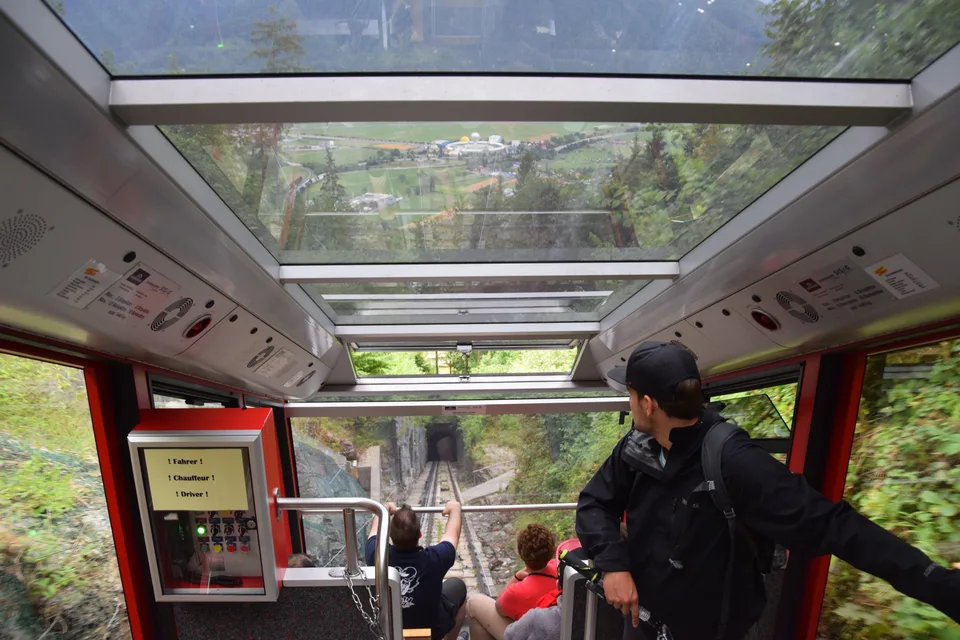
The Harder Kulm funicular starts a short walk from Interlaken Ost and reaches the mountain in about ten minutes. The viewpoint stands at 1,322 metres and looks across the two lakes and surrounding peaks. It offers a change of scale without the longer journey required for some higher excursions.
Allow time for the walk to the station, queues, time at the top and the descent. The advertised ride time is only one part of the outing. Check the day's operation and final return before boarding, especially outside the main summer period. A mountain view is less compelling when cloud hides the landscape, so keep the decision flexible where ticket conditions allow.
Starting prices shown on promotional pages can reflect different journeys or reductions. Obtain a quote for your actual return trip, age group and pass rather than treating the smallest displayed number as the universal adult fare. Keep the restaurant purchase separate unless you deliberately choose a combined offer.
Distinguish Jungfraujoch from a general regional pass
Jungfraujoch is a substantial excursion beyond Interlaken, not an attraction in the town centre. The operator's ticket information places the railway destination at 3,454 metres and makes seat reservations compulsory from 1 May through 31 October 2026. Check the route, reservation and return arrangements together before committing to the day.
A three-day Jungfrau Travel Pass costs CHF210 at the full adult tariff; CHF165 is the reduced adult price. Those figures should not be interchanged. The pass offers travel on its specified network, while the Jungfraujoch connecting ticket is an additional purchase, advertised from CHF89 during May-October 2026.
Compare your planned journeys rather than assuming a pass necessarily saves money. Check age rules, eligibility for reductions and any reservation charges separately. Keep expectations realistic about visibility and your own comfort at altitude. Visitors with relevant health concerns should obtain individual medical advice before choosing a high-altitude day, rather than relying on an itinerary's popularity.
Consider Schynige Platte while the season fits
For an excursion focused on the mountain landscape and alpine plants, investigate Schynige Platte above Wilderswil. The Alpine Garden's own calendar gives its 2026 season as 13 June through 25 October. Its collection includes around 800 Swiss alpine plant species, but that does not mean every species will be flowering whenever you arrive.
Build the visit around the railway's actual operation and the conditions on the day. A pass whose overall validity extends later into autumn does not establish that every individual attraction remains open until the same date. This distinction is particularly useful when assembling a trip near the end of October.
Visit St Beatus Caves with the access conditions in mind
The St Beatus Caves near Lake Thun offer a different kind of landscape, with a public cave route and museum. Checked ordinary admission is CHF20 for adults and CHF12 for children aged six to sixteen. The cave visit includes the museum; a museum-only ticket is another product.
This is not a step-free indoor alternative. The cave route has 297 steps and is unsuitable for wheelchairs and prams. Temperatures inside remain around 8 to 10°C, so bring a warm layer and shoes suited to damp paths. The approach from the boat landing is uphill and takes longer than the approach from the road.
The dated maintenance notice closes the caves and restaurant from 9 to 20 November 2026. Seasonal opening hours also change after that break. Check last entry as well as closing time, and leave enough time to reach the entrance rather than arriving at the nearest stop at the final admission minute.
Decide whether an adventure activity suits you
Tandem paragliding is a prominent part of Interlaken's visitor identity. The tourism board's operator listing describes transfer to the Beatenberg take-off area and a landing on the Höhematte. It is one possible experience, rather than an essential purchase for everyone visiting the town.
Before booking, ask the provider about participation requirements, weather decisions, cancellation terms and what happens if the flight cannot operate. Confirm the meeting point and whether photographs or video cost extra. Published age and weight limits belong to the specified provider and product; they should not be assumed identical across every activity company.
Eat regionally and make everyday shopping practical
The regional food information highlights alpine cheeses, fondue, raclette and seasonal game. In autumn, menus may pair game with mushrooms, spaetzli, red cabbage and chestnuts. These are useful dishes to recognise, but ask about ingredients and preparation when allergies, vegetarian requirements or other dietary needs affect your choice.
Balance a few meals you particularly want with simpler food that fits the day's travel. Before an early departure, check breakfast hours and whether your accommodation can support the routine. An apartment kitchen or hostel cooking area only saves money if its equipment and access hours meet your needs.
For shopping, separate daily groceries from souvenir browsing along the promenade. Check opening hours for the actual shop and date, especially around weekends and holidays. Buy food for the journey without assuming a restaurant will be operating at every intermediate stop or that a mountain ticket includes a meal.
Budget for the excursions you will actually take
Price accommodation and the major journeys first. The difference between two plausible Interlaken holidays may lie mainly in paid mountain transport, rather than the cost of walking around town. Add airport travel, local connections, meals and any optional activities before deciding what a room-rate saving is really worth.
Use a simple comparison sheet: each intended journey, ordinary price for your circumstances, eligible reduction and any supplement. Then compare the total with the pass. Avoid counting attractions you would not otherwise visit merely to make a pass appear valuable. A guest-card reduction, a regional pass and a national travel product answer different travel patterns.
Give weather and operating seasons room in the plan
Choose dates around your priorities. Visitors interested in the Alpine Garden need its published season; visitors planning lake journeys need the correct boat schedule. Winter travel calls for a different selection of activities, and a snow-covered mountain photograph does not establish the conditions on a town pavement or walking route.
Keep one low-level day interchangeable with the major mountain day. Check forecasts, webcams and operating notices close to departure, and carry suitable layers and rain protection. Visibility can matter as much as precipitation when the purpose of an expensive excursion is the panorama.
A three-day plan with useful alternatives
Use day one to establish the layout: Höheweg, Höhematte, the former monastery area and a walk towards Unterseen. Add Harder Kulm only if operating times, visibility and your arrival schedule make it worthwhile. A late flight or railway delay should not turn the first afternoon into a race.
Set aside day two for one substantial mountain excursion, choosing Jungfraujoch or another route that suits your interests, budget and conditions. Check reservations and the complete return journey. Combining several major mountain destinations into one day can leave more time in transfers than enjoying the places themselves.
Use day three for a lake journey with a worthwhile stop, or the caves when open and suitable for your mobility. Change the order around weather and opening dates. These are editorial suggestions, not a timed tour: leave room for lunch, queues, family energy and the journey home, including any West-Ost replacement bus.
Look for a home as a resident, not a holiday guest
When investigating relocation, view properties in the exact commune where you might live. Test the trip to work or study at the relevant hour, including the evening return. Check grocery access, noise, storage, stairs, laundry and the cost of keeping a vehicle if your household needs one.
The official Swiss rental guidance explains contractual terms and deposits. For a residential tenancy, a deposit required by the agreement may be up to three months' rent. Read the additional charges, notice dates and house rules carefully, and establish which premises and facilities belong to the tenancy.
Do not treat a holiday apartment's monthly quote as evidence of the ordinary residential market, or an old published average as a current rent. Compare actual suitable listings and written terms. A temporary first stay can be useful while investigating, but confirm that the arrangement supports your administrative needs and does not substitute for permission to reside.
Register and set up services in the correct commune
Interlaken's registration instructions require arrival registration within fourteen days. People arriving from abroad must attend the residents' office in person; the domestic online moving service is not a universal alternative. Prepare the applicable identity, tenancy, employment and family documents, and check permit-related requirements before the appointment.
For utilities, IBI provides an address and tenant-change entry point. Ask the landlord which bills you pay directly and which are included in the tenancy. Check the actual internet connection available at the building before choosing a service, and retain opening meter information where relevant.
Household waste also has local rules. Interlaken requires AVAG charged refuse bags or the appropriate fee labels, with collection arrangements varying by area. Check the calendar for your address and holiday cancellations. Do not transfer Interlaken's collection days to a property in Matten or Unterseen simply because all three share the tourism area's name.
Arrange schooling and healthcare before they become urgent
Families can start with the municipal education office for school questions. Investigate language support, the appropriate school and the enrolment process for the particular address. Interlaken's Tagesschule information describes childcare, meals and homework support, with parental charges linked to income and assets. Confirm current availability and registration rather than assuming a school place includes all-day care.
Residents generally need Swiss compulsory health insurance within three months. Each family member is insured individually, and timely enrolment backdates both cover and premiums to the start of the obligation. Exemptions depend on the circumstances and may need cantonal approval; a tourist policy should not automatically be treated as sufficient resident insurance.
Find suitable routine care and check whether a practice accepts new patients. For a medical emergency, Spital FMI directs callers to 144. Spital Interlaken's emergency service is in neighbouring Unterseen, another practical reason to check actual addresses instead of relying on a facility's name alone.
Separate visiting from work, study and settlement
Check SEM's nationality-specific entry requirements before travelling. Ordinary Schengen short stays generally permit up to ninety days within any 180-day period across the area; crossing another Schengen border does not restart the allowance. Entry for a holiday is not permission to take employment or settle permanently.
Swiss working rules distinguish EU/EFTA citizens from third-country nationals. EU/EFTA employees generally need an employment contract and local registration within fourteen days and before starting work; some short employment uses a notification procedure. Third-country admission is more restrictive and normally requires the future employer to apply for permission.
Study, family reunification and longer residence have separate requirements. Use SEM's visa and residence guidance for the correct route and competent authority. As checked on 15 October 2026, SEM says ETIAS applications are not yet being collected. Recheck before departure, and distinguish application assistance from an authority's decision. A visitor booking, tenancy or attractive job advertisement does not itself establish an immigration entitlement.
Consider a different base when it fits the journey
Interlaken works well when you want access to both lakes and several excursion directions. If most of your time will be spent in one mountain valley, compare staying closer to that valley with the repeated journeys from the Bödeli. Check luggage transfers, evening services and the seasonal operation of the exact accommodation.
For a wider Swiss itinerary, compare the onward journey to Lucerne or Bern before adding another change of hotel. One well-chosen base can make a visit less fragmented. The better choice is the one that fits the places you intend to experience, the pace you enjoy and the ordinary journeys you are willing to repeat.
Official planning resources
Reviewed 15 October 2026. Use the official resources linked throughout this guide for admission, transport, housing and immigration decisions. Prices, services and rules can change; confirm the details relevant to your dates. Photography illustrates the locations and is not a live view.
View all official resources
- Interlaken Tourism: guest card
- Interlaken Tourism: 2026 guest-card information and area
- Jungfrau Railways: Harder Kulm
- Interlaken municipality: moving and registration
- Interlaken municipality: history
- Interlaken municipality: facts and services
- BLS Navigation: 2026 Lakes Thun and Brienz timetable
- St Beatus Caves: hours, admission and access
- Interlaken municipality: education
- Interlaken municipality: household waste collection
- Jungfrau Railways: Travel Pass prices and coverage
- Interlaken Tourism: arrival and 2026 station closure
- Jungfrau Railways and Interlaken Tourism: old town walk
- Interlaken Tourism: Hohematte setting
- Interlaken Tourism: Hoheweg promenade
- Interlaken Tourism: regional food
- IBI: address changes and tenant changes
- Interlaken School: childcare and registration
- Spital FMI: emergency care
- Swiss authorities: rental agreements
- SEM: working in Switzerland
- SEM: entering Switzerland
- Federal Office of Public Health: resident health insurance
- SEM: entry and residence questions
- Jungfrau Railways: Jungfraujoch tickets and reservations
- Interlaken Tourism: accommodation types
- Interlaken Tourism: tandem paragliding
- Schynige Platte Alpine Garden: 2026 season
- BLS: St Beatus Caves access and maintenance closure
- SBB: current Swiss journey planner
Plan the next part of your journey
Explore the Switzerland guide, browse other cities or compare consultants for your travel and relocation questions.