Visa
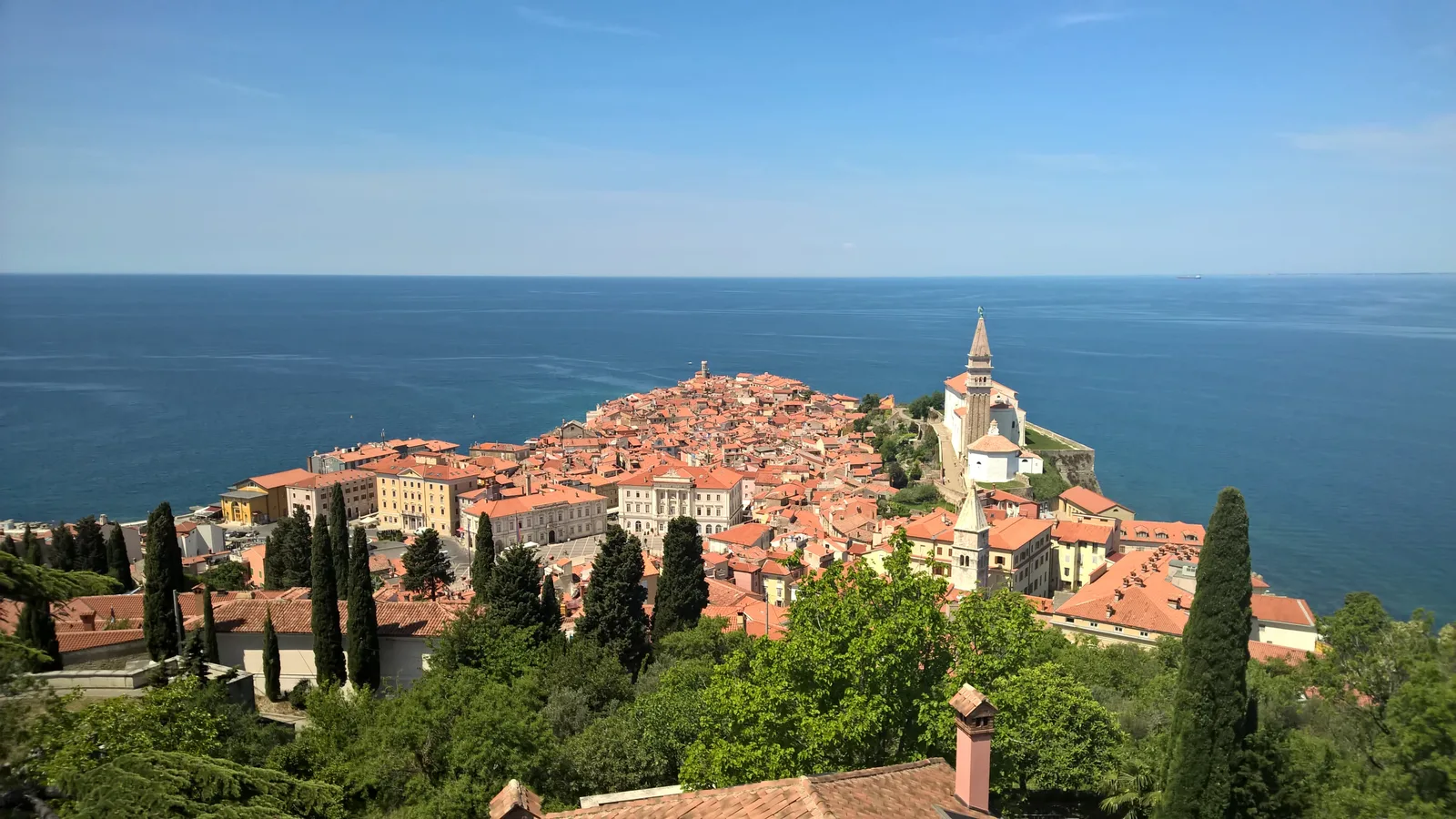
A small Adriatic town that rewards an overnight stay
Piran’s red roofs crowd onto a narrow peninsula, with Saint George’s church above them and the sea around the edges. Its scale is part of the attraction. You can spend a rewarding visit moving between a square, a waterfront table and a viewpoint, without needing a long list of separate districts or an elaborate sightseeing timetable.
A day is enough for an introduction; two nights give you more freedom to enjoy the town before and after the busiest visiting hours. Add further nights for the surrounding coast, salt pans or a slower holiday, rather than expecting a small historic centre to supply a major city’s range of daily activities.
The practical decisions begin before arrival. Steep approaches, restricted vehicle access and the final journey with luggage can matter more than a room’s distance from the sea. Use VisaWand’s Slovenia country guide for the national context, then plan your stay around the exact property and the kind of coastal visit you want.
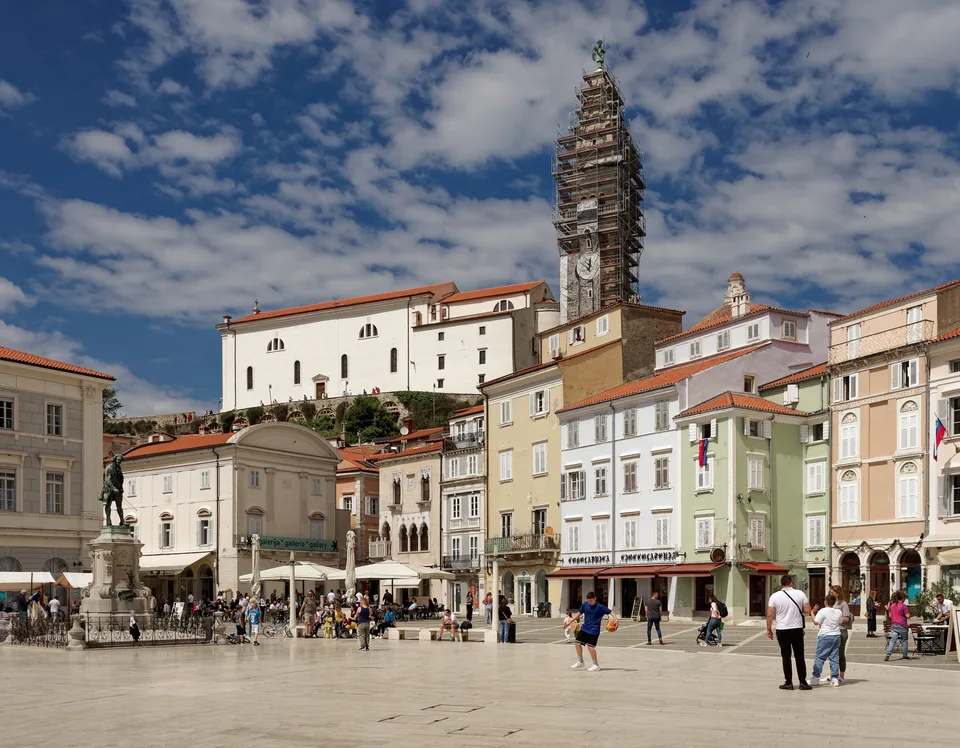
Tartini Square explains something of the town’s character
The tourism board’s account of Giuseppe Tartini’s legacy connects the central square with a very different earlier scene. An inner fishing harbour once occupied this space. Filling it created the square that now bears the name of the violinist and composer, born in Piran in 1692. His monument was erected in 1896 and faces his birthplace.
That connection gives you a useful way to look at the square: as a space shaped by work, water, music and later civic life. Start with a slow circuit, noticing the relationship between the open square and the lanes leading away from it. Then choose one route towards the church or waterfront instead of trying to cover everything at once.
Check an individual building’s visiting arrangements before assuming that an attractive facade means its interior is open to visitors.
Choose a base by its approach, not just its address
Think in terms of the old-town lanes, the harbour and seafront, and the higher approaches towards the church and walls. These are useful planning areas, rather than a claim that Piran has a large system of distinct urban neighbourhoods. A map’s short distance can conceal steps, a slope or an awkward luggage route.
An old-town room suits someone who wants to walk out into the historic setting. A waterfront property may appeal for its outlook, while accommodation outside the core can make repeated car journeys easier. Ask the host to describe the route from your arrival point and the actual entrance to your room.
Compare nearby Portorož and Lucija as separate accommodation possibilities if your priorities include access, transport or a different range of facilities. Check the door-to-door connection into Piran rather than treating every listing in the municipality as a room within the old town. The municipality and the settlement cover different geographical areas.
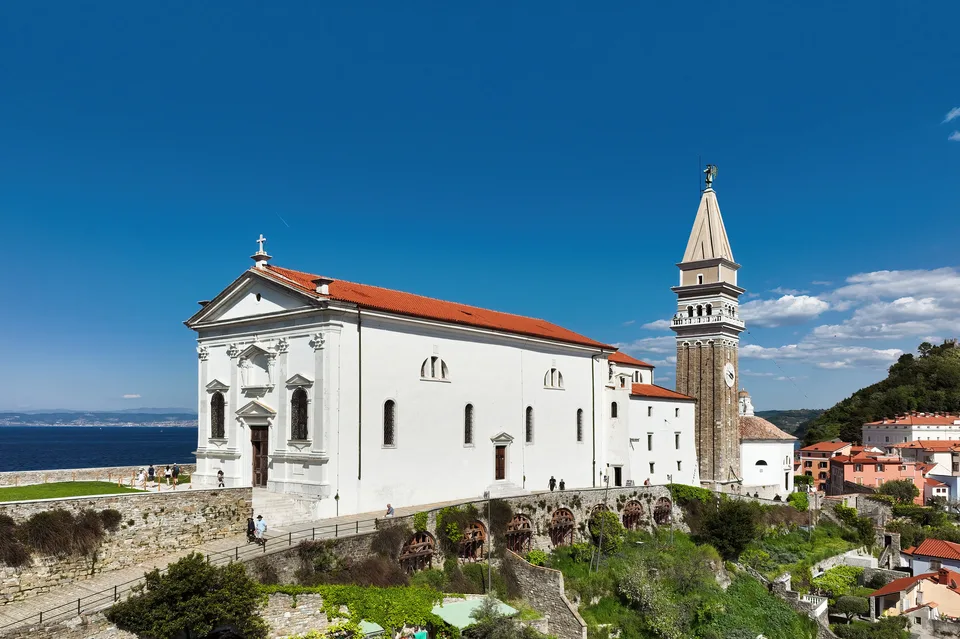
Saint George’s church and the climb above the roofs
Saint George’s church and bell tower occupy the elevated position that helps define Piran’s skyline. The tourism board describes a fourteenth-century church given its present character through seventeenth-century Baroque renovation. The tower reflects Venetian influence and the model of Saint Mark’s in Venice.
The appeal here combines architecture with the setting above the town. Allow time for the approach and the view, particularly if your group walks at different speeds. Before purchasing tower or museum admission, establish what is included, whether the climb suits you and which parts are open on your date.
Keep church use in mind when entering or photographing the interior. If steps or confined spaces are difficult, investigate the precise route before making it a fixed appointment. Enjoying the surrounding view can be a worthwhile visit in itself.
The town walls: a viewpoint with steep steps
The walls operator’s visitor information currently lists adult admission at €4, students at €2.50 and free entry for children up to twelve. It also warns that the narrow passages and steep steps make the walls unsuitable for wheelchair users and inadvisable for people with reduced mobility. These are restrictions on the walls visit, rather than a statement that nobody with mobility needs can visit Piran.
The walls close in bad weather. Check opening arrangements close to your visit and choose a time when the conditions suit an exposed viewpoint. Wear shoes with a secure grip, take the climb at a comfortable pace and avoid making a tight onward booking depend on finishing quickly.
Parking immediately outside the walls is reserved for eligible permit holders. The operator directs visitors towards garages instead. If you are driving, settle the parking plan before reaching the hill. The view is a good reason to make the effort, but it is an optional activity if the approach or steps are unsuitable.
When the culture pass makes sense
The Discover Culture: Portorož & Piran Pass is listed at €13.50 per person. It combines the town walls, Saint George’s church, museum and bell tower, and Mediadom Pyrhani, with a further benefit at Mestna Kavarna Piran. Compare it with the places you actually want to visit and the physical demands of each stop.
The purchase process matters. An online voucher is exchanged at a tourist information centre for the original ticket with stubs. The ticket is valid for three days from purchase, so check the collection arrangements and validity before paying, especially for a short stay or late arrival.
A pass can make a cultural visit easier to organise, but it should fit your day rather than dictate it. Confirm each venue’s opening times independently. Someone skipping the walls or tower may find individual admissions more suitable, while a visitor with two relaxed days can spread the included visits out.
Maritime history and Tartini’s birthplace
The Maritime Museum’s schedules and prices distinguish the main Gabrielli Palace museum from its other sites. The palace lists adult admission at €5 and a Monday closure. Its published September–June hours differ from the split morning and evening opening in July and August, which makes the season important when planning a visit.
The Tartini collection in his birthplace has its own hours and a €4 adult tariff. Read the relevant entry rather than assuming one museum schedule applies across town. The same page also covers locations outside central Piran, so check the address as well as the name before setting off.
Choose the palace if the sea and the town’s maritime background are your main interests, or the birthplace if music is the thread you want to follow. For a rainy afternoon, confirm that your chosen site is open before making it the fallback plan.
The waterfront is not a promise of a sandy beach
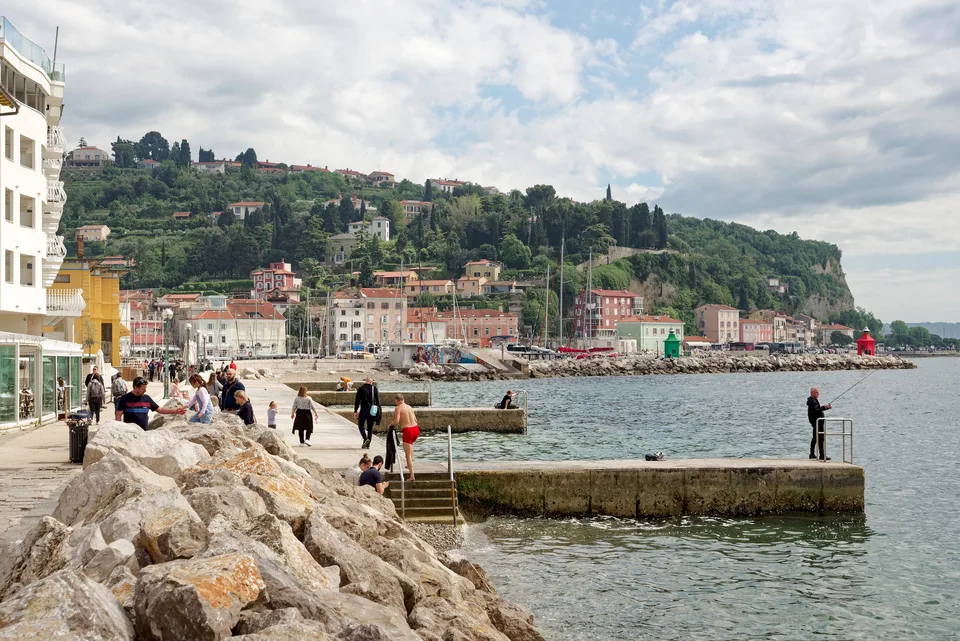
Piran’s waterfront is worth exploring for the changing relationship between buildings, harbour and open sea. Keep working areas, moorings and access routes clear.
For swimming, investigate the actual entry point, surface and conditions. A waterside hotel or a photograph of people beside the sea does not establish a sandy beach, a lifeguard or safe water on the day. Choose somewhere appropriate to your swimming ability and the needs of any children with you.
The Slovenian Environment Agency’s bathing-water pages provide monitoring information for designated sites. Check local notices and present conditions too. Historical classifications are useful background, but wind, waves and temporary warnings need a current decision. If swimming is central to the holiday, compare accommodation by the specific bathing area you intend to use, not the general phrase “near the beach”.
Accommodation and the final journey with luggage
Hotel, guest-room and apartment choices need a little more investigation in a compact old town. Ask about stairs, lift access, air conditioning, reception hours and where you can leave bags before check-in. For an apartment, establish whether the kitchen and laundry facilities are private, shared or absent.
Hotel Piran’s official arrival information provides one concrete example of how access can work. The seafront hotel directs guests to the Fornače garage, offers a parking discount when payment is handled at reception, and advertises a complimentary transfer between the garage and hotel. Confirm the arrangements directly for your arrival time. These are that hotel’s arrangements, not a guarantee attached to every Piran booking.
Compare the final room cost with parking, transfers, breakfast and cancellation conditions. If you require a step-free stay, obtain precise details for both the route to reception and the booked room.
Parking: identify the garage and the tariff
The municipal operator’s parking page lists Arze garage at €2 for each started hour up to ten hours, with a €20 daily charge for parking beyond ten hours. The neighbouring outdoor parking area has a different tariff. Match the signs and location to the entry you read rather than treating every nearby space as the same facility.
Fornače’s permit-controlled parking area is also distinct from the garage used by many visitors. Resident and subscription benefits do not automatically apply to a tourist. The operator says issuance of monthly Arze subscriptions has been stopped because of capacity, which is particularly relevant if you are thinking about a longer stay.
Before booking a room, ask where the car will remain overnight and how you will get back to it. Check whether your host has an arrangement and whether any discount requires a specific payment procedure. For a brief walking visit, calculate parking as part of the outing’s cost rather than discovering it after spending the day in town.
Arriving from an airport or another city
The destination’s airport-access information includes Ljubljana, Trieste and Venice among the choices to compare. They are different airports, with different onward journeys and, in some cases, a border crossing. Compare the complete trip to Piran, including the final connection and the return flight time. A low airfare may leave a costly or inconvenient transfer.
Pre-booked shuttle and private-transfer providers are listed by the tourism board. Obtain a quote for your party, luggage and exact destination, and confirm what happens after a delayed flight. The presence of nearby Portorož Airport on a map does not establish a scheduled flight suitable for your journey.
For bus arrivals, the official getting-here guidance describes connections through Koper and onward Arriva services towards Portorož and Piran. It also distinguishes international services stopping in Portorož from an arrival in Piran itself. Confirm the actual stop and last connection before buying.
Local journeys and the difference between bus networks
Walking is the natural way to experience much of Piran’s historic core. For journeys beyond it, plan around the actual stop, service and destination. A local municipal bus, an intercity service through Koper and a garage shuttle can have different payment and eligibility rules.
The tourism board’s local-bus guide lists €2 per ride with contactless Visa or Mastercard and €1 through the Arriva Piran app or City Card. The card itself costs €3.50; cash is not accepted on municipal buses. Confirm the current tariff before travelling, and distinguish these fares from intercity tickets and garage minibuses.
Keep a payment method suitable for your chosen service and check how any mobile ticket is activated. For a late meal outside Piran, establish the return connection before leaving. Someone considering a move should test the route at commuting hours and during the season in which they will live here, rather than drawing conclusions from a single convenient holiday journey.
Food and shopping with an Istrian connection
The tourism board’s local-products guide highlights Piran salt, olive oil, truffles and other Istrian produce. Ask where a product comes from and how it has been prepared rather than assuming every item sold beside the harbour is locally produced.
Salt-baked fish is one example in the board’s Istrian recipe collection. Its sea-bass recipe uses a salt crust with additional ingredients, illustrating why anyone with an allergy should ask about preparation as well as the fish itself. A recipe is background to the food culture, not an assurance about a restaurant’s kitchen.
Read whether seafood is priced per portion or by weight before ordering, and clarify accompaniments if the menu is unclear. For souvenirs, a small pack of salt or a carefully packed bottle can be more useful than a bulky purchase. Check luggage limits and food-import rules for your destination before buying.
Budgeting without a misleading daily average
Start with your accommodation dates, parking or transfers, and the admissions you genuinely intend to use. Add meals, local journeys and some flexibility. A day spent walking and one built around several paid visits have different costs, so a single citywide daily figure can be a poor planning tool.
The municipality’s tourist-tax information lists a standard combined tourist and promotion tax of €3.13 per person per night. Reduced and exempt categories apply, including a half-rate for the listed seven-to-eighteen age group and exemption for children under seven. Ask your accommodation which category applies to each guest and whether the quote includes it.
At the full rate, two adults staying three nights would have €18.78 in these taxes. Keep that separate from any property-specific cleaning or service charge when comparing bookings. For a longer stay, seek an actual written quotation and clarify its status instead of multiplying a low-season nightly rate into an assumed annual housing cost.
When to visit and what the weather changes
The tourism board’s weather and webcam page is useful for checking the coast shortly before travel. For a swimming-focused break, summer is the obvious season to investigate. For walking and cultural visits, consider spring or early autumn if those dates fit your interests and the venues you want are operating.
Winter can suit a short, quieter cultural stay, but plan around the available services and the possibility of wind or rain. A Mediterranean setting does not guarantee a warm outdoor meal or comfortable swimming on a particular day. Check the forecast again before exposed walks and viewpoints, and respect closures prompted by bad weather.
Pack for the approach as well as the destination: shoes that work on steps and slopes, a sun hat when needed and a layer for changing coastal conditions. On a hot day, move the climbing earlier or later and keep a proper break. On a wet one, choose an open indoor site and shorten the route.
A manageable first day and a flexible second
After leaving your luggage, begin in Tartini Square and choose either Saint George’s area or the town walls as the main climb. Keeping one elevated visit optional makes the day easier for mixed abilities and for anyone arriving tired.
Return to the lower town for lunch and a waterfront walk. Add a museum only if its hours fit comfortably, then leave the evening for a meal and another look at the square. The appeal of an overnight stay is having time for those returns, not needing to fill every hour with another ticket.
On day two, follow your main interest: Tartini’s collection, maritime history or an outing along the surrounding coast. If you want the salt pans, give that excursion its own time for travel and walking. With children, build in frequent breaks and make swimming conditional on a suitable location and conditions. With one day only, keep the square, one viewpoint and the waterfront.
Salt pans and nearby natural places
Sečovlje Salina Nature Park’s visiting guidance distinguishes the Lera and Fontanigge areas and requires an entrance ticket. Decide which part you want to visit before arranging transport. A guided visit needs its own booking arrangements, and a look at working or former salt-making landscapes is a different experience from walking around Piran’s harbour.
The park’s published seasonal prices and opening information list adult entry at €7 from April through October and €6 from November through March. The Saltworks Museum is closed during the latter period, even though park areas remain open under their winter schedule. Confirm current access and choose footwear and clothing for an outdoor visit.
The Fiesa lakes provide another nearby place to investigate, between Piran and Strunjan. Check the route and conditions before setting out on a coastal walk, especially after poor weather.
Moving here means testing the ordinary week
Before taking a lease, spend some of an exploratory stay doing ordinary tasks. Carry groceries along the likely route home, test the connection to work or study, and investigate where deliveries can stop. A view that makes a weekend memorable does not answer those household questions.
The Slovenian government’s tenancy guidance says a residential lease must be written and identifies the important terms, including the property, rent, charges, occupants and duration. Read the agreement carefully, obtain help with unfamiliar wording and establish what happens when the fixed period ends. Check availability across the full year you need rather than accepting a vague promise about later months.
Ask about heating, ventilation, laundry and internet installation. Record meter readings and the property’s condition at handover. Compare homes in Piran with suitable options elsewhere on the coast against the actual commute and household needs. Current written offers are a better basis for that decision than unsupported claims about average rent or universal cheap living.
Residence, work, study and healthcare
The government’s entry-and-residence guidance distinguishes EU citizens’ arrangements from those for third-country nationals. Short visits fall within the relevant Schengen rules, including the ninety-days-in-180 framework where applicable. Working, studying long term and settling require the appropriate status for your circumstances; a tourist booking does not establish those permissions.
For employment, the Employment Service’s single-permit information explains the residence-and-work process for relevant non-EU applicants. Students should confirm their course location and formalities with their institution before choosing accommodation. Use VisaWand’s Slovenia consultant listings to identify advisers if needed, while the authorities decide applications.
Permission to reside and registration of an address are separate enquiries. Ask the Piran Administrative Unit about the documents and procedure for your status. For healthcare, ZZZS’s temporary-stay guidance explains EHIC access to necessary care through public or contracted providers. A move requires checking your own insurance route and any dependants’ cover, rather than relying on holiday arrangements indefinitely.
Other coastal bases worth considering
Compare Piran with Koper, Izola and Portorož if you are deciding where to spend several nights. Prioritise your actual activities, transport and accommodation requirements. A traveller making repeated regional journeys may choose differently from someone who wants to remain in the historic lanes for most of the stay.
For a wider Slovenian trip, Ljubljana is another base to investigate, with the time and cost of changing accommodation included in the comparison. Two well-chosen bases with useful time in each can make a more satisfying journey than repeated packing and brief arrivals.
The Slovenia location directory identifies further places to research. Its entries vary in depth, so follow the relevant official visitor and administrative resources before making decisions. For anyone considering relocation, narrow the choice with a suitable home, a workable commute and a clear legal route, then judge the coastal setting alongside those practical foundations.
Official planning resources
Reviewed 21 October 2026. Use the official resources linked throughout this guide for admission, transport, housing and immigration decisions. Prices, services and rules can change; confirm the details relevant to your dates. Photography illustrates the locations and is not a live view.
View all official resources
- Portorož Tourist Board: Tartini legacy
- Portorož Tourist Board: Saint George church and tower
- Walls of Piran: visitor information
- Portorož Tourist Board: Discover Culture pass
- Sergej Mašera Maritime Museum: opening hours and prices
- Slovenian Environment Agency: bathing-water monitoring
- Hotel Piran: official accommodation and arrival information
- Okolje Piran: parking locations and tariffs
- Portorož Tourist Board: airport choices
- Portorož Tourist Board: arriving by bus
- Local bus routes, fares and parking minibuses — Portorož Tourist Board
- Portorož Tourist Board: Istrian local products
- Portorož Tourist Board: Istrian recipes
- Piran municipality: tourist and promotion tax
- Portorož Tourist Board: weather and webcams
- Sečovlje Salina Nature Park: visit planning
- Sečovlje Salina: opening periods and prices
- Portorož Tourist Board: Fiesa lakes
- Slovenian government: tenancy rights and housing
- Slovenian government: entry and residence
- Employment Service of Slovenia: single residence and work permit
- Slovenian government: registering an address
- Piran Administrative Unit: official information
- ZZZS: healthcare during temporary stays
Plan the next part of your journey
Explore the Slovenia guide, browse other cities or compare consultants for your travel and relocation questions.