Visa
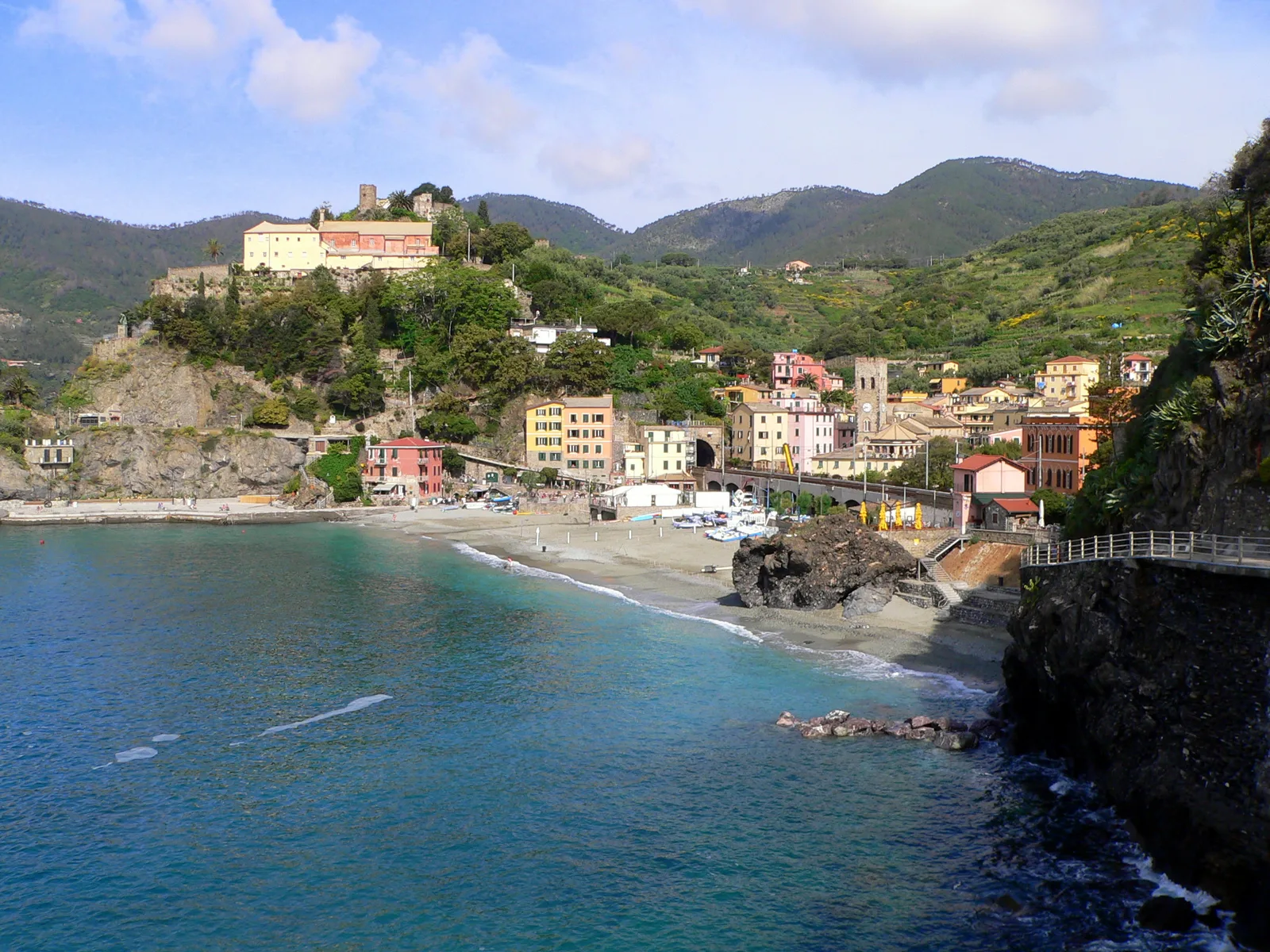
A coastal village worth staying in
Monterosso al Mare offers a useful combination for a Cinque Terre holiday: a historic village, a substantial beach setting and access to the wider coast by rail. It suits travellers who want time beside the sea as well as outings, rather than a different accommodation address every night. Its scale is intimate; plan around a village and its surrounding landscape, not the services or neighbourhood choices of a large city.
The Cinque Terre tourism consortium distinguishes the old village from Fegina, the more tourism-oriented district. That division is a better starting point for choosing accommodation than simply searching for “Cinque Terre”. Decide whether your priority is the older streets, a beach-focused stay or the simplest arrival with luggage, then examine the actual property entrance and route from transport.
Give Monterosso at least one unhurried day of its own. A stay of two or three nights allows a more comfortable balance between village time and regional exploration. If you are investigating a move, add days for ordinary errands and commuting trials. VisaWand’s Italy country guide supplies the national context for those decisions.
The landscape tells the history
The tourism consortium records Monterosso as documented in 1056. Its history is visible in the fourteenth-century church of San Giovanni Battista and in the settlement’s relationship with the sea and hills. The surrounding scenery also has a working history: terraces were made and maintained for cultivation, rather than designed as a backdrop for visitors.
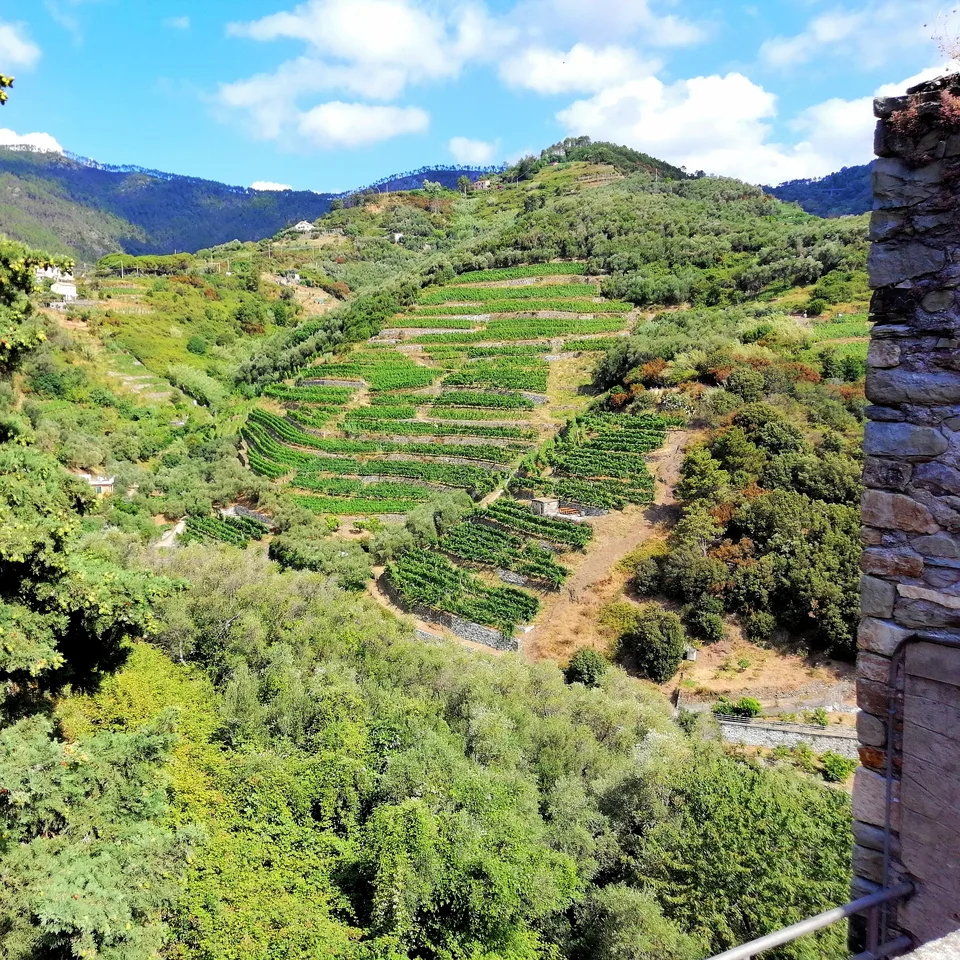
UNESCO’s description of the Cinque Terre cultural landscape explains how communities shaped the steep slopes into stone-walled terraces for vines and olives. It includes Monterosso alongside the other four villages, Porto Venere and the islands of Palmaria, Tino and Tinetto. The World Heritage property was inscribed in 1997. The designation recognises a wider landscape and its settlements, not just a sequence of attractive waterfronts.
UNESCO also identifies the railway built in the 1870s as a turning point in access to an area previously difficult to reach except by sea. Today’s visitor can arrive by train and see the coast quickly, but the terrain remains fundamental. A short distance on a map can involve a demanding ascent; accommodation with a view may require a climb every time you return.
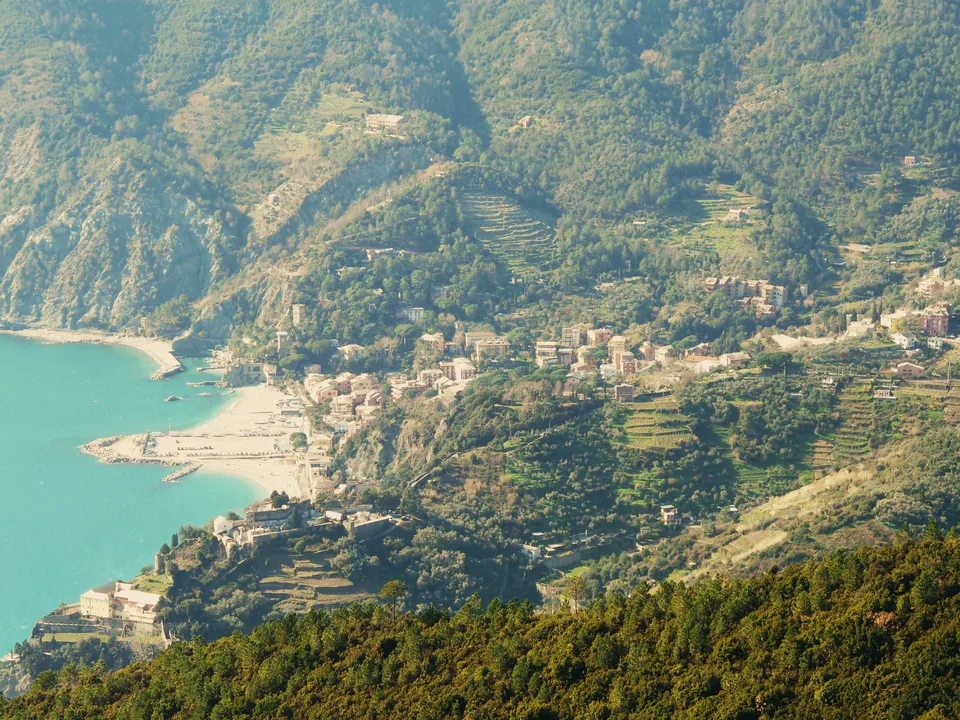
Old village or Fegina: choose your everyday setting
Choose the old village if you want your stay to revolve around its streets and historic buildings. Choose Fegina if the beach setting is central to the holiday. Neither label tells you everything about an individual room. Ask where the entrance is, which floor it occupies and whether the approach includes steps before judging convenience from a map pin.
For a family, compare the whole journey from room to beach and back. A place that looks close across a hillside may involve more effort than a slightly longer route at street level. For a walking holiday, convenient access to the station and somewhere to dry equipment can matter more than an elaborate terrace.
If quiet is important, ask where the bedroom faces and what surrounds the building. If accessibility is essential, request specific information about gradients, stairs, lifts and bathroom arrangements. “Central” and “near the sea” describe location, not access standards. Match the property to the least mobile member of your party, including the person who will handle luggage or push a buggy.
Discover the village before leaving it
Start with San Giovanni Battista and the streets of the old village, then let the walk introduce you to the waterfront. Avoid treating every stop as a timed attraction. The reward here is often the relationship between small spaces, buildings and the hillside rather than a long list of separately ticketed monuments.
In Fegina, the consortium identifies Villa Montale with the Nobel Prize-winning writer’s stays and the Gigante as an early-twentieth-century reinforced-concrete statue that originally supported a shell-shaped terrace. These give a coastal walk a historical focus. Do not assume that a building associated with a writer is a regularly open house museum; establish access before making an interior visit essential.
Leave some time for the ordinary pleasures of a coastal base: a coffee without a departure deadline, browsing food shops and returning to the same area at a different hour. For children or anyone tired after travel, a short orientation walk can be more satisfying than an immediate excursion. Save the longer climbs for a day when the weather, footwear and energy levels fit the route.
Visit the Capuchin hill respectfully
The Capuchin convent provides a different perspective on Monterosso, both physically and culturally. It stands on a hill and remains a religious community. The convent’s own visitor information describes special opening days and guided visits, with personalised appointments available by arrangement. That is a reason to contact the community, not to assume unrestricted daily access to every part of the complex.
The published address is Salita Cappuccini 20. Ask about the proposed visit, language, duration and route if you would like more than an exterior walk. Mention any access needs at the time of enquiry. An invitation to a particular event or retreat does not establish general opening hours for another date.
Allow the ascent to be part of the experience, with time to pause instead of squeezing it between two departures. Dress and behave appropriately for a place of worship, and follow instructions around services and private areas. If an arranged visit is unavailable, the day can still work around the village and coast; there is no need to make entry to a working convent the measure of a successful stay.
Arrive by rail and plan the airport connection separately
The national park’s arrival guidance identifies rail as the natural way into the Cinque Terre, with local services calling at all five village stations on the Pisa–Genoa coastal corridor. Search for the journey to Monterosso itself. Compare the number of changes, arrival time and final approach to the property, rather than choosing a flight solely by its headline fare.
Genoa and Pisa are practical airports to investigate. Trenitalia’s Genova Airlink information describes the Airlink shuttle to Sestri Ponente Aeroporto railway station. For an onward journey outside Genoa, its guidance explains how to purchase a combined ticket using “Genova Aeroporto C. Colombo” as the airport endpoint.
At Pisa, Pisamover (source unavailable) connects the airport with Pisa Centrale. Its published regular operating window is 06:00 to midnight, with a summer extension from June through September. Continue by rail using a journey appropriate to your date; the airport shuttle is only the first leg.
For a late landing, check that the complete connection works after allowing for baggage collection. A final night near an airport may be more practical than depending on the last possible train before an early flight.
Buy the card that matches your journeys
The Cinque Terre Trekking Card and Cinque Terre Train Card solve different problems. The Trekking Card includes specified walking-route access and village bus services, but does not include trains. The Train Card adds unlimited regional rail travel on the covered corridor, which the park’s current service summary defines as La Spezia Migliarina–Levanto. It does not cover every railway journey in Italy or reserved long-distance services.
For adults aged twelve to sixty-nine, the published one-day Trekking Card is €10, rising to €15 on the specified peak days. The Train Card’s one-day adult prices for 14 March–1 November 2026 are €22, €29.50 or €35 according to the calendar band. For 2 November–31 December 2026, the published one-day adult Train Card is €17.30. Do not carry these dated prices forward as a promise for 2027.
A one-day card expires at midnight on its stated day; it is not a rolling twenty-four-hour pass. Compare the journeys you will actually make and the walking access you need. A day spent entirely in Monterosso may require a different purchase from a day involving several village visits.
For the Via dell’Amore, make the required reservation as well as buying the appropriate card. The park describes a one-way visit from Riomaggiore to Manarola, taking approximately thirty minutes. This separate route is not the Monterosso–Vernazza hike.
Ask about the accommodation discount before purchasing
The park offers reduced card rates for guests of participating CETS Phase II accommodation. Participation is the important qualification: an overnight booking anywhere in the Cinque Terre does not automatically entitle you to the discount. Ask the property whether it is included and how eligibility is established before purchasing a standard card.
For the published period from 14 March to 1 November 2026, the adult one-day guest Train Card is €18.70 in band A and €22 in bands B and C. Compare the relevant date and product, rather than assuming a discount percentage applies to every card. Family, child and longer-duration arrangements need their own check.
Choose accommodation on its overall suitability, with the card saving as one factor. A property that saves a little on a pass but creates a difficult daily approach may be the wrong choice. Ask about arrival times, luggage arrangements, breakfast and cooking facilities as well. A clear written response about practical details is more useful than a broad claim that everything is nearby.
Treat the coastal paths as real hikes
The park’s Vernazza–Monterosso trail sheet lists a length of 3.668 km and classifies the route as EE, for expert hikers. Its stated times are two hours in the Vernazza-to-Monterosso direction and two hours fifteen minutes in reverse. These are planning references, not guarantees for every walker. The short distance should not be mistaken for an easy waterfront stroll.
Read the official hiking handbook before setting out. The park requires closed, waterproof, ankle-covering shoes with non-slip soles; open footwear and smooth soles are prohibited. Choose a route for your ability, carry what you need, remain on marked paths and check current accessibility through the park’s information points or trail resources.
Do not build a hiking day around a restaurant booking that forces you to hurry. Allow time for rests, other walkers and changing conditions. Check any temporary direction controls as well as closures: special one-way arrangements have been used on peak dates, and an old event notice is not a permanent rule. A return by train can make a sensible plan when the outward walk is sufficient for your party.
Weather and closures decide the day
The park’s card guidance makes clear that a purchase does not override safety restrictions. Under an orange or red weather alert, trails are closed and card sales are interrupted; yellow alerts can bring limitations. Post-alert inspections may also affect reopening. Check the current position before leaving, rather than assuming that the end of rainfall means a path has been cleared.
For a trip centred on walking, choose dates with flexibility and keep at least one day free of a fixed excursion. For a beach holiday, confirm the seasonal operation of the particular facilities you intend to use. Neither an old photograph of umbrellas nor a hotel description establishes that beach services operate throughout the year.
In warm conditions, avoid making the most demanding part of a walk an unavoidable midday commitment. Carry water and build in a realistic rest. In unsettled weather, switch to a village visit or another appropriate indoor plan rather than searching for an unofficial alternative around a closure. For travel outside the main season, a well-chosen room and reliable transport connection become especially important. For a walking-led trip, start by comparing spring and autumn dates; for summer, give the beach more of the schedule. In winter, prioritise a comfortable room and check seasonal openings before committing.
Eat and shop with the landscape in mind
The park’s local-products directory connects the region’s food with agriculture and fishing. Monterosso salted anchovies, lemons, extra-virgin olive oil, honey, Cinque Terre DOC wine and Sciacchetrà provide a useful starting point for browsing. Look at origin labels and ask about the producer rather than assuming that every item on a souvenir shelf was made locally.
Choose meals according to your appetite and budget. A simple lunch leaves more flexibility for walking or swimming than a tightly scheduled sequence of restaurant reservations. Ask about fish preparation, ingredients and portion sizes before ordering if dietary requirements or cost are important. A named local speciality is not a complete allergy statement.
An apartment kitchen is useful if you intend to shop and cook, but check equipment and storage before relying on it. Buy quantities you can use, especially when moving on the following morning. For food gifts, consider leakage, refrigeration and your destination’s import rules. A small, clearly labelled purchase with a known producer can be more satisfying than carrying home a heavy assortment selected only for its packaging.
Build a budget around the actual stay
Separate accommodation, meals, transport, walking access, beach services and any guided activity. Published card prices can anchor part of the calculation, while rooms and individual excursions require quotes for your dates. For two adults, compare each person’s eligibility and intended journeys before buying identical products automatically.
A hotel may offer staffed arrival arrangements and breakfast; a guesthouse or apartment can have different check-in and housekeeping arrangements. Request the total amount, including mandatory charges, and establish what is paid in advance. Compare cancellation terms alongside price if your main activity depends on the weather.
The municipality’s accommodation-tax service lists exemptions, including residents and children below twelve, as well as specified other categories. It does not provide a clear numerical rate on the service page. Ask the accommodation provider for the applicable current charge and an itemised total rather than relying on an old travel-blog figure.
Keep some contingency for a changed connection or an additional meal. A budget that only works when every path, boat and train arrangement remains unchanged leaves little room to enjoy the place. Saving money is most useful when the underlying plan still suits your party.
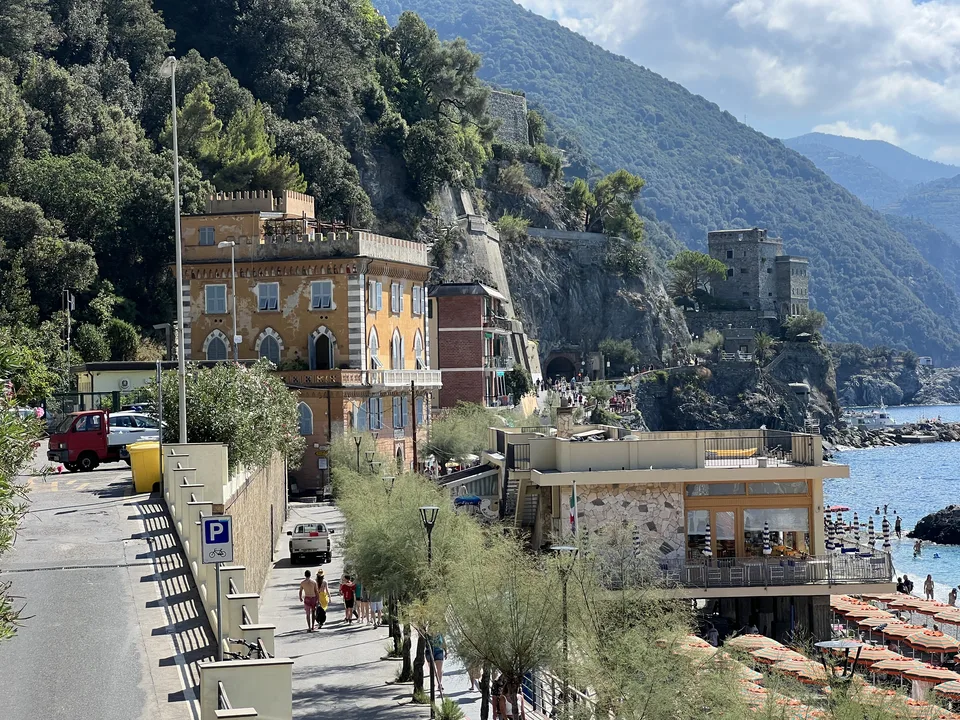
A three-day stay with room to adapt
Day one: settle into the accommodation, find the route between your base and the old village or Fegina, and explore at an easy pace. Include San Giovanni Battista and a waterfront walk. Keep the evening local so the first day does not depend on another connection.
Day two: choose a suitable walking route only after checking access, weather and your equipment. If you choose the Vernazza connection, make the walk the main activity, with time to rest before returning. A non-hiking alternative is a rail visit to another village, leaving sufficient time there rather than trying to collect every stop.
Day three: arrange the convent visit if available, spend more time by the sea if conditions suit, or make one separate regional outing. Leave the final hours uncomplicated if you have a long onward journey.
A seasonal boat outing can show the coast from the water. The park lists sea connections serving Monterosso, Vernazza, Manarola and Riomaggiore. Check the operating timetable and sea conditions, and keep a rail alternative; do not assume every village has a boat stop or that a rail card includes the fare.
With only one full day, stay mainly in Monterosso. With four or more, use additional days for other villages and a different perspective on the coast. This suggested pace is deliberately adjustable: it should survive a cancelled outdoor plan without turning the holiday into a recovery exercise. No itinerary here assumes all trails or seasonal services operate daily.
Living here requires a different inspection
A holiday stay can help you decide whether Monterosso’s scale and setting fit a longer-term life, but inspect housing as a household, not as a tourist. Look at heating, ventilation, damp, cooling, bedroom noise and the practicalities of getting shopping to the door. Test the internet connection for your actual work, including video calls if needed, rather than accepting a general Wi-Fi promise.
Request written rental terms covering duration, deposit, notice, bills and shared charges. Verify the property and the person authorised to let it before transferring a substantial payment. Compare a genuine longer-term tenancy with the complete cost of short-stay accommodation; multiplying a holiday nightly price by thirty is not a reliable market estimate.
The ACAM Acque service information includes Monterosso among the municipalities it serves. Establish who holds the water contract, how charges are allocated and what readings should be recorded at handover. Check electricity, rubbish arrangements and any building maintenance responsibilities separately.
Try the commute you expect to make at the time you will make it, in both directions. The right address must work on an ordinary weekday, including an evening return, not just during a relaxed sightseeing visit.
Check essential services before committing
The municipality lists Farmacia Cinque Terre at Via Fegina 42, with telephone 0187 818391. Its directory asks visitors to contact the pharmacy for opening hours and service costs. Do not assume it offers continuous opening or that every medicine can be supplied immediately. Bring the information needed to discuss regular prescriptions and arrange suitable cover for your stay.
For a move involving children, investigate the actual school arrangements, transport and enrolment requirements before choosing housing. If specialist healthcare, frequent appointments or particular accessibility features are necessary, establish how you will reach them and what support is available. A village directory entry is not evidence of a full range of services within walking distance.
Plan routine shopping as carefully as leisure travel. Walk the route with a realistic load, find out how deliveries reach the address and ask about seasonal opening patterns. A short exploratory rental can reveal whether the setting works comfortably before you undertake a longer commitment. Keep copies of tenancy and service documents, and obtain qualified advice where the legal or financial terms are unclear.
Separate a visit from permission to settle
Check the Foreign Ministry’s Italy entry guidance and the official Visa for Italy database for your nationality, country of residence, purpose and duration. For eligible visa-exempt short visits, the usual Schengen maximum is ninety days in any 180 across the area, not ninety days separately in each country. Tourism permission is not permission to accept employment or settle permanently.
For a qualifying longer stay, identify the correct national route before relocating and follow the applicable residence-permit process after arrival. The visa database describes an eight-working-day obligation for the relevant permit application. Study, employment and family routes involve different evidence; a rental contract or an attractive address does not create eligibility. EU citizens follow different residence formalities and should check the rules relevant to their situation.
Compare nearby bases according to the journeys and services you need. VisaWand’s Levanto location page and La Spezia location page can help place alternatives geographically; browse the Italy location directory and Italy destination page for wider planning. Use consultant listings to identify relevant professional support, checking authorisation and written scope before booking advice.
Official planning resources
Reviewed 17 October 2026. Use the official resources linked throughout this guide for admission, transport, housing and immigration decisions. Prices, services and rules can change; confirm the details relevant to your dates. Photography illustrates the locations and is not a live view.
View all official resources
- Cinque Terre tourism consortium: Monterosso
- UNESCO cultural landscape: Cinque Terre and Porto Venere
- Capuchin Convent official visits
- National Park arrival and transport guidance
- Trenitalia official Genova Airlink connection
- Pisamover official airport–station shuttle (source unavailable)
- Official Trekking Card fares and inclusions
- Official Train Card prices for 2026
- National Park card services and weather restrictions
- Official Via dell’Amore visiting rules
- CETS accommodation guest card discounts
- Official Vernazza–Monterosso trail sheet
- Park official hiking handbook and footwear rules
- National Park local foods and produce
- Municipal accommodation tax service
- ACAM Acque water service area
- Municipal pharmacy directory
- Italian Foreign Ministry entry guidance
- Visa for Italy official application database
Plan the next part of your journey
Explore the Italy guide, browse other cities or compare consultants for your travel and relocation questions.