Visa
Decide how much time Mostar deserves
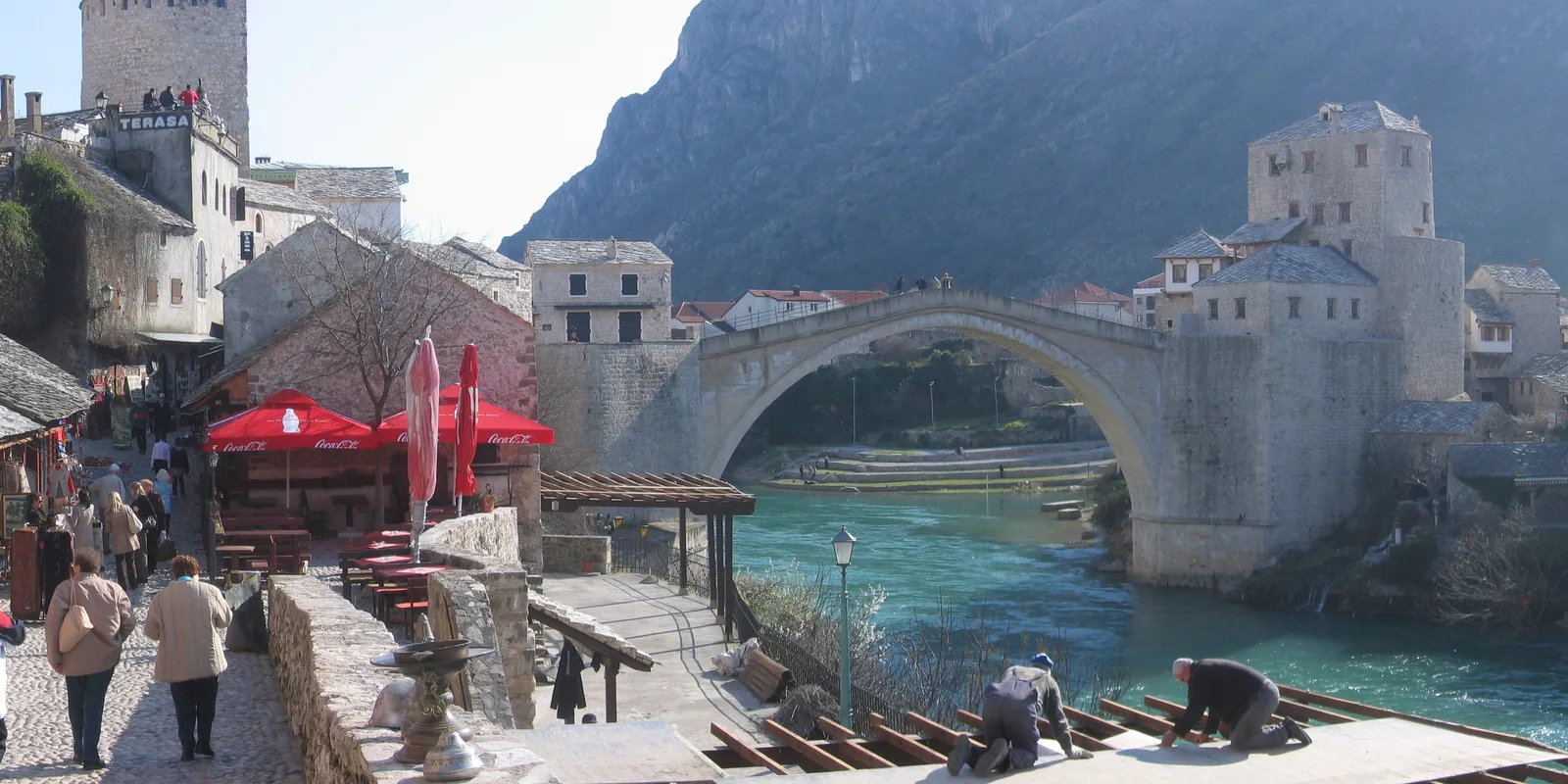
Mostar makes an immediate impression: a stone arch above the Neretva, tightly arranged old-town buildings and hills rising beyond the roofs. The famous view is easy to recognise, but a useful visit needs more than a photograph from the bridge. Stay long enough to explore both riverbanks, understand the rebuilding of the historic centre and see how the visitor area connects with the wider city. Two or three nights give you more flexibility than a brief excursion from another destination.
Choose Mostar for architectural heritage, a compact historic core and outings into Herzegovina. It is less suitable if you require entirely level sightseeing routes or frequent public transport to every rural attraction. Prospective residents should look beyond the old town to the actual journey to work, study and essential services. Begin with VisaWand’s Bosnia and Herzegovina country guide for national context, then use the local distinctions below to decide where to stay and how to organise your time.
Understand the bridge as a reconstruction and a symbol
The UNESCO record for the Old Bridge Area describes Mostar’s development as an Ottoman frontier town and the later influence of the Austro-Hungarian period. Its buildings reflect overlapping cultural and religious traditions. The destruction of the bridge and much of the historic centre during the 1990s conflict is essential to understanding what visitors see today. The reconstructed Old Bridge was completed in 2004, and the area entered the World Heritage List in 2005.
That history changes the meaning of a walk through the centre. Stari Most is neither an untouched survival nor merely a replacement tourist attraction: reconstruction itself forms part of the site’s significance. Take time to learn how the bridge and surrounding buildings were restored. Approach discussions of the conflict with care and listen without expecting a single personal account to represent the whole city. Mostar is a living place whose residents have different experiences, rather than a backdrop for a simplified story of destruction and recovery.
Explore the lanes around Kujundžiluk
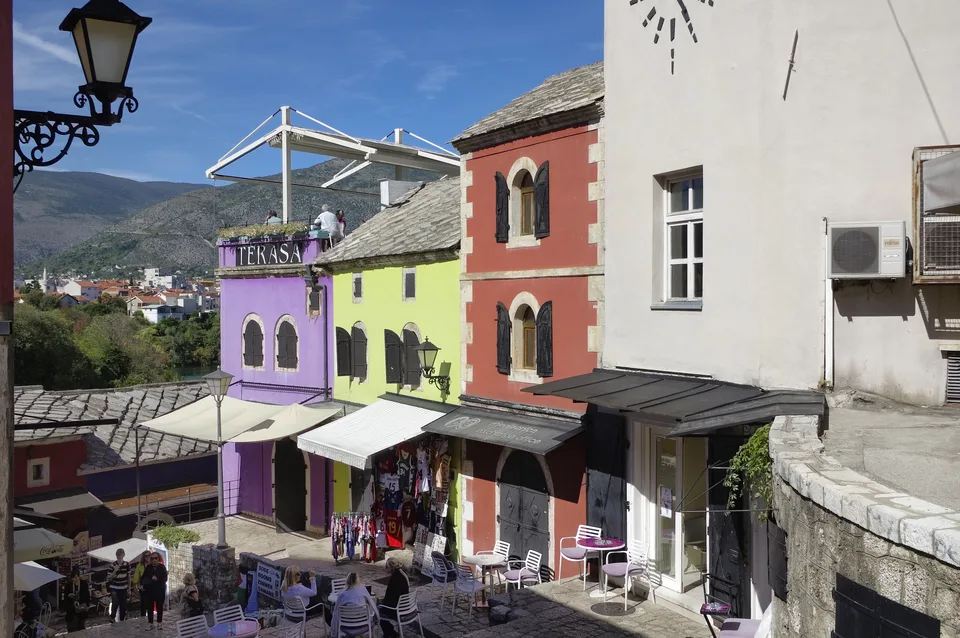
Begin with a gentle circuit through the old-town lanes, allowing the river to remain your reference point. Kujundžiluk provides an introduction to the area’s shops and visitor activity. Compare it with the approaches on the opposite bank, and return at another time of day if your stay allows. A short circuit can take much longer than its map distance suggests once you stop for buildings, views and the practical business of sharing narrow passages with other pedestrians.
Stone surfaces, steps and slopes matter as much as distance. Wear shoes with useful grip, and be especially careful after rain. Travellers using wheelchairs or managing limited stamina should ask about the exact route to each entrance; a property or attraction being close to the bridge does not establish a step-free approach. Keep residential entrances clear and ask before photographing people closely. For shopping, enquire about materials, origin and how fragile items will travel. A souvenir displayed in an old bazaar is not automatically locally made or an antique.
Use the Old Bridge Museum to look more closely
The Old Bridge department of the Museum of Herzegovina occupies the Tara tower complex on the Neretva’s left bank. Its material connects the bridge’s restoration with the development of the town, including archaeological remains and documents. The museum describes an archaeological site below the tower approach and displays on the upper floors, with a viewing area above. This gives the bridge a more substantial context than another circuit of the busiest viewpoints.
Plan around the museum’s own published departmental hours. The Old Bridge department lists daily opening from 10:00 to 18:00 between 1 April and 1 November, with organised visits outside that period. Other museum departments follow different arrangements, so do not assume that one opening time applies everywhere. Confirm the admission charge and access before arrival, particularly outside the main season. Tower floors and the archaeological section may pose different practical questions. If you are travelling with children, choose a manageable visit and leave room afterwards to connect what you have learned with the bridge outside.
Give the smaller bridges and streets some time
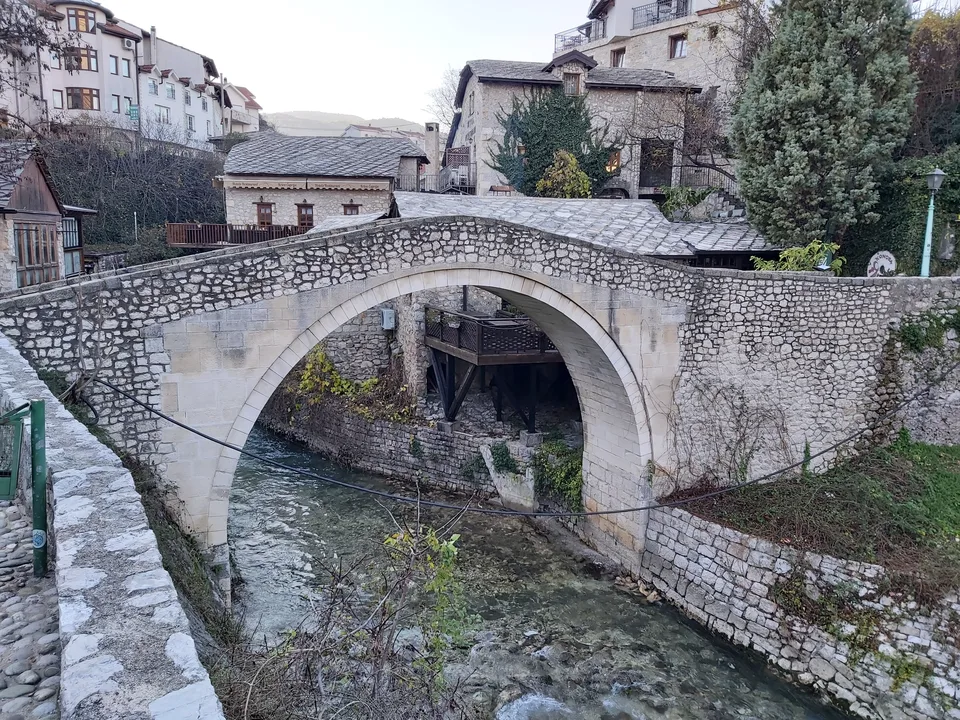
Kriva ćuprija, commonly called the Crooked Bridge, offers a quieter change of scale from Stari Most. Include it in an old-town walk rather than treating every stop as a separate expedition. Smaller watercourses, close-set buildings and changes in street level help explain why a compact map can still involve careful walking. Pause where there is space, and avoid blocking a narrow crossing while arranging photographs.
For another architectural perspective, investigate Koski Mehmed Pasha Mosque. The Herzegovina Wine Route’s heritage description identifies it as an Ottoman mosque built in 1618–1619 beside the Neretva. Check current visitor arrangements directly at the site, including which spaces are open, dress expectations and whether photography is permitted. Worship and local use take priority over sightseeing. No current admission price or minaret access is promised here. Travellers who prefer not to enter can still build an engaging walk around the river, streets and exterior architecture without pursuing every possible viewpoint.
Choose your base by the route to the door
An old-town stay suits travellers who want to walk out for an early look at the bridge or return easily after dinner. The trade-off may be luggage access, stairs and noise from nearby visitor activity. Ask the accommodation provider for the actual arrival route and nearest permitted drop-off. A map pin close to the river does not establish vehicle access, parking or a level path. Request entrance photographs if mobility or heavy luggage makes this important.
Compare that with accommodation towards the railway and bus-station area or the wider city around Spanish Square and Rondo. These are useful reference points for transport and everyday errands, but assess the specific street and your daily destination. A longer walk to the bridge may be acceptable if it provides simpler arrival or a more practical apartment. For a work or study stay, identify the precise institution or workplace first. Do not assume that the location best suited to a weekend visit will also produce the easiest commute.
Compare hotels, guesthouses and apartments properly
A staffed hotel can simplify late check-in and luggage storage. A guesthouse may offer a more personal arrangement, but clarify when someone will be available and how delays should be communicated. Apartments can be useful for cooking or laundry, particularly over a longer stay. Confirm what is actually supplied: a kettle and refrigerator do not establish a kitchen suitable for regular meals. Check cleaning charges, cancellation terms and any applicable accommodation taxes in the full quote.
Ask about heating for a winter visit and effective cooling for summer. Look at the room you are booking rather than assuming every unit has the balcony or view shown in the main photograph. If arriving by car, establish whether parking is reserved, charged separately or located away from the building. Families should confirm sleeping arrangements and any steps between rooms and bathrooms. No reliable single nightly price represents all Mostar accommodation and seasons; compare current offers with equivalent room type, location and cancellation conditions.
Connect the airport journey to your accommodation
Mostar Airport’s official shuttle information lists a commercial service operated by Mostar Bus at 10 KM. It identifies arriving flights from Zagreb, Belgrade, Düsseldorf and Stuttgart, with departures from outside the terminal after arrival. The published route includes the bus and railway station, Spanish Square, Rondo and several hotel stops. Confirm that the service matches your actual flight rather than assuming it meets every aircraft.
Choose a stop by the onward route to your accommodation, not simply by its name. Ask your host whether the final walk involves stairs, difficult surfaces or a long detour with luggage. For an early flight or a journey in the opposite direction, verify the outbound arrangements separately; the arrivals description does not establish a convenient return departure. If choosing a private transfer, request the complete price, passenger capacity and any child-seat arrangements in writing. Keep contact information and check-in instructions available offline in case a delayed flight changes the plan.
Read intercity tickets carefully
Mostar can form part of a wider itinerary by rail or coach, but compare actual dated services rather than assuming both provide the same flexibility. Use ŽFBH’s official timetable and current service information for the railway journey. Mostar is an intermediate stop on the Sarajevo–Čapljina corridor, so a departure listed for a terminal station must not be mistaken for the Mostar time. International services towards Ploče have their own operating-day and seasonal conditions.
The Mostar bus station’s address and passenger information identifies its location as Trg Ivana Krndelja 4. Check the departure point printed on your ticket, the carrier, luggage conditions and any separate fee. For journeys across borders, allow additional time and check entry requirements for each country involved. Keep the final evening flexible if an onward connection is important. A late return from a regional outing should not be allowed to jeopardise a separately booked intercity departure, especially when the next available option would substantially change your itinerary.
Walk centrally and check local buses for longer trips
Much of an old-town visit can be organised on foot, with breaks chosen around heat, gradients and your group’s stamina. For longer journeys, use the Mostar Bus route information to identify the appropriate service and current timetable. The operator lists routes 10 and 12 towards Blagaj, but the route name alone does not establish a frequent service at the time you need. Check the return before leaving the city.
The operator’s published city-zone single fares are 1.80 KM for zone 1, 2.50 KM for zone 2 and 3.20 KM for zone 3. Establish the correct zone and ticket for your destination rather than applying the lowest price to every trip. A taxi or arranged transfer can make sense for a small group or a time-sensitive journey; agree the fare and meeting place. Hiring a car is most useful when it materially improves a regional itinerary. For a stay focused on the historic centre, first consider parking costs and access restrictions.
Eat, shop and manage cash deliberately
Give meals a place in the day rather than treating every café stop as another obligation. Compare the current menu and full price before choosing a riverside table. A good view can be part of the experience, but it does not establish the quality, portion size or value of the food. Ask what accompanies a main dish and whether items are priced individually or by weight. Travellers with allergies should discuss ingredients and preparation directly rather than relying only on translated dish names.
For self-catering, locate an ordinary grocery shop before filling the refrigerator with small purchases from visitor streets. Keep cash in practical denominations for purchases where card payment is unavailable. The Central Bank’s exchange information identifies the convertible mark as BAM; prices are commonly displayed as KM. Its published euro rate is 1 EUR to 1.95583 BAM. That official relationship does not guarantee a fee-free exchange or a particular rate offered by an ATM or private business. Review the amount, currency and charges before accepting a transaction.
Build a budget around confirmed choices
Start with the room quote and the complete arrival and departure journeys. Add meals, local travel, any paid museum visits and the excursions you actually plan to take. The checked 10 KM airport shuttle and city-zone bus fares provide useful anchors, but they are not a complete daily allowance. Where a museum has not published a reliably verified current admission price, leave room in the budget and confirm it rather than substituting a figure from an old travel blog.
If visiting Kravica, include admission, the entire return journey and parking where relevant. Compare an organised excursion with an independent visit by looking at time allowed, inclusions and cancellation conditions. Keep an allowance for a changed connection or unsuitable weather.
Match the season to the kind of visit
The Federal Hydrometeorological Institute’s climate overview explains the Mediterranean influence in Herzegovina and along the Neretva valley. Plan for summer heat and a different winter experience from the colder mountain areas inland. A warm daytime forecast does not remove the need to check evening conditions, wind or rain. For summer walking, start earlier, carry water and choose an indoor or shaded pause when the day is hottest.
Spring and autumn can suit a mixed programme of town walks and excursions, provided you check opening arrangements. Winter may appeal to visitors seeking a quieter stay, but it changes museum access and the practicality of outdoor plans. Take rain protection and footwear that works on wet stone. For a longer rental, assess indoor comfort as carefully as the view: heating, cooling and ventilation can determine whether the place works across seasons. Check the forecast again before leaving Mostar for higher ground or another part of the country, where conditions may differ substantially.
Make Blagaj a separate outing
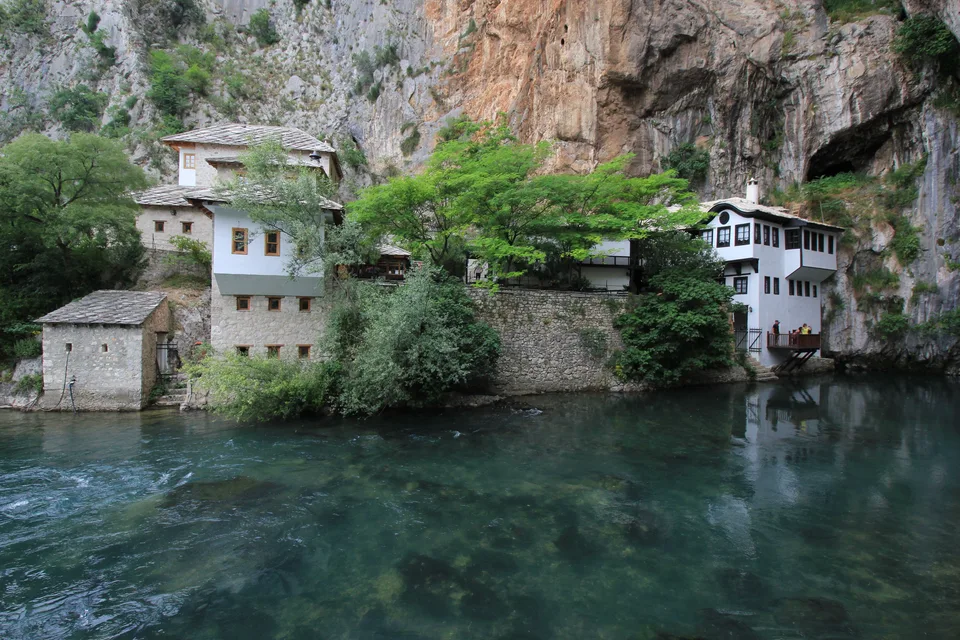
Blagaj offers a different setting, with the tekke beside the Buna spring beneath a high rock face. Give it enough time to appreciate the place rather than fitting it between two timed city visits. The tekke’s own website introduces its religious role, while the published visitor contact page provides opening information and a direct way to confirm arrangements. Treat the listed hours as something to check before travel, especially outside the busiest season. No current admission fee is quoted here.
The tekke remains a place of religious practice. Follow the instructions for clothing, shoes, photography and the spaces visitors may enter. Confirm any guided visit or special arrangement rather than assuming a ritual will be available as entertainment. If travelling by local bus, establish the final walk from the stop and the return departure. With a driver or tour, agree the time you will have on site. A relaxed visit and a meal can be a worthwhile outing without adding several other destinations simply because they fit on a map.
Give Kravica its own transport plan
Kravica waterfall near Ljubuški is another possible day out, with a different journey and visitor arrangement from Blagaj. The operator’s visitor information lists standard adult admission at 20 KM throughout the year; the lower resident price is subject to eligibility. It also lists car parking at 3 KM for each started hour. Opening hours vary by month, so check the current closing time before setting out, particularly when travelling outside summer.
The operator states that swimming is at the visitor’s own risk and warns about falling tufa. Assess conditions locally and follow the rules rather than assuming that a photograph of people in the water establishes safety. Arrange the return journey and allow time to change or dry off if appropriate.
Spend three days at a manageable pace
On day one, settle the luggage and walk the old-town area on both sides of the Neretva. Include Stari Most, the smaller lanes and Kriva ćuprija, with time to rest and eat. Visit the Old Bridge Museum if its opening season and your arrival time allow. Otherwise leave it for the following morning. Keep the first evening flexible after a long flight, coach or rail journey.
Use day two for Blagaj, checking the outward and return connections before departure. Return with time for another look at the river or a relaxed dinner. On day three, choose Kravica or remain in Mostar for the museum, mosque visitor areas and wider-city walking. Travellers leaving that day should favour nearby activities and confirm luggage storage first. With only two nights, remove one excursion rather than compressing every stop. With children or limited stamina, use the same sequence with fewer interiors, shorter walking sections and a longer midday pause.
Test ordinary life before taking a longer lease
A holiday stay does not establish that the same accommodation will work for a semester or year. Confirm the proposed rental period, renewal conditions, deposit and notice arrangements in writing. Establish who has authority to rent the property and whether the address can support the registration and residence documentation you need. Avoid paying a deposit solely on the strength of photographs or an informal message. Seek qualified assistance if the contract language or obligations are unclear.
Compare current offers with similar size, location and duration rather than relying on an unverified citywide rent figure. Ask which bills are included, how utilities are measured and reconciled, and who handles repairs. Record the condition and meter readings at handover. Test the exact commute and the grocery journey, including the final stretch with shopping bags. Check noise, heating, cooling, ventilation and internet performance at the place you would work. Students should ask their actual institution about accommodation options without assuming a room is guaranteed or that every campus is in the same location.
Arrange healthcare and household essentials
Mostar’s University Clinical Hospital provides an official starting point for identifying hospital services, but a household also needs a suitable local doctor, pharmacy and clear insurance arrangements. Confirm who can provide your regular care and how prescriptions will be handled. For emergencies, the UK government’s health guidance for Bosnia and Herzegovina lists 124 for an ambulance and states that EHIC and GHIC cards do not cover the country. Check any applicable arrangements and obtain appropriate cover rather than assuming a card used elsewhere will be sufficient.
For communications, compare current operator terms and test coverage inside the property. BH Telecom’s tourist-package information is one primary source for checking prepaid options and included countries. Do not assume a neighbouring-country or European roaming allowance covers Bosnia and Herzegovina, or that a local regional package includes Croatia. Ask about laundry, waste collection, water and energy accounts before moving in. Families should investigate school admission, language and available places directly. These details determine a workable stay more reliably than a picturesque address.
Separate a holiday from permission to work or settle
Bosnia and Herzegovina has its own entry and residence rules. Check your nationality and documents rather than assuming permission to enter a neighbouring country applies here. The Service for Foreigners’ Affairs FAQ describes a usual visa-free allowance of up to 90 days in a 180-day period for eligible nationals, subject to relevant agreements. It also explains registration duties. Confirm who registers your accommodation and what you must do if the provider does not fulfil that role.
The service’s residence information distinguishes education, employment and other purposes. Paid work generally requires the appropriate work authorisation and approved residence before it begins, subject to legal exceptions; tourist entry is not a substitute. Study, family circumstances and permanent residence require their own assessment. Do not assume buying property or working online automatically creates a right to stay. VisaWand’s Bosnia and Herzegovina consultant listings can help you identify advisers to assess, while official authorities remain responsible for applications and decisions. For a wider itinerary, compare the Sarajevo destination page, Trebinje destination page and country destination directory, checking each page’s actual content before treating it as a completed guide.
Official planning resources
Reviewed 24 October 2026. Use the official resources linked throughout this guide for admission, transport, housing and immigration decisions. Prices, services and rules can change; confirm the details relevant to your dates. Photography illustrates the locations and is not a live view.
View all official resources
- UNESCO: Old Bridge Area of the Old City of Mostar
- Museum of Herzegovina: Old Bridge department
- Museum of Herzegovina: department opening hours
- Herzegovina Wine Route: Koski Mehmed Pasha Mosque
- Mostar Airport: official shuttle bus information
- ŽFBH official 2025/2026 timetable
- Mostar bus station address and passenger services
- Mostar Bus route and timetable information
- Mostar Bus: city-zone single fares
- Central Bank of Bosnia and Herzegovina exchange rates
- Federal Hydrometeorological Institute: regional climate
- Blagaj Tekke – official site
- Blagaj Tekke: visitor contact and published hours
- Kravica waterfall: official visitor prices and rules
- University Clinical Hospital Mostar
- UK foreign travel advice: healthcare in Bosnia and Herzegovina
- BH Telecom: tourist mobile packages
- Service for Foreigners Affairs: stay and work FAQ
- Service for Foreigners Affairs: residence categories
Plan the next part of your journey
Explore the Bosnia and Herzegovina guide, browse other cities or compare consultants for your travel and relocation questions.