Visa
Make time for the capital itself
Tirana deserves more than the interval between an airport arrival and a journey to the coast. Its appeal comes from the proximity of very different experiences: a large civic square, a small historic mosque, a museum about state surveillance, a market lunch and an evening in streets full of cafés. Architecture changes abruptly, and a walk can raise as many questions as it answers.
Three nights give a first visit enough room for central sights and a mountain outing without treating the city as a checklist. For a possible move, add ordinary working days and investigate specific addresses. The National Tourism Agency’s Tirana overview provides geographical context: this is an inland capital near Dajti, not a beach resort, and its wider municipality extends well beyond the visitor centre.
Read the city through changes of use
Tirana became Albania’s capital in 1920. That relatively recent national role helps explain why civic buildings, broad boulevards and modern development are so important to its character. Rather than looking for one perfectly preserved historic quarter, follow the connections between older religious buildings, twentieth-century institutions and contemporary public spaces.
The Pyramid makes those changes unusually visible. Elsewhere, the meaning of a building may be less obvious from the street. Use museum interpretation to understand the communist period, and distinguish documented history from the entertaining story a guide or driver happens to tell. A good city visit leaves time to consider what a place was built for, who could enter it and how people use it now.
Start at Skanderbeg Square
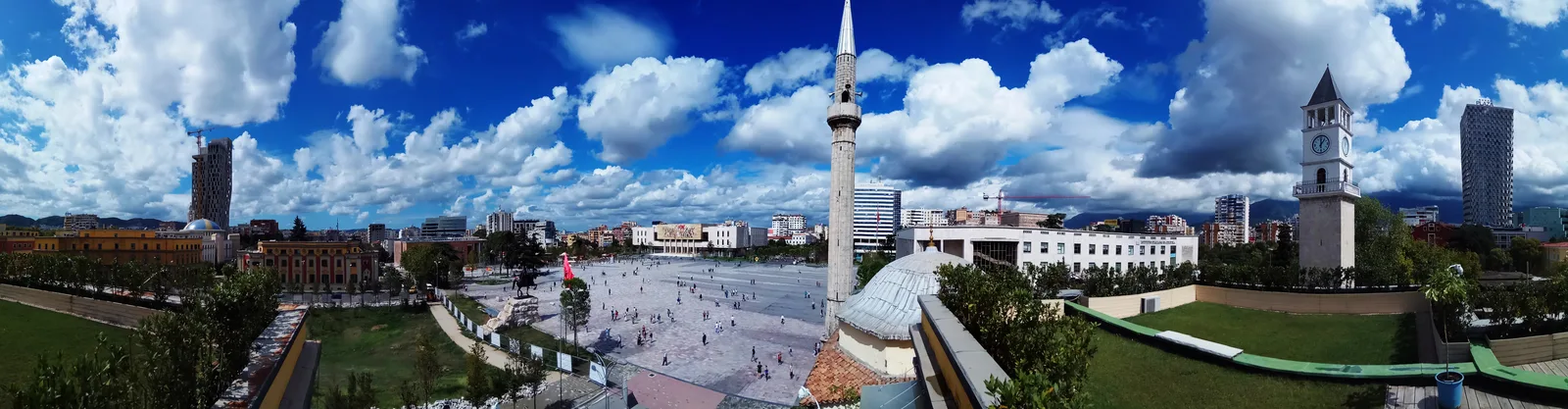
The official Skanderbeg Square page introduces the capital’s principal civic space. Begin here to understand the relationship between the mosque and Clock Tower, the Palace of Culture and the museum façade. Walk across the square as well as around its edges; the open space is part of the experience, rather than simply a route between attractions.
Choose an early or later walk when summer heat makes exposed paving less inviting. Keep an indoor visit or a shaded break in reserve. Events and demonstrations can change access, so do not build an airport connection around the assumption that every central street will remain open. Save your accommodation address and the airport-bus boarding location before heading out on your first circuit.
Visit the mosque with the right expectations
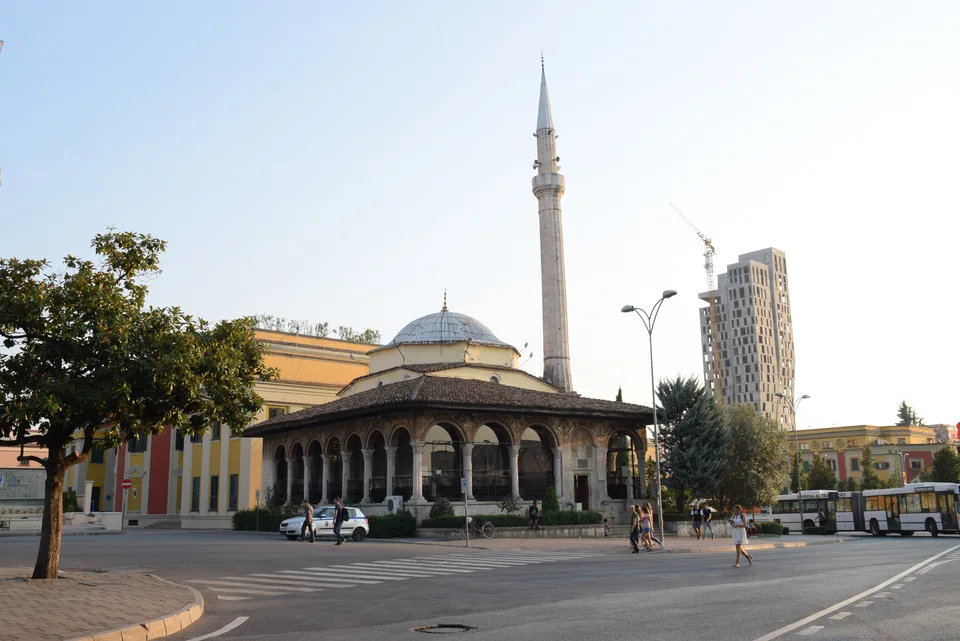
Et’hem Bey Mosque and the neighbouring Clock Tower offer a useful counterpoint to the scale of the square. Approach the mosque as a working place of worship. Ask about visitor access, follow instructions on clothing and shoes, and avoid interrupting prayer. Confirm photography rules before taking pictures of the interior or of worshippers.
Treat a tower visit as a separate decision: check current opening, admission and your comfort with the ascent before paying. Exterior sightseeing still gives you a useful sense of the relationship between these landmarks. There is no need to turn a brief visit into a rigid promise of access to every room and viewpoint, particularly on religious holidays or event days.
Choose your base by how you spend evenings
Around Skanderbeg Square, a central hotel can simplify a short trip focused on museums and walking. Ask about the actual entrance, vehicle drop-off and room position. A central address on a booking map does not establish whether a room faces a quiet courtyard or a busy road.
Blloku suits visitors who want restaurants, bars and cafés nearby. Its history as a restricted area for the communist leadership gives that present-day openness a particular significance. For accommodation, however, the practical question is noise: investigate the street and the room’s position rather than assuming every address in the quarter has the same atmosphere. Stay elsewhere if early nights matter more than having your evening options immediately downstairs.
Use the New Bazaar for a slower morning
The New Bazaar, or Pazari i Ri, combines market activity with places to eat and drink. Give it time before deciding where to have lunch. Look at what is actually on sale, ask the price and quantity clearly, and leave enough room in your bag if you intend to buy food.
An apartment near this area can suit travellers who enjoy shopping for breakfast or preparing an occasional meal. Confirm that a listed kitchen contains the equipment you need. For souvenirs, distinguish locally made goods from imported merchandise by asking about the producer. Food, alcohol and plant products may face restrictions when you return home; check your destination’s rules before buying something that cannot travel with you.
Keep the National Historical Museum out of a guaranteed itinerary
The National Historical Museum remains an important landmark, but an institutional website describing its collections should not be read as proof that the galleries are open. Albania’s public broadcaster reported its reconstruction closure, with a planned reopening in 2028. Treat that as a project timetable, not a guaranteed opening date.
Check the museum’s own information before travelling specifically for an interior visit. UNOPS documents the restoration project, including work on the façade mosaic. The exterior can still help you read the square’s history, but it is sensible to build your museum day around institutions with confirmed access. Avoid booking a tour whose description still promises an ordinary visit to galleries affected by the works.
Give the House of Leaves your attention
The House of Leaves examines surveillance and repression through a very different building from Tirana’s monumental public spaces. Set aside a focused visit rather than adding it between two rushed appointments. Its subject benefits from time with the interpretation and a pause afterwards; it is not simply another unusual interior for photographs.
The museum’s published standard admission is 700 lek. Concessions and free-entry categories require the appropriate evidence. The page’s title mentions opening hours, but its displayed text does not provide a reliable daily timetable, so check directly for the date you intend to visit. Do not assume that a general holiday free-entry list means every visitor qualifies on every listed national holiday.
Decide which Bunk’Art visit fits your interests
Bunk’Art 1 and Bunk’Art 2 are distinct museums in different locations. The Bunk’Art 1 visitor guidance describes an extensive underground bunker on the outskirts, with interpretation covering twentieth-century Albania. Allow at least an hour inside, and longer if you read closely. Bring a light layer for the cooler underground environment, even when it is hot outside.
Bunk’Art 2 is the central option associated with the former Interior Ministry bunker. Choosing it can make sense when your time is concentrated around the square. If you want both, the operator describes a combined ticket valid for 72 hours; verify the current price and conditions when purchasing. Check seasonal notices separately for each museum. An old winter announcement or summer timetable is not sufficient evidence of today’s hours.
See the Pyramid as a contemporary public place
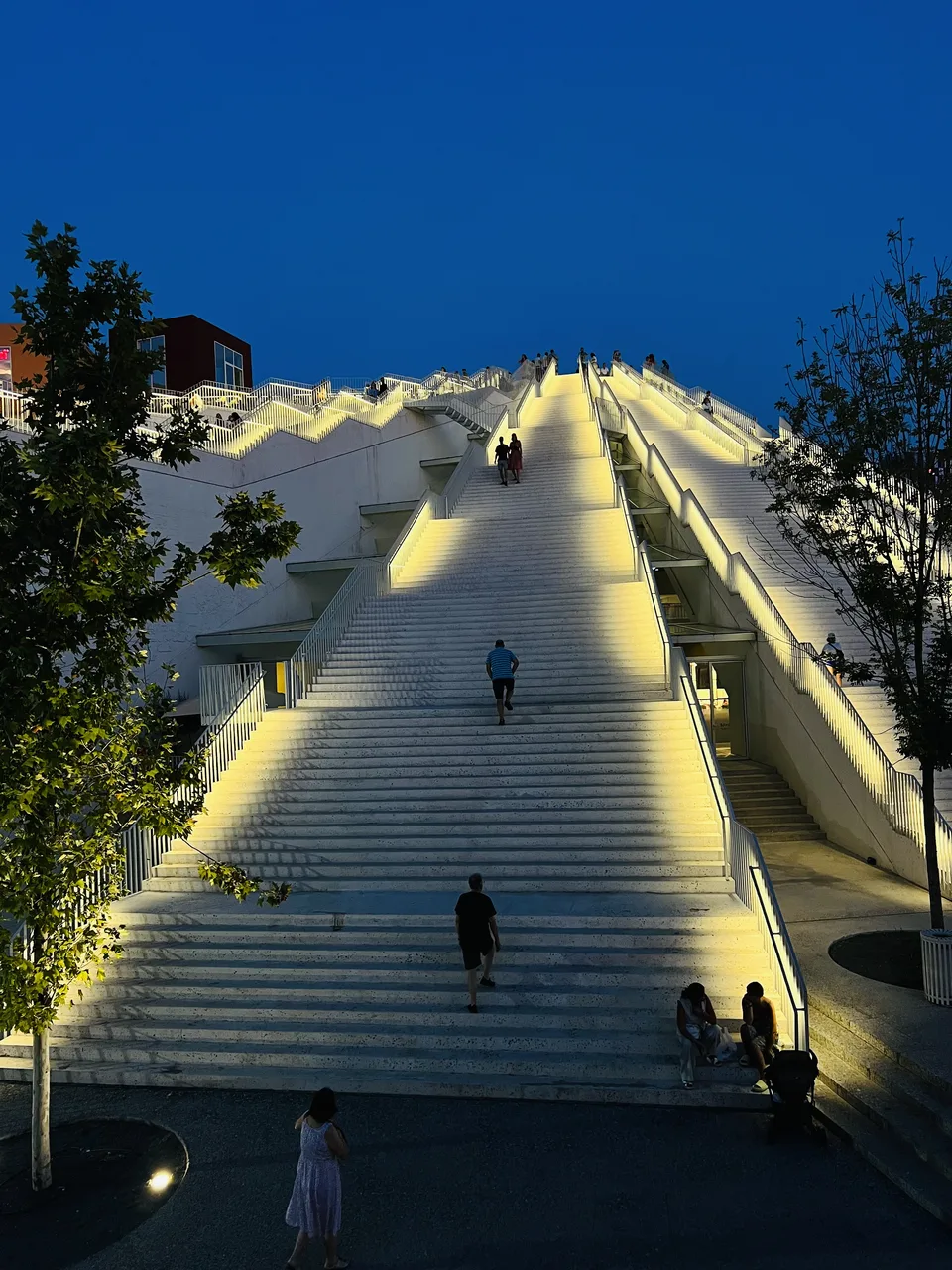
The architect MVRDV’s account of the Pyramid explains its transformation from a museum dedicated to Enver Hoxha into a cultural and educational hub. The completed redesign added exterior steps and spaces for new activities while retaining the concrete structure. It is an unusually direct example of adapting a politically difficult building rather than erasing it.
Use the intended stairs and respect any barriers or temporary restrictions. Do not copy old travel advice about scrambling up the former sloping surfaces. The architect describes a lift for people unable to climb the steps, but confirm that it is operating before relying on it. Public access to the building does not automatically include entry to classrooms, offices or programmed activities.
Leave an unhurried slot for the Grand Park
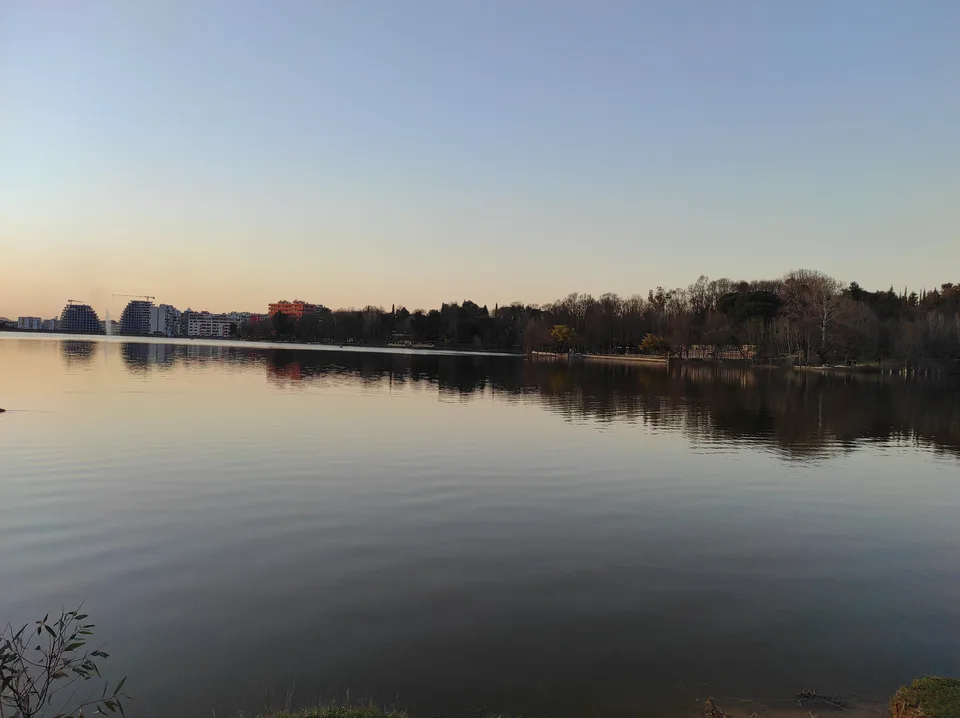
The Grand Park and artificial lake provide a change of pace after central sightseeing. Choose a walk that fits your energy and the available daylight. A shorter route with time to sit is often a better use of a warm afternoon than committing to a circuit simply because it appears on a map.
For a longer stay, investigate homes towards the park alongside more central options. Compare the daily journey to work or university, not just the attraction of nearby green space. Ask where you would buy groceries and how you would return after dark. Regard the lake as part of a recreational landscape; do not assume that attractive water is a designated or suitable swimming place.
Plan Dajti as a weather-dependent outing
Dajti Ekspres requires a journey to its lower station as well as the cable-car ride. The operator’s arrival guidance describes the Qendër–Porcelan bus from near the Clock Tower, followed by an uphill walk. Check the actual boarding point and allow for traffic. A taxi may simplify the journey for some parties, but agree the fare and return arrangements clearly.
The current ticket and opening page says tickets are sold at the lower station and directs visitors to ask for current prices. It lists Tuesday as the usual closing day, with a public-holiday exception, and different weekday and weekend closing times. It also explicitly prohibits wheelchairs on the cable car. Contact the operator if that restriction affects your party. A panoramic excursion should remain optional when weather or access makes it unsuitable.
Arrive on the correct airport bus
Tirana Airport’s official bus information distinguishes two services. The central Tirana route runs hourly, around the clock, with its city stop behind the Palace of Opera and Ballet. The published one-way price is 400 lek, with a separately quoted euro payment amount. Its advertised journey time of 30–40 minutes is an indication, not a traffic guarantee.
A separate service connects the airport with the North and South Bus Terminal. That route has daytime hours and a different fare. It is useful for onward travel but should not be confused with the central-city bus. Read the destination before boarding, and consider the final walk or taxi to your accommodation. For an early departure, work backwards from the airline’s reporting time and leave a sensible margin for the road journey.
Distinguish city transport from intercity departures
Many central sights can be grouped into walking routes, but the outskirts need a transport plan. The municipal public-transport portal provides route resources. Use the route and direction, not only a bus colour, to confirm where you are going. Keep small-denomination cash available and ask about the ticket arrangements for your service.
For journeys beyond Tirana, consult eTransport’s national route information and confirm the exact departure terminal with the operator. Different services do not all leave from the airport bus’s central stop. Check where you will arrive as well as where you depart, particularly if connecting to another bus. If driving, establish a real parking arrangement at your accommodation; do not assume that an available rental car makes every city-centre journey easier.
Eat with an eye on ingredients and portions
Fërgesë is a useful introduction to Tirana’s food traditions, but ask how a particular restaurant prepares it. A dish name alone does not establish whether the recipe contains meat, dairy or another ingredient you avoid. The wider Albanian menu includes tavë kosi and pastries, with considerable variation between kitchens.
Balance a restaurant dinner with simpler meals when you want to control costs. Read the menu before sitting, check what a portion includes and clarify the price of a shared platter. Use a café because you like its setting or coffee, rather than assuming a busy terrace guarantees a particular standard of cooking. For allergies, communicate the restriction directly and establish whether the kitchen can manage it safely before ordering.
Budget in lek and compare total costs
Use Albanian lek for your working budget, and consult the Bank of Albania’s reference exchange rates when comparing currencies. A central-bank reference is not a promise of the rate or fees offered by a card provider, ATM or exchange office. Check the amount you will receive and retain receipts when changing money.
Build your trip estimate from accommodation for the actual dates, airport transfers, meals and selected admissions. Some attractions publish clear prices; others require an enquiry, so do not fill the gap with an old blog quotation. Compare the cost of a cheaper outer address with the transport it requires. For an apartment, check cleaning charges, deposits, cancellation terms and whether advertised facilities are private or shared before comparing it with a hotel room.
As a limited example, two central airport-bus journeys at the published lek fare and one standard House of Leaves admission total 1,500 lek per adult. That is a useful transport-and-museum subtotal, not a daily spending target. It excludes your room, food, local journeys and any other attraction. Keep the calculation in one currency, rather than mixing the operator’s separate euro fare with a bank’s reference conversion.
Pick the season around your activities
Spring and autumn are sensible periods to investigate for a walking-heavy visit. Summer can make the exposed square and longer urban walks tiring, so plan earlier starts, breaks and accommodation with cooling that meets your needs. Ask whether air conditioning serves the bedroom itself, rather than assuming a photograph of one unit covers the whole apartment.
Keep the mountain outing flexible. Conditions above the city can differ from those outside your hotel, and a cable-car timetable does not guarantee clear views. In winter, confirm operating arrangements before leaving town. Look at the current forecast and the event calendar together: a pleasant weather window is less useful if your chosen museum is closed or your route is disrupted by a large event.
A three-day itinerary with room to change
On the first day, orient yourself at Skanderbeg Square, visit the mosque if access allows, and explore the New Bazaar for lunch. Choose one central museum for the afternoon rather than trying to absorb several accounts of repression consecutively. Leave the evening for dinner and a walk in the area where you are staying.
On the second day, explore the boulevard and Pyramid, then continue towards the Grand Park. This is a useful day for a slower pace, particularly after an emotionally demanding museum visit. Add a cultural performance only after checking the actual programme and ticket arrangements.
Use the third day for Dajti and, if its hours fit, Bunk’Art 1. Start with the transport plan and retain a city alternative if conditions change. With only two days, choose between that excursion and a fuller central museum programme rather than compressing everything into hurried transfers.
Test a neighbourhood before signing a lease
For a move, start with temporary accommodation and inspect homes in person. Visit the street during the working day and again in the evening. Test the journey to your own workplace, faculty or school; an address convenient for a visitor’s first weekend may be awkward for an ordinary week.
Ask about contract duration, deposit return, notice and the currency in which rent must be paid. Identify which bills are included and who is responsible for maintenance. Inspect ventilation, hot water, heating and cooling, and look beyond a recently painted wall for signs of a recurring problem. Obtain written agreement about the address documentation your residence application requires. Property ownership, a holiday booking and a suitable tenancy are different arrangements with different practical consequences.
Check the household behind the listing
Test the internet connection in the actual room where you will work. Ask who holds the account and how faults are reported. Check mobile reception as a potential backup rather than assuming coverage from the building’s address. Inspect the lift, entrance lighting, locks and the route from the nearest vehicle drop-off.
For a longer tenancy, ask how water and electricity problems are handled and who can authorise urgent repairs. Record meter readings and the condition of the inventory at handover. Families should test the grocery journey and arrangements for deliveries, rubbish and laundry. If a car is part of your plan, establish whether parking is reserved, shared or only informally available. These details influence everyday comfort more directly than a broad claim that one district is ideal for expatriates.
Arrange healthcare and study independently
For an ambulance, call 127. Review current healthcare guidance and arrange appropriate insurance before travelling. Identify how you would obtain continuing treatment or essential medication, including any prescription documentation you need to carry. A nearby clinic and an insurance policy are not interchangeable: check both the service and how you would pay for it.
Students can begin with the University of Tirana’s current admissions information, then confirm requirements with the specific faculty. Ask about programme language, recognition of previous qualifications, fees and teaching locations. Families should similarly establish school places and language support directly. Admission, housing and immigration permission are separate matters; progress with one does not guarantee the others. Include the actual campus or school journey in your accommodation search.
Separate entry permission from a move
Use the Foreign Ministry’s current visa rules and nationality-specific visa information before making non-refundable arrangements. Conditional exemptions based on another country’s visa or residence document have detailed requirements. Do not assume that holding any Schengen document automatically qualifies you, or that a temporary seasonal concession continues into the following year.
Applications belong on the official Albanian e-Visa portal where a visa is required. A short-stay permission does not establish a right to work or settle. The Interior Ministry’s residence and unique-permit guidance explains purpose-specific procedures, including work, study and family categories. The Labour Inspectorate’s migrant-worker guide is a further resource for employment questions. Confirm the appropriate route, document translations and application steps for your circumstances before committing to a long tenancy. A temporary permit should not be described as permanent residence.
Keep the documentary work separate from the reconnaissance trip. Before leaving home, establish which records must be obtained from your country of origin and whether they require translation, legalisation or an apostille. Ask the relevant authority about validity periods before paying for documents too early. Keep copies of submissions and payment confirmations, and allow time to respond to requests for further evidence. A consultant can help clarify an individual application, but should explain the service, fees and responsibilities in writing rather than promise an outcome.
Choose nearby trips selectively
Kruja offers a coherent excursion centred on its castle, museums and town, while Durrës provides a different coastal and archaeological focus. Check transport and attraction access for the day you intend to go. Do not add distant destinations simply because an operator advertises them as a day trip; the time spent travelling may change the value of the outing.
For broader planning, use VisaWand’s Albania country page and Albania consultant listings. Keep daily decisions informed by current safety advice, particularly around demonstrations and road travel. Avoid active protests, watch belongings at busy transport stops and allow for diversions. Tirana works best when you leave enough time for its public spaces and daily routines, while checking the practical details that determine whether an appealing plan will actually work.
Official planning resources
Reviewed 17 October 2026. Use the official resources linked throughout this guide for admission, transport, housing and immigration decisions. Prices, services and rules can change; confirm the details relevant to your dates. Photography illustrates the locations and is not a live view.
View all official resources
- National Tourism Agency: Tirana
- National Tourism Agency: Skanderbeg Square
- National Tourism Agency: Blloku
- National Tourism Agency: New Bazaar
- RTSH: National History Museum renovation
- National Historical Museum
- UNOPS museum restoration project
- House of Leaves national surveillance museum
- House of Leaves admission and concessions
- Bunk’Art 1 visitor guidance
- Bunk’Art 2 official visitor site
- MVRDV: Pyramid of Tirana
- National Tourism Agency: Grand Park
- Dajti Ekspres transport information
- Dajti Ekspres current tickets and opening rules
- Tirana Airport bus connections
- Tirana municipal public transport portal
- Albania national transport timetable platform
- National Tourism Agency: fërgesë
- Bank of Albania official exchange rate
- FCDO Albania healthcare guidance
- University of Tirana admissions
- Albanian Ministry for Europe and Foreign Affairs visa rules
- Official visa regime by nationality
- Official Albania e-Visa application
- Interior Ministry residence and unique permit procedures
- Labour Inspectorate guide for migrant workers
- National Tourism Agency: Kruja
- FCDO Albania safety guidance
Plan the next part of your journey
Explore the Albania guide, browse other cities or compare consultants for your travel and relocation questions.