Visa

About Arsom Silp Institute of the Arts
A holistic-learning institute in Bangkok
Arsom Silp Institute of the Arts is a nonprofit private higher-education institution in Bangkok. Its origins lie in the experience of Roong Aroon School, whose approach brought art, academic subjects and community life into an integrated form of learning. That experience was extended into higher education when Arsom Silp received permission to establish in October 2006, with support from foundations contributing people, funding and land.
The institute describes its vision as holistic learning for human development and a sustainable society. It organises its work through three specialised academies: architecture for community and environment, holistic education, and social entrepreneurship. Teaching, research, academic service and the preservation of arts and culture are intended to operate together. Its institutional development plan for 2023–2027 places a holistic competency-based curriculum within that framework, connecting professional competence with reflection, values and responsibility to society.
Sources: About the institute ↗
Architecture through community participation
The Academy of Architecture for Community and Environment approaches design through the relationships between people, their surroundings and daily life. Its stated concerns include housing, social and economic conditions, health and the environment. Community participation and cooperation with public and private organisations form part of this approach.
Learning is organised around actual work in professional studios. The academy identifies architectural, community and conservation studios as settings for this activity. Its design principles emphasise genuine usefulness to people and the environment, participation by those involved, simplicity and a relationship with nature. It also brings local and Thai knowledge into architectural design, including tropical and vernacular traditions. In this educational model, architectural study is linked with understanding a place and the people who use it. The academy presents professional development and active citizenship as connected aims of its work.
Sources: Academy of Architecture for Community and Environment ↗
Developing educators and learning environments
The Academy of Holistic Education specialises in learning that supports change both inside and outside educational institutions. It describes degree and other forms of provision for administrators, teachers, education personnel and interested members of the public. Its focus includes educators' own development and their capacity to design meaningful learning experiences.
The academy aims to help teachers create challenging learning situations in which learners participate actively and develop intended competencies. This extends to whole-school development, rather than attention to a single classroom technique. It also describes forums for exchange, social laboratories and networks supporting learning across different stages of life. Real situations and varied learning sites are important parts of this approach. Its work responds to an educational environment shaped by change and uncertainty, with collaboration and the design of learning environments treated as continuing professional tasks.
Sources: Academy of Holistic Education ↗
Social entrepreneurship rooted in place
The Academy of Social Entrepreneurship designs collaborative learning processes across sectors. Its partners include public agencies, academic organisations, communities, civil society, religious groups, businesses and the media. Community challenges provide the basis for learning and for developing responses through participation.
The academy's description recognises several forms of community resources: ecosystems and natural resources, local knowledge, social and cultural relationships, economic activity and local partner networks. Its areas of expertise include the restoration of relationships between soil, water, forests and people. It connects these concerns with Thailand's sufficiency-economy philosophy and locally grounded development. The intended result is social enterprise built from within communities. This gives entrepreneurship a broader meaning than creating a conventional business: it includes collective learning, stewardship of resources and the organisation of cooperation around a place's needs.
Sources: Academy of Social Entrepreneurship ↗
Coffee, land and applied learning in Nan
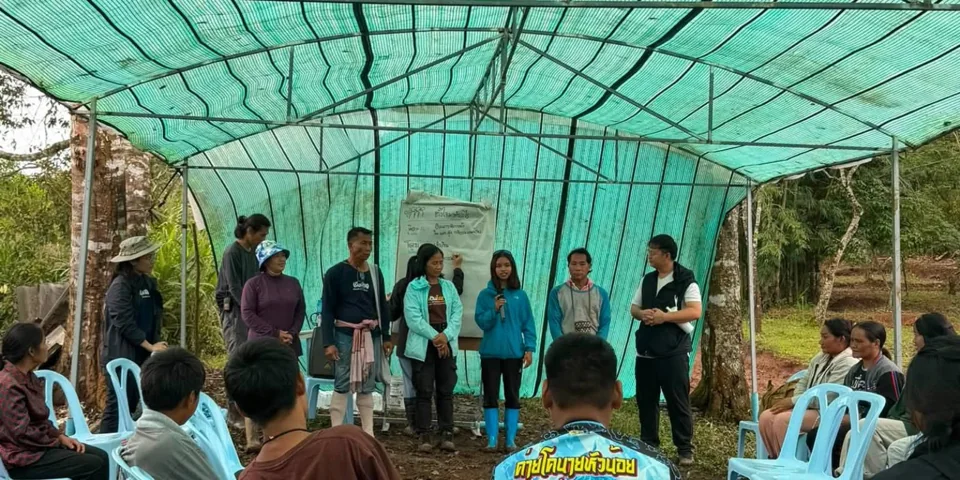
An institute report describes a coffee-learning programme held at Ban Mani Phruek in Nan province on 8–11 August 2026. The Academy of Social Entrepreneurship worked with Gem Forest and community partners to connect coffee production with the management of land, rainwater and forest environments. Participants considered their own agricultural plots and took part in practical learning activities.
The same page describes a non-degree programme on using artificial intelligence and local knowledge for highland agricultural water management. Its modules cover spatial analysis, digital tools such as geographical information systems and sensors, the design of water-system prototypes, and communicating learning through creative media and policy proposals. Field sites, community knowledge and digital information are brought together in its proposed learning sequence. This is a specific example of the institute's effort to turn community challenges into structured educational work.
Sources: Coffee learning and highland-water programme ↗
International exchange about education
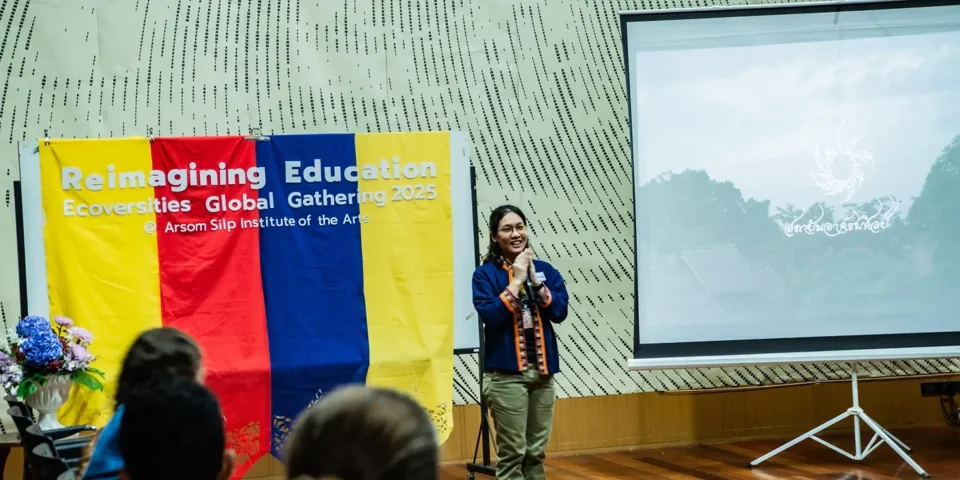
On 6 November 2025, Arsom Silp welcomed participants from the Ecoversities Alliance for a gathering about reimagining education. The institute's account describes a visit to its museum space to learn about its origins, followed by an introduction at the Rabindhorn Building. The programme opened a wider learning journey through Thailand's communities, cultural practices and educational initiatives.
Discussion at the gathering addressed learning through experience and practical activity. It also provided a setting for exchange between the institute's own community-based approach and alternative educators visiting from other countries. The report describes relationship-building and conversation with Ecoversities co-founder Manish Jain. For Arsom Silp, the occasion linked local educational practice with an international network and the possibility of further cooperation. The group’s wider six-day Thailand itinerary also included planned learning visits to Mab Ueang Natural Farming Centre in Chonburi and community networks in other provinces.
Sources: Ecoversities gathering, 6 November 2025 ↗