Visa


About Arrupe Jesuit University
A Jesuit university in Harare
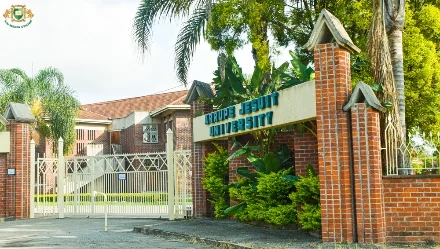
Arrupe Jesuit University is an independent Catholic university in Harare, Zimbabwe, with an international outlook and an educational identity rooted in the Jesuit tradition. Its address is on Link Road in Mount Pleasant. The institution developed from Arrupe College, established in 1994 for philosophical and humanistic education, and takes its name from Pedro Arrupe. Its historical account records associations with the University of Zimbabwe and the Pontifical Gregorian University from 1996. A provisional charter followed in December 2017, the university's inauguration took place in February 2018, and its final charter was received in May 2020. The university describes intellectual ability, compassion, conscience and service as central to its mission. Excellence, accountability, service and innovation are the values it identifies in its institutional statement.
Sources: History and mission ↗
Philosophy within the humanities
AJU's four-year philosophy honours degree places philosophical inquiry alongside other approaches to understanding human life. The programme begins with African contexts and develops a wider international perspective. Its published description brings together African and world history, literature, religion and the social sciences, as well as philosophy itself. Sociology, anthropology and psychology contribute different ways of examining human experience. Students also encounter statistics, information technology and some theology. The range of electives described by the university varies by year; examples include African literature, environmental questions and artificial intelligence. This structure gives philosophy a clear disciplinary focus while connecting it with questions discussed across the humanities. The programme presents this breadth as a means of developing philosophical thinking about people, society and how people should live.
Sources: BA Honours Degree in Philosophy ↗
Information technology and practical problems
The honours programme in Information and Communication Technology combines computing with an interest in management, leadership and entrepreneurship. Its academic description emphasizes mathematics, analysis and programming, together with web design, systems programming and software development. Computer and mobile networking and communication technologies also form part of its stated scope. Alongside technical knowledge, the programme addresses the social and business skills involved in delivering information effectively. AJU presents the course as practical and grounded in critical analysis, with attention to professional and ethical responsibilities in developing and maintaining computing infrastructure. Its stated educational aim includes using sustainable information technology to address problems in businesses, government, education, medicine and everyday life. Creativity and innovation are therefore treated as part of the programme's approach to applying technical skills.
An approach to inclusive education
The university also describes an honours degree in Inclusive Education. Its overview centres on making academic and social development accessible to children with different abilities, backgrounds and learning needs. Rather than assuming that a single teaching approach suits every learner, the programme's educational rationale favours adaptable methods that respond to individual students. It recognizes differences in learners' strengths, experiences and challenges. Diversity, equity and inclusion are presented as principles that can improve the educational experience across a classroom. The university links this approach with reducing discrimination, barriers and stereotypes in education. Its published programme page distinguishes two-year and four-year study options with different prior-qualification requirements, allowing the description to address both existing education diploma holders and applicants entering through school qualifications.
Sources: Inclusive Education ↗
Community service as part of education
Community engagement has a long place in the institution's account of student life. AJU traces its service programmes to 1994, the year Arrupe College began. Its overview describes activities ranging from teaching children and assisting community food provision to work with refugees and high-school teaching in Zimbabwe, Zambia and Malawi. These examples describe the programme's historical range rather than a promise that every activity is offered in every year. The university's published service page states that students must complete 100 hours of service before graduating from its degree programmes. By incorporating service into degree requirements, AJU connects academic study with direct involvement in communities and with the responsibilities that accompany its educational mission.
Sources: Service Programs ↗
Developing ideas through the Innovation Hub
AJU's Innovation Hub operates through its Directorate of Research, Innovation and Industrialisation, with oversight from a corresponding university committee. Its description connects teaching and research with the development of practical responses to social and economic challenges. Students and staff are encouraged to bring ideas forward, refine concepts, develop prototypes and consider potential users or collaborators. The hub describes training and mentorship in areas such as creative problem-solving, design thinking, entrepreneurship, presentation and intellectual property. It also encourages collaboration between disciplines and links with industry, civil society and other research organizations. Business incubation centres are described as an envisaged development, rather than an already completed network. The wider framework sits within the university's 2024–2029 strategic plan and its commitment to applying knowledge through innovation.
Sources: Innovation Hub ↗
An example of international exchange
An August 2026 university report illustrates another aspect of AJU's educational outlook. It records Social Work student Zoe Demanyundo's departure for Spain through the MAGIS Exchange Program. The report connects that opportunity with cross-cultural collaboration and learning beyond Zimbabwe. AJU describes international exposure as part of its Social Work curriculum's preparation for engagement with wider professional contexts. This individual example adds a concrete dimension to the university's international identity, alongside the local community involvement described in its service programmes.
Sources: MAGIS exchange report, August 2026 ↗