Visa
About Anton de Kom University
Humanities within a Surinamese university
Anton de Kom University, known in Dutch as Anton de Kom Universiteit van Suriname and abbreviated AdeKUS, is based in Paramaribo, Suriname. Its university campus address is Leysweg 86. The Faculty of Humanities brings language, history and cultural study into this university setting, connecting academic inquiry with questions relevant to Surinamese society.
The faculty’s introduction describes work in language, cultural studies and history. Its language and communication programme places independent study, a research-minded attitude, social engagement and critical thinking among its educational priorities. Dutch language is considered across different areas of use, with preparation for further academic study and communication-related work. The faculty’s published programme table includes history, language and communication, and culture, policy and diversity at different study levels. This combination places the study of language alongside historical understanding and the ways culture interacts with public life.
Sources: Faculty of Humanities ↗
Botanical collections and research
The National Herbarium of Suriname is part of the university’s research environment. Its collections include dried plant specimens, preserved flowers and fruits, wood samples, fungi and mosses, together with botanical publications. The institutional history records the movement of the forestry-service herbarium to the university in 1979, incorporation of the CELOS herbarium, and adoption of the National Herbarium name in 1980.
The herbarium’s work includes collecting and preparing plants, identifying specimens, maintaining botanical names and recording information in digital systems. It contributes data to GBIF and provides a setting for studying Suriname’s plant diversity. Its services include specimen loans, support for visiting botanists and the distribution of duplicate specimens. Educational activity uses collections to illustrate plant structures, families and locally occurring economic plants. Students also receive guidance in research projects. These functions connect the preservation of botanical material with identification, documentation, teaching and wider biodiversity research.
Sources: National Herbarium of Suriname ↗
Developing teaching and evaluating learning
The university’s Quality Assurance Department works on educational policy and the development of an internal quality system across the institution. It also supports faculties in external accreditation processes for academic bachelor’s and master’s programmes. The department describes course evaluations, other evaluation studies and internal audits as tools for monitoring and improving education.
Staff development forms another part of its role. The Docent Professionalisering Onderwijs training pathway develops teaching competencies concerned with organising, carrying out and evaluating educational tasks. The department also provides training in the use of electronic learning environments, including AdeKUS StudentSpace. Its published services therefore bring together policy, evaluation and practical support for teaching staff. The emphasis is on processes that help faculties examine their educational work and develop how it is delivered, alongside the digital environments used to support learning.
Research and education concerning children’s rights
The University Institute for Children’s Rights was officially proclaimed on 1 November 2002 and is situated within the Faculty of Law. Its mission concerns strengthening the rights of children as individuals, members of society and citizens of the wider world. The institute identifies scientific research, knowledge development and specialised training among its purposes.
Its published activities include courses that support the implementation of children’s rights and research involving both students and lecturers. Interdisciplinary and multidisciplinary inquiry, scholarly publications, workshops, seminars, lectures and public information also form part of its account. The institute connects this work with the implementation of the Convention on the Rights of the Child and with national youth policy. This provides an example of a university unit linking a defined area of legal scholarship with education and public engagement, while involving students and academics in the development and communication of knowledge.
Graduate education across disciplinary boundaries
Interfaculty Graduate Studies and Research, or IGSR, was established on 9 March 2023 within the university’s organisational structure. Its introduction distinguishes this interfaculty unit from the Institute Graduate Studies and Research foundation created in 2006. The transition brought the graduate-study and research organisation into a faculty-based university framework, with accommodation in the Staatsolie building.
IGSR describes its role as offering interfaculty graduate and postgraduate education together with multidisciplinary research and services. Its published programme table includes applied statistics, finance and control, research methods and preparatory academic study. The unit’s mission connects advanced education with applied research addressing social questions. It also identifies scholarly publications, scientific presentations and participation in international research groups as ways of contributing to academic knowledge. Work commissioned by outside organisations is described as drawing on expertise from several disciplines and faculties, linking the university’s research capacity with needs beyond the institution.
Research discussed with a wider audience
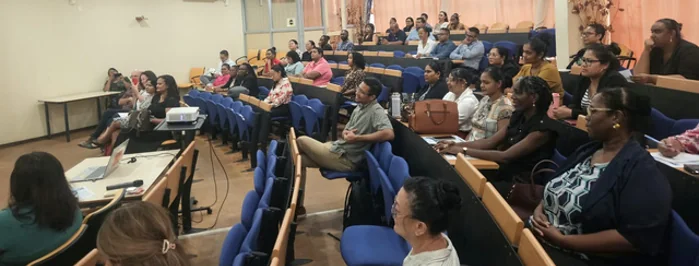
A university report published on 2 November 2026 describes an IGSR networking event associated with Caribbean Statistics Day 2026. The gathering brought together students, lecturers, researchers and representatives from professional settings around the relationship between data, research and practice. Master’s students in Applied Statistics, Research Methods and Chemical Sciences presented research proposals and results.
The topics ranged across economic developments, insurance, health, parenting and approaches to optimisation using data. The event was intended to make student research more visible and create opportunities for feedback, discussion and continuing cooperation. Contributions from academic staff accompanied the student presentations. A concluding poster session allowed participants to speak directly with presenters about their work. This offers a concrete example of graduate education extending beyond taught courses, with students explaining research to other researchers and people working outside the university.
Sources: Graduate research networking event, November 2026 report ↗