Visa


About Andean Simón Bolívar University, Ecuador
Postgraduate education in Quito
Universidad Andina Simón Bolívar, Sede Ecuador is the Quito institution represented by the directory name Andean Simón Bolívar University, Ecuador. Its campus address is Toledo N22-80, Plaza Brasilia. The wider university was created in 1985 within the Andean integration framework, while its Ecuador presence was established in 1992. The Ecuador institution began postgraduate courses in 1993, graduated its first cohorts in 1995 and opened its first Quito campus building in 1996. Doctoral programmes began in 2000.
The institution’s academic purpose centres on the Andean region, its cultures, history, development and integration. International cooperation is part of that mission, linking study of the region with wider Latin American and global questions. The Andean Community’s institutional profile separately identifies the Quito and Sucre locations, helping distinguish the Ecuador campus from the university’s Bolivian presence.
Sources: Institutional history and postgraduate mission ↗ · Andean Community institutional profile ↗
Research connected with teaching and society
The university describes research as connected with academic programmes, training and engagement with the wider community. Its policy supports disciplinary work alongside multidisciplinary, interdisciplinary and transdisciplinary approaches. Research groups are intended to connect these different forms of inquiry with the institution’s educational aims.
The Research Committee provides institutional direction for this activity. Published strategies include joint projects with other institutions, workshops and academic chairs that encourage focused debate, and closer connections between research and teaching. A research fund supports projects by faculty members and graduates of master’s and doctoral programmes. International networks and strategic partnerships form another part of the framework.
The policy also identifies documentary collections, computing, laboratory, publishing and administrative resources as supports for research. Dissemination through printed and digital publications is included, connecting the production of knowledge with its circulation among academic and wider audiences.
Library collections and digital access
The Information Centre and Library occupies three floors of the Eugenio Espejo building. Its facilities include reading areas, individual and group work spaces, multimedia rooms, sound resources and specialist collections. Open shelves support consultation, while borrowing and interlibrary loans provide other routes to materials.
Its research collections include the Juan García Salazar Afro-Andean Documentary Collection, alternative-media materials, a multimedia collection associated with social movements, recorded Ecuadorian voices and testimonies, and a classical-music collection. The library presents these documentary holdings as primary material for studying Ecuador and the Andean region.
The Koha library system supports catalogue searching, reservations and circulation. UASB-Digital provides open access to institutional research outputs, including master’s and doctoral theses, publications, journals and research reports. The library also offers access to subscribed databases and open resources. Individual and group training sessions help users work with its digital information tools.
Sources: Information Centre and Library ↗
Buildings for academic and residential life
The Quito campus has operated in purpose-built facilities since 1996. Its buildings combine teaching, research, residential and cultural functions, with Andean identity expressed through paintings, textiles, craftwork and other artistic features. The Mariscal Sucre building houses classrooms, academic offices and meeting rooms, together with the Paraninfo auditorium.
The Paraninfo is used for academic and cultural occasions, including graduations and international events. Its equipment supports sound, recording, projection and simultaneous interpretation. The university also makes the space available for academic activities organized by other institutions.
The Manuela Sáenz building contains university accommodation, dining and shared living and study spaces for visiting teachers and students. The José Joaquín de Olmedo building includes the bookstore, teaching rooms and meeting facilities. Eugenio Espejo houses the library, computing facilities, academic offices, classrooms and exhibition or meeting spaces. These different buildings bring several aspects of postgraduate university life together on the Quito campus.
Sources: The Quito campus ↗
Education as an academic field
The Education area combines teaching and research with discussion of educational processes and problems in Ecuador. Its academic interests connect science, technology and education with university teaching, learning processes, and approaches to reading and writing. It also identifies popular education, competency-based education, knowledge and new media as subjects of inquiry.
The area’s research lines cover educational technologies; teacher education and educational management; and relationships between education, social sciences and humanities. These lines include questions about curricula, pedagogy, learning environments, educational innovation and the social settings in which education takes place.
Its published programme portfolio includes doctoral study, research master’s degrees, professional master’s degrees and specializations. Examples concern educational research, innovation, digital competencies, technology-supported teaching and educational policy. Publications and the Revista Andina de Educación provide routes for sharing academic work. The area also describes continuing education and activities intended to connect its scholarship with teachers and educational communities.
Sources: Education academic area ↗
A documented meeting with civil society
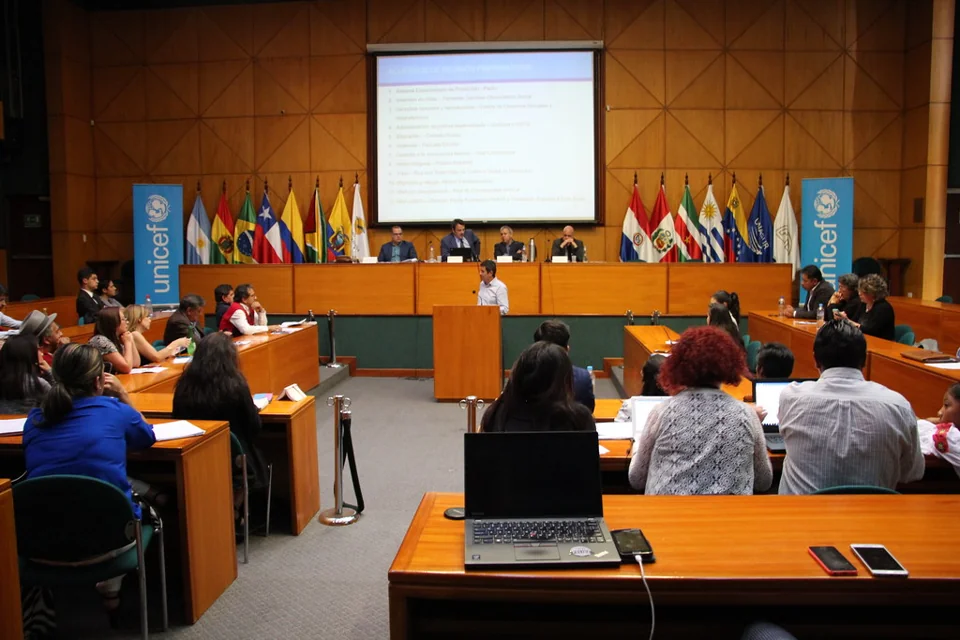
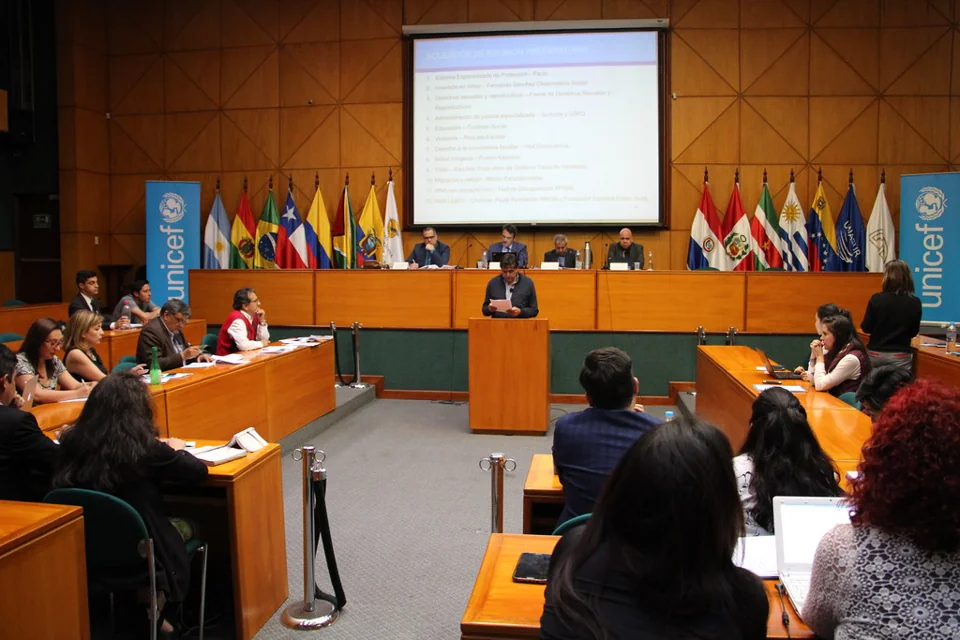
UNICEF Ecuador documented a discussion with civil society held at Universidad Andina Simón Bolívar in Quito on 14 December 2017. Its account identifies participation by members of the Committee on the Rights of the Child, alongside UNICEF representatives. The photographs record participants meeting in a university auditorium, with presentations and discussion taking place around the room.
This historical event provides a specific example of the campus hosting dialogue involving an international organization and civil society. It complements the university’s description of its auditorium as a venue for academic and institutional gatherings. The accompanying images are dated records of that meeting and show the venue as it appeared in 2017.
Sources: UNICEF: civil-society discussion at UASB, December2017 ↗