Visa
About American University of the Middle East
A university in Egaila, Kuwait
The American University of the Middle East, commonly known as AUM, is a higher education institution established in Kuwait in 2005. Its campus is in Egaila, also rendered Al Uqaylah. The university offers undergraduate and graduate education through the College of Engineering and Technology and the College of Business Administration. A Liberal Arts Department and an English Preparatory Program form additional parts of its academic structure.
AUM’s institutional overview describes an Engineering Research and Innovation Center encompassing robotics and artificial intelligence, nanotechnology and engineering capstone work. A Business Innovation Center includes consulting and capstone facilities, together with spaces associated with finance, human resources, accounting, marketing, management information systems and entrepreneurship clubs. These centres sit alongside a broader system of educational support that includes a Writing Lab, Academic Advancement Center, Tutoring Center and Tawteen Career Center. The university presents this combination of disciplinary teaching, practical facilities and student support as central to its learning environment.
Sources: AUM institutional overview ↗
The relationship between theory and practice
AUM organises its educational philosophy around four interdependent components. Foundations and theories address conceptual understanding and analytical thinking through teaching, digital learning and assessment. Applied and experiential learning connects that foundation with projects, problems and practical experience in classrooms, laboratories, workshops, specialist centres and internships. The university describes these settings as ways to apply knowledge to real challenges.
A third component concerns communication, teamwork, leadership, adaptability and continued learning. The fourth combines research, innovation and entrepreneurship through inquiry, applied projects and faculty mentorship. Two principles run across the framework: sustainability and global perspectives, and ethics and integrity. The former includes intercultural awareness and environmental and social responsibility, while the latter emphasises accountability and responsible conduct in academic, professional and personal life. This framework explains the university’s intended relationship between subject expertise, practical work and broader personal development, rather than treating them as separate educational activities.
Sources: Learning and educational philosophy ↗
Campus facilities and student participation
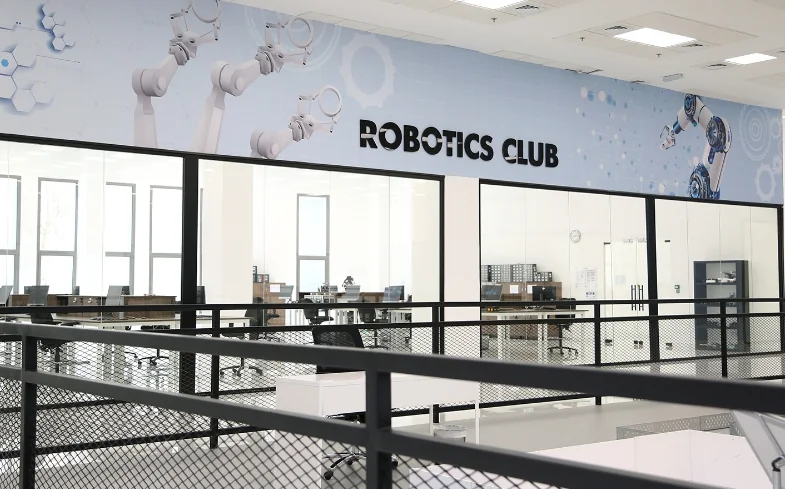
The campus brings together buildings for business administration, engineering and technology, a dedicated library and a sports centre. The Cultural Center includes an opera house and a conference centre. Landscaped outdoor spaces, cafeterias and parking facilities accompany the teaching and activity areas. The university describes its campus as a combination of green and urban spaces, with several entrances and exits supporting movement around the site.
Student participation includes business and engineering societies whose representatives are elected to serve the wider student body. Clubs provide another setting for people with shared interests to meet, with examples including art and design, robotics, music and photography. Indoor and outdoor sports facilities support recreation and university teams. Campus information also identifies accessibility, special-needs services, safety and emergency resources as parts of its provision for the university community. These facilities and activities complement the spaces used for scheduled classes and practical academic work.
Sources: Campus life and facilities ↗
Print and electronic learning resources
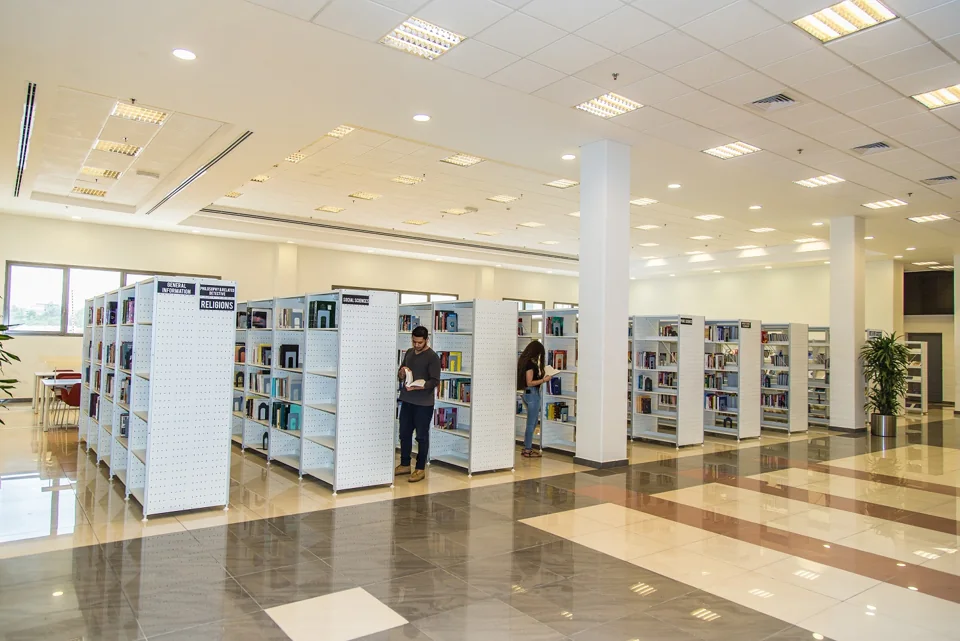
The AUM Library provides a gateway to print and electronic resources. Its book section covers subjects taught at the university, with material in mathematics, engineering and technology alongside a reference collection. Periodicals include printed and electronic journals and magazines, including peer-reviewed publications. The resource description distinguishes these from other digital collections and research tools.
Electronic provision includes databases of academic articles and conference proceedings, electronic books and reference works, and services for finding citations and abstracts. Video databases and other research platforms extend the range of formats available. Students can use the Online Public Access Catalog to search library holdings and check whether particular items are available. Personal library accounts show borrowed items and overdue materials. The catalogue and associated resource services therefore support both finding information for coursework or research and managing the practical details of borrowing library material.
Sources: Library resources ↗
Borrowing, reservations and library guidance
Library services include issuing, returning, renewing and reserving material, together with reference assistance. Staff offer instruction and orientation sessions to help students and faculty use the collections and facilities. These services connect access to resources with guidance on how to find and work with them.
Group study rooms can be booked through the library’s reservation system or through tablets beside the rooms. Access is linked to university identification cards, and rooms in the designated loud zone include interactive touch screens. The library also describes off-campus access to digital resources through the university’s proxy service, using university credentials. This allows the academic community to reach the catalogue, databases and electronic learning resources away from campus. Circulation, reservation, remote access and orientation are presented as related services supporting different stages of study, from locating material and arranging a workspace to using collections outside the library building.
Sources: Library services ↗
Spaces for individual and collaborative study
The library’s physical provision includes electronic learning zones, individual study areas, group study rooms and collaborative spaces. Computers in the electronic learning zones provide access to library resources and electronic courses. Dedicated collaborative areas have large screens for shared work and discussion, while individual study cubicles offer another type of workspace.
Interactive technologies form part of this setting. Touch tables can be used independently or linked with video walls for group research and educational activities. Announcement screens display information about workshops, events and other university opportunities. Self-check kiosks near the exit allow students to borrow, return and renew books. The library also contains a cinema equipped for screenings with surround sound. Its official description includes reservation-based film sessions and faculty requests to show educational material from university databases. The facilities combine conventional reading and study spaces with equipment for digital resources, shared presentations and audiovisual learning.