Visa
About All Saints University School of Medicine
A medical university in Roseau
All Saints University School of Medicine is a private medical university in Roseau, the capital of the Commonwealth of Dominica. Established in 2006, it identifies its Dominica campus address as Hillsborough Street. Its educational work includes medicine and nursing, with a stated mission centred on scientific knowledge, professional ethics, social responsibility and lifelong learning.
The university places communication and cultural understanding alongside medical science in its educational goals. Its mission refers to emerging global health issues, research, evidence-based medicine and medical technologies. It also describes community engagement and collaboration between faculty members as parts of its institutional vision. These aims connect its classroom teaching with the wider social contexts in which healthcare professionals work.
Sources: About All Saints University ↗
The structure of medical study
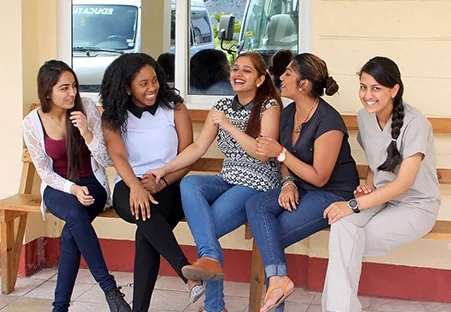
The university presents two MD programme structures. Its four-year programme begins with the Basic Medical Sciences sequence, organised as MD1 through MD5, followed by clinical rotations. Its five-year programme adds an earlier premedical sequence, identified as PM1 through PM4, before the same basic-science and clinical stages. The distinction is therefore an additional period of foundational study within the longer programme.
Sources: Four-year MD programme and curriculum ↗ · Five-year MD programme ↗
Biomedical and professional foundations
The basic-science curriculum moves from the structures and functions of the body towards disease processes and clinical understanding. Listed subjects include gross anatomy, histology and cell biology, embryology, biochemistry, physiology, genetics and neuroscience. Later subjects include microbiology and immunology, general and systemic pathology, and pharmacology and therapeutics. Epidemiology and preventive medicine appear alongside these laboratory and biomedical disciplines.
The MD curriculum also includes a sequence on the patient–doctor relationship, medical ethics, physical diagnosis and an introduction to clinical medicine. Research projects are listed through several basic-science semesters. This arrangement places research activity and professional understanding alongside the study of biological mechanisms and disease.
Premedical and clinical subjects
The clinical stage is organised around core and elective clerkships. The curriculum identifies internal medicine, surgery, paediatrics, psychiatry, obstetrics and gynaecology, and family medicine among the core subjects.
The premedical subjects listed include biology, chemistry, physics, mathematics, English and humanities.
Sources: Five-year MD programme ↗
Arranging clinical learning
The university’s clinical department describes coordinating placements after completion of the basic-science curriculum and the relevant university examinations. It asks students to discuss their intended timing and clinical-site preferences with the department. The medical programme thus spans study in Dominica and a subsequent supervised clinical-learning stage at teaching sites arranged through the university.
Sources: Clinical clerkships ↗
Nursing education
The Bachelor of Science in Nursing curriculum combines biomedical subjects, social understanding, nursing practice and supervised practical work. Its opening semesters include anatomy and physiology, biochemistry, nutrition, chemistry and nursing foundations. English, sociology, psychology in healthcare, computing and statistics are also included in the published sequence.
Later study covers community health nursing, health assessment, pathophysiology and pharmacology, together with nursing laboratory work. The curriculum then develops adult medical and surgical nursing, paediatric and neonatal nursing, maternity and obstetrical nursing, geriatric nursing and mental health nursing. Research methodology and the management of nursing services and education follow. The final stages include practica, clinical decision-making, practical nursing management and evidence-based practice. The sequence illustrates the programme’s combination of scientific foundations, care-related subjects and professional organisation. The published plan is arranged over eight semesters of sixteen weeks each. Early nursing foundations precede the more specialised subjects, with practical nursing management listed in the seventh semester.
Teaching spaces and simulation
The university’s student-led campus tour introduces several different learning environments. These include an auditorium for lectures and university events, a library, an anatomy laboratory and a chemistry laboratory. The tour describes anatomical models as part of practical anatomy learning. It also identifies clinical-skills and nursing laboratories as teaching spaces.
A SimMan laboratory and control station provide medical-simulation facilities. The tour additionally features an examination room and a study room used for focused work and group collaboration. These spaces show the range of activities accommodated within the campus, from listening to lectures and consulting learning resources to practising skills with models and simulators.
Sources: Campus tour and teaching spaces ↗
Study resources and daily campus life
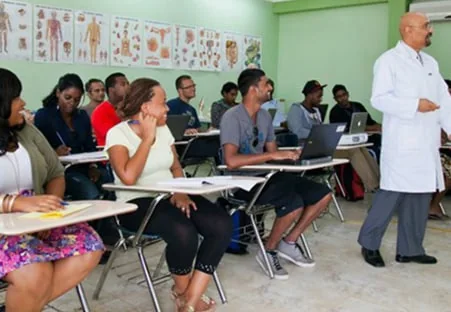
The library supports teaching and learning through medical texts, journal articles, research materials, instructional resources and computers. The university distinguishes individual cubicle spaces designated for quiet study from a separate group-study hall. Its account of teaching facilities also identifies histopathology, physiology and biochemistry laboratories and an anatomy dissection laboratory.
Campus life includes a cafeteria, lounge and gym room. Housing is described in terms of rooms, apartments and houses rented within the local community, with assistance from a university housing coordinator. The university also describes a bus service linking student residences with the campus. These arrangements place student life within Roseau as well as within the university’s own teaching buildings.
Student participation and community activities
The Student Government Association represents student needs and organises activities beyond formal teaching. Its published examples include introductory social events, formal gatherings, graduation parties and community activities. Food drives and blood-pressure clinics are among the forms of community participation described by the university.
The university’s description of life in Dominica also places students within the island’s cultural environment. Together, its academic spaces, student association and surrounding city form the setting for the institution’s educational community.