Visa
About African University of Technology and Management
UATM-GASA in Cotonou
The African University of Technology and Management is known in French as Université Africaine de Technologie et de Management and commonly uses the name UATM-GASA Formation. It is based in Cotonou, Benin, with its principal campus in Gbégamey. Its teaching spans technical subjects, agriculture, management and legal studies, bringing several professional fields within the same institution.
The university traces its origins to GASA-FORMATION / SUPELEC Bénin, established by Théophane Ayi in 1992. Its initial educational focus was on higher technical training in electronics and management computing. The institutional history records official recognition in January 1997 and the transition to university status in February 2006. These dates represent different stages of its development from a technical training establishment into UATM.
Its mission connects knowledge, technology and creativity with socioeconomic development in Benin and Africa. The institution describes an approach combining academic rigour with personal development, leadership and initiative. This practical orientation is reflected across its programme descriptions and teaching facilities.
Sources: History and educational mission ↗
Computing and applied technologies
The science and technology unit covers computing, telecommunications, industrial systems, biotechnology and energy. Network and telecommunications study concerns the installation, management, security and maintenance of communication systems. Its description spans local and wide-area data networks, mobile communication, fibre access and internet-based services.
Computing and software study includes application development, databases, Linux systems and software engineering. The industrial systems field combines electrical and electronic engineering with automation, solar energy and connected building technologies. Additional subjects listed by the unit include cybersecurity, industrial computing and maintenance, refrigeration and air conditioning.
Biotechnology teaching addresses scientific and operational work connected with food processing, product analysis and research. Electrical engineering and renewable energy study includes solar technologies, energy efficiency, storage and the sizing of installations. These areas connect the technical curriculum with industrial processes, digital infrastructure and changes in energy use.
Sources: Science and technology programmes ↗
Agriculture and rural development
The agronomic sciences unit relates its teaching to agriculture, livestock production, agro-industry and food systems. Animal production study covers feeding, growth, reproduction, animal handling, health monitoring and welfare, together with the design of livestock buildings. The emphasis is on understanding the different components of managing production systems.
Plant production encompasses vegetables, perennial crops, legumes, forage, cereals and oil crops. Its description includes setting production objectives, agricultural advice and the redesign of cropping systems. Agricultural economics provides another perspective, bringing rural economics, agribusiness, value-chain management, marketing and agricultural policy into the curriculum. The combination gives the unit interests in both biological production and the organisation of agricultural activity.
Sources: Agronomic sciences ↗
Management, commerce and organisations
Management teaching includes finance, accounting and audit; banking and insurance; human resources; transport and logistics; and entrepreneurship. The accounting description includes financial reporting, taxation, management control and audit, with reference to SYSCOHADA and international financial reporting frameworks. Banking and insurance study addresses financial products, risk and market analysis.
Human resources teaching concerns recruitment, career management, payroll and internal communication. Logistics study follows the movement of goods through purchasing, production, transport, storage and distribution. Marketing provision connects commercial strategy with digital communication and customer relationships. Entrepreneurship and project management focus on developing, managing and evaluating projects across different sectors. These subjects give students several ways to examine how organisations plan their activities, manage resources and communicate with the people they serve.
The marketing curriculum also identifies electronic commerce, online promotion and digital customer communication. Sales and negotiation study addresses prospecting, merchandising and the assessment of commercial performance. These topics connect the management unit’s organisational focus with the tools used in changing retail and service environments.
Sources: Management sciences ↗
Law, communication and international affairs
The legal and political sciences unit combines legal knowledge with the methods used to analyse and present legal arguments. Its description identifies case studies, analysis of court decisions and legal writing. Supporting subjects include political sociology, economics, languages, computing and international relations.
Digital law and electronic commerce receive specific attention within the legal curriculum. A further field combines communication and international relations, with subjects such as diplomacy, international law, economic relations, negotiation and conflict management. This academic provision brings legal reasoning into contact with the communication and institutional questions arising in international and organisational settings.
Sources: Legal and political sciences ↗
Practical facilities and student access
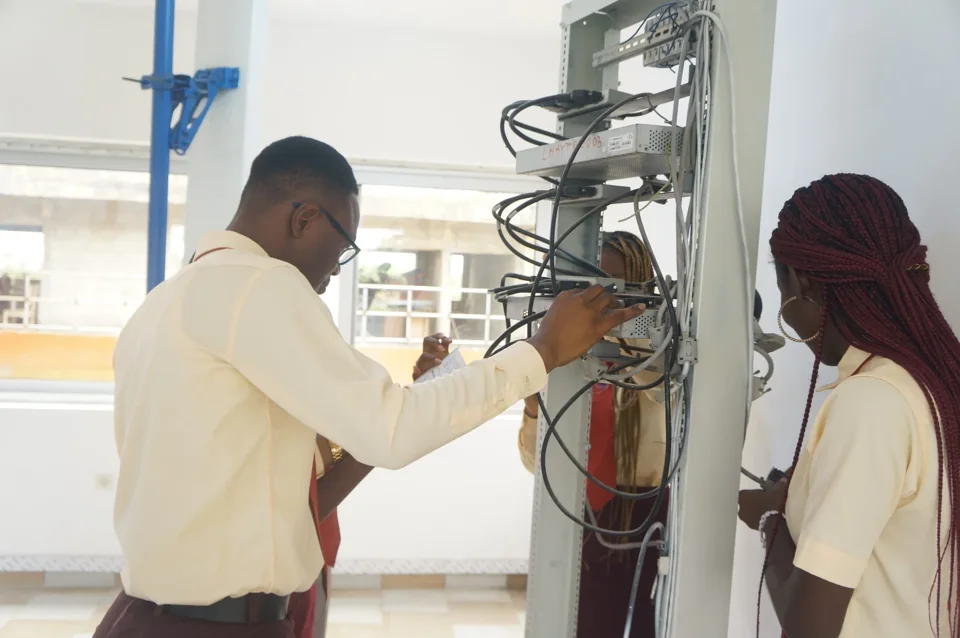
The university describes teaching facilities for computer maintenance, electronics, telecommunications, measurement, quality control, biotechnology and industrial maintenance. Equipment identified includes network racks, routers, switches, electronic testing instruments and programmable industrial systems. Agricultural facilities include fish-production basins and cultivated land for practical work. Libraries, reading spaces, digital resources and sports areas complement the specialist teaching environments.
The admissions process begins with selecting a programme and completing a pre-registration form. Applicants are asked to supply academic qualifications and records alongside identity documents. The university also describes financial support linked to academic merit and documented social circumstances. These application and support arrangements sit alongside its practical teaching provision, connecting entry into the institution with the different educational pathways it offers.
The computer maintenance workspace is described as supporting diagnosis, repair, component assembly and system configuration. Electronic laboratories provide instruments for experimentation, while quality-control facilities support microbiological and physicochemical analysis. The published facilities description also identifies food transformation and biochemical work, linking laboratory activities with the institution’s biotechnology and applied science subjects.
Sources: Campus infrastructure ↗ · Admissions and support ↗