Visa
About Academy of Fine Arts Vienna
A university for artistic practice and research
The Academy of Fine Arts Vienna is an Austrian art university whose teaching brings together artistic practice, scientific inquiry and critical reflection. Its six institutes cover fine arts, conservation-restoration, education in the arts, art and architecture, art theory and cultural studies, and natural sciences and technology in the arts. This structure connects studio work with the interpretation, preservation and material investigation of art.
The Academy's mission places arts-based research within teaching and public discussion. Exhibitions, lectures, symposia and publications communicate work beyond the university. Its educational range includes architecture, scenography, conservation, art education and fine arts, alongside doctoral study and a Master in Critical Studies. The institution also maintains historic art collections and contemporary exhibition spaces. Its stated values include academic freedom, respectful debate, diversity and opposition to discrimination, connecting the development of artistic independence with attention to wider social conditions.
Sources: Mission statement ↗
From a private academy to a modern university
The Academy's history begins with Peter Strudel's private academy in 1688 and its recorded imperial recognition in 1692. After a closure following Strudel's death, the school was re-established as a public Imperial Court Academy in 1726. Several art schools were brought together in 1772, forming an important stage in the development of the present institution.
The building at Schillerplatz, designed by Theophil Hansen, opened in 1877. Women were first admitted in the academic year 1920/21. The institutional timeline records the exclusion of students and the removal of staff after Austria's annexation by Nazi Germany in 1938. Later milestones include university status in 1998 and legal autonomy under the 2002 university legislation. Renovation of Schillerplatz ended in 2021, and the history page records the start of work on a new institute building in the Vienna Arsenal in 2026.
Sources: History ↗
Fine arts through studios and workshops
The Institute for Fine Arts organises artistic teaching through studios, specialist workshops and laboratories, accompanied by practical and theoretical courses. Its eighteen studios are grouped around four perspectives: Art and Time, Art and Space, Art and Image, and Art and Intervention. The arrangement encompasses painting and drawing alongside photography, moving images, performance, installation and conceptual approaches.
The central artistic subject within each studio provides space for individual exploration, discussion and collaborative projects. Students receive guidance from artists and academic staff while developing their own work. The institute supervises the Fine Arts Diploma programme and, with the Institute of Art Theory and Cultural Studies, the PhD-in-Practice programme. Its facilities at Schillerplatz, the Studio Building and Kurzbauergasse create different working environments. Across these locations, the combination of studios, workshops and theoretical teaching connects practical skills with questions about contemporary society and artistic production.
Sources: Fine Arts institute ↗
Architecture and scenography
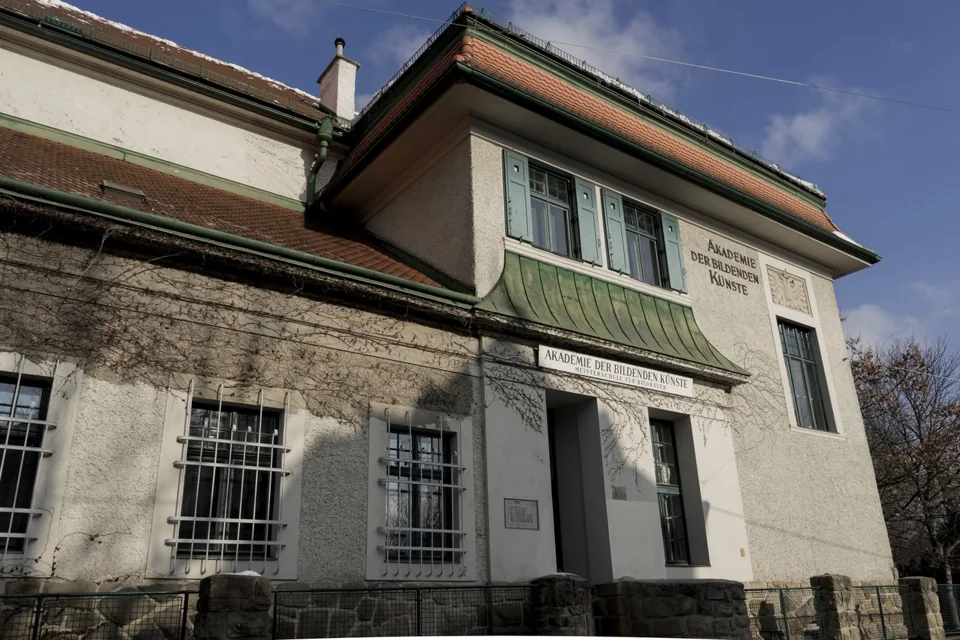
The Institute for Art and Architecture brings two fields together through an interest in the creation and interpretation of spaces. Its offer includes bachelor's and master's programmes in architecture, a doctorate in technical sciences and a diploma in scenography. Architectural teaching addresses housing, materials, cultural heritage and ecological questions, with students working closely with teachers throughout design development.
Scenography focuses on space and costume for theatre, musical theatre, dance and performance. Students translate texts, music and performance ideas into spatial proposals, making communication and teamwork important parts of their training. Architecture facilities at Schillerplatz include studios, computer laboratories, teaching rooms and workshops with analogue and digital equipment. Scenography occupies large loft spaces in the Studio Building on Lehargasse. Exchanges between the two programmes, interdisciplinary cooperation, excursions and international partnerships extend learning beyond a single studio or discipline.
Sources: Art and Architecture institute ↗
Conserving cultural objects
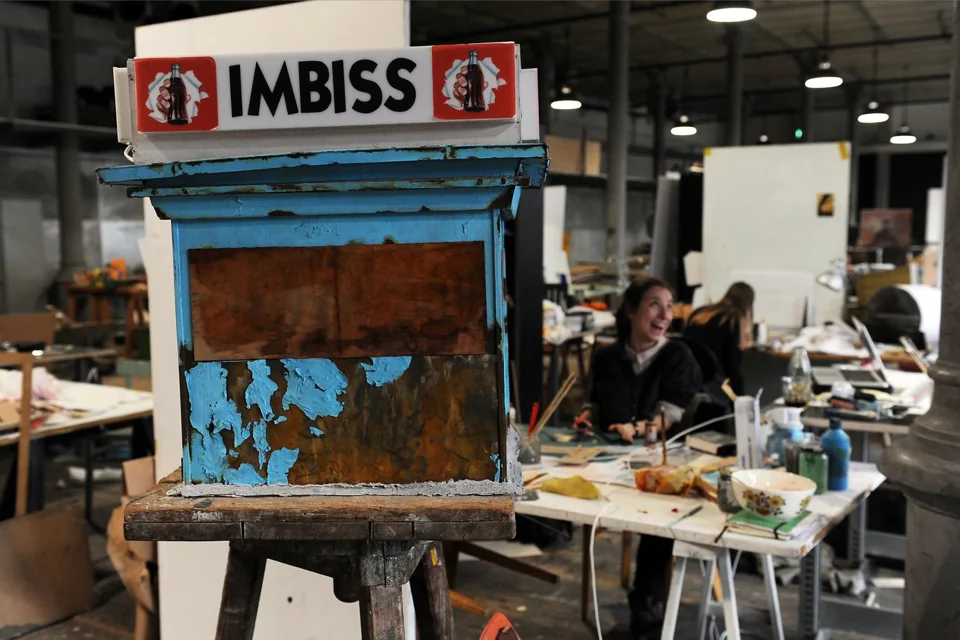
The Institute for Conservation-Restoration prepares students to preserve cultural objects through an approach combining artistic, scientific and theoretical knowledge. Its specialisms include paintings and polychrome wooden sculpture, paper and books, mural painting and architectural surfaces, wooden objects and historical musical instruments, modern and contemporary art, and media art conservation. The institute supervises diploma and dissertation work.
Teaching links research with practical case studies and professional ethical responsibilities. Research areas include art technology, material culture, architectural heritage and restoration history. Cooperation with other Academy institutes brings scientific analysis, artistic practice and cultural interpretation into conservation projects. The institute also works with museums, heritage organisations and international research partners. Its Best Available Copy lecture series examines current theoretical approaches and the long-term preservation of technology-based and time-based art, showing how conservation questions extend beyond traditional objects and materials.
Sources: Conservation-Restoration institute ↗
Materials science within an art university
The Institute of Natural Sciences and Technology in the Arts supplies teaching in materials science, colour chemistry, perception, documentation, material analysis and microbiology. It contributes to conservation-restoration, architecture and fine arts and offers doctoral study in natural sciences. Its work examines how materials behave, change and deteriorate, connecting laboratory investigation with the care and understanding of artworks.
Research interests include the ageing of synthetic materials, Asian lacquers, paintings and manuscripts, surface patinas and microbiological traces. Scientific techniques support the identification and documentation of materials. The institute describes equipment for spectroscopy, chromatography, elemental analysis and molecular biology, as well as specialised photography. These resources give the Academy a scientific dimension alongside its studios. Collaboration with conservation and architecture connects material knowledge with practical questions about objects, buildings and their long-term preservation.
Sources: Natural Sciences and Technology in the Arts institute ↗
Locations across Vienna
The Academy works across several Vienna locations. Its official directory lists Schillerplatz, the Studio Building on Lehargasse, the sculpture studios at Kurzbauergasse, Karl-Schweighofer-Gasse, the exhibition space on Eschenbachgasse and a temporary location on Kelsenstrasse. The directory provides building-specific accessibility information, including step-free routes, lifts and tactile guidance, helping students and visitors plan access to the different sites.
Sources: Locations and accessibility ↗