Visa
About Académie des Beaux-Arts
Visual arts education in Kinshasa
The Académie des Beaux-Arts de Kinshasa, commonly known as ABA-KIN, is a public higher education institution in the Democratic Republic of the Congo specialising in visual and graphic arts. Its teaching connects artistic practice with research, critical discussion and the study of contemporary culture. The academy identifies two principal fields: plastic arts and graphic arts. Together, these encompass nine specialisations, ranging from sculpture and painting to photography, design and the conservation of artworks.
The institution’s mission combines the education of specialised artists and graphic practitioners with research into the adaptation of new techniques within the arts. Its approach includes humanities and social sciences alongside artistic training. Students are encouraged to think, design and create in relation to contemporary challenges while developing their critical judgement and imagination. Traditional methods, modern techniques and contemporary forms of expression all appear within this educational framework.
Sources: Institutional overview and specialisations ↗ · Mission and partnerships ↗
Origins and development
The academy grew out of the École Saint-Luc, founded in 1943 at Gombe Matadi by Marc Stanislas Wallenda, a Belgian missionary of the Brothers of the Christian Schools. Sculpture was its original field of study. In 1949, the school moved to Kinshasa, and in 1957 it adopted the name Académie des Beaux-Arts. Painting and ceramics were added during the 1950s, broadening a school that had initially centred on three-dimensional work.
Subsequent expansion brought visual communication, interior design and metalwork into its teaching. A curriculum reform in 2004 changed several departmental names: advertising became visual communication, decorative arts became interior architecture, and beaten metal became metal. The academy also has an associated secondary-level application school, the Institut des Beaux-Arts, which provides artistic humanities education and prepares pupils for further study in fine arts.
Sources: History ↗
Materials, images and designed spaces
Plastic arts specialisations include sculpture, painting, ceramics, metal, and conservation and restoration. Sculpture teaching works with varied materials and three-dimensional forms. Painting includes drawing and work across different supports and modes of expression. Ceramics combines historical and theoretical study with practical work in clay, while metal provides another medium for artistic construction. Conservation and restoration introduces a further relationship with artworks through their preservation and care.
The graphic arts field comprises visual communication, interior architecture, photography and design. Visual communication includes graphic design, illustration, editorial design, motion design and visual identity. Interior architecture addresses the organisation and adaptation of spaces through considerations such as volume, light, colour and materials. Photography teaching covers still and moving images, including documentary and experimental approaches. Design includes objects, furniture, textiles and urban applications. Photography and design were both introduced in 2020, adding newer pathways to the academy’s older artistic disciplines.
Theory and international exchange
The academy’s teaching combines practical studio subjects with broader intellectual and professional knowledge. Its studies page lists aesthetics, philosophy and history of art, museology, Congolese art, sociology, anthropology and research methods among shared subjects. Management, marketing and intellectual property also feature in the published curriculum description. These topics situate artistic production within cultural institutions, professional practice and the social settings in which images and objects circulate.
International partnerships support exchanges of teachers, students, programmes and information. The mission page describes workshops led by visiting teachers and accommodation for artists and cultural practitioners coming from abroad. Such exchanges are intended to contribute to teaching and artistic development. Exhibition participation, both within the country and internationally, provides another way for students and the institution to engage with wider artistic communities.
Sources: Mission and partnerships ↗ · Studies and teaching subjects ↗
Student representation and campus participation
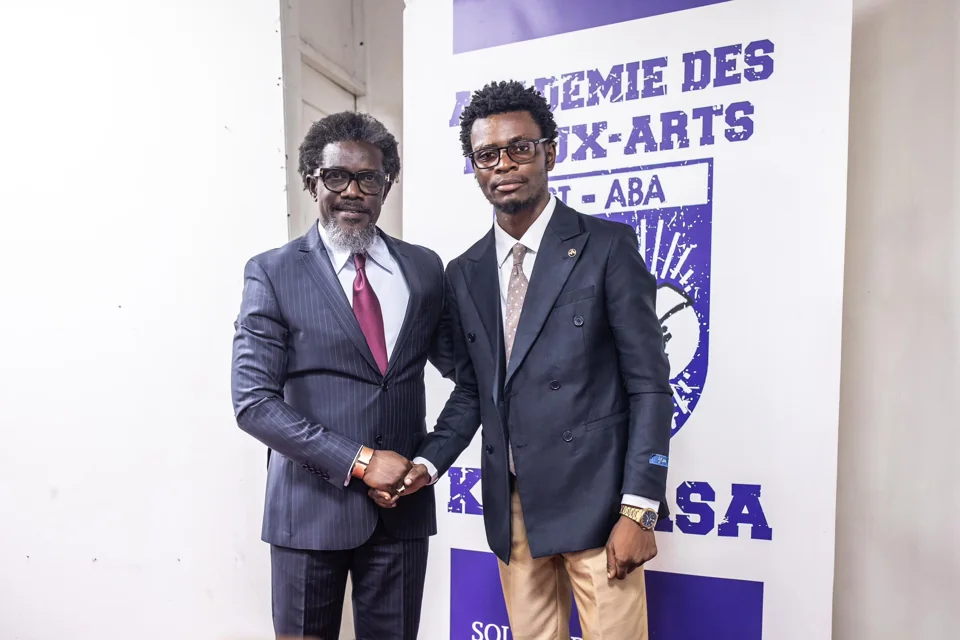
Student life includes an elected coordination body that acts as an interlocutor between learners and the academic authorities. On 11 May 2026, Olivier Chiteya formally took office as its president at a ceremony in the academy’s Salle de Promotion. The official report identifies him as a third-year LMD student in interior architecture. It records an earlier election held on 31 March and describes the participation of academic, scientific, administrative and student representatives in the inauguration.
The ceremony emphasised listening, initiative and constructive dialogue. The student coordination’s responsibilities were presented as bringing students together and contributing to a respectful, collaborative institutional environment. This provides a concrete example of student organisation alongside the academy’s studio teaching, exhibitions and other academic activities.
Sources: Student coordination inauguration, May 2026 ↗
Residencies, heritage and artistic dialogue
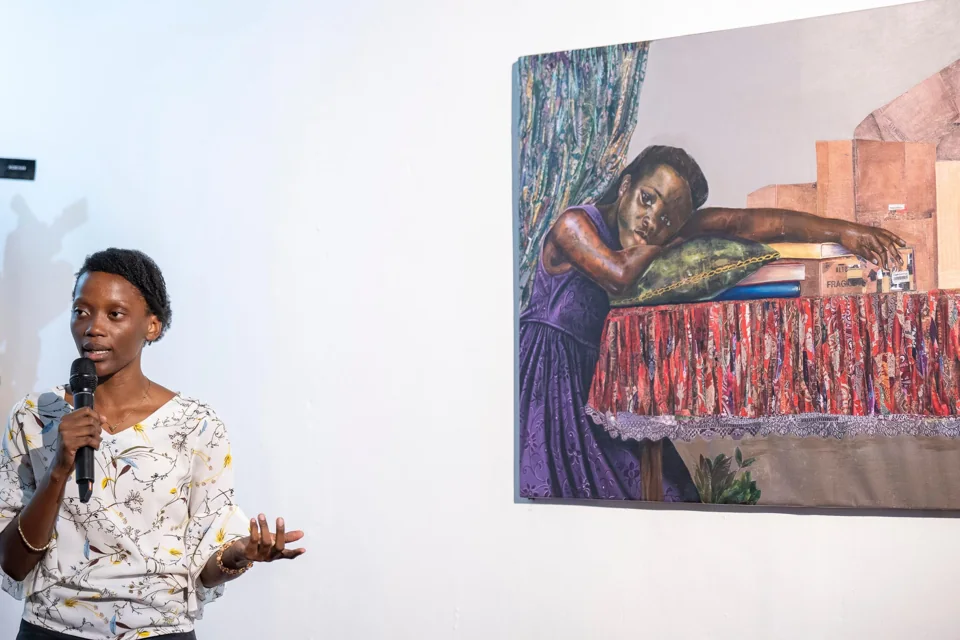
The academy’s museum room hosts presentations and discussions as well as encounters with artworks. On 7 April 2026, Manuella Alonge and Destin Ushindi presented work developed through the Leridon scholarship and creation grant. Their three-month residency took place in Cameroon and Kinshasa. The academy’s report describes Alonge’s emphasis on intercultural dialogue and Ushindi’s use of acrylic and ballpoint pen to address Congolese social realities. The programme was organised through collaboration with the Matthias and Gervanne Leridon Foundation.
A March 2026 discussion at the academy examined digitalisation, African cultural heritage and artificial intelligence. Organised with Krithika Artprojects and the Royal Museum for Central Africa, it brought artistic and scholarly perspectives to questions of restitution and digital preservation. Another June report describes a critical conversation around Henri Kalama Akulez’s Abstraire exhibition at Texaf Bilembo. These events extend the academy’s educational setting into residency research, public discussion and the critical interpretation of contemporary art.
Sources: Leridon residency presentation, April 2026 ↗ · Digital heritage and artificial intelligence discussion, March 2026 ↗ · Critique Talk and the Abstraire exhibition, June 2026 ↗