Visa
About AAB College
A non-public higher education institution in Kosovo
AAB College is a non-public higher education institution in Kosovo, with its central campus in the Pristina area and branches in Ferizaj and Gjakova. Its official institutional account describes an origin in the period following the war in Kosovo, when the country’s social, economic, and cultural circumstances were changing. Early provision centered on arts and mass communication before the college expanded into additional academic fields.
The About page connects this growth with institutional autonomy and academic freedom in teaching and research. It describes purpose-built educational spaces and sports facilities at the central campus, alongside investment in the Ferizaj and Gjakova branches. The account also identifies membership in the Magna Charta Universitatum from 2010 as part of its wider commitment to university values and cooperation. These features place AAB’s development within both Kosovo’s higher education landscape and its efforts to establish relationships with institutions elsewhere in Europe.
Sources: About AAB College ↗
Student-centered learning and public responsibility
The college’s current mission emphasizes student-centered higher education, the preparation of competent professionals, and the development of responsible citizens. It connects education with scientific research, innovation, and international cooperation. Its stated contribution extends across social, economic, technological, cultural, and artistic development, as well as community health and wellbeing. This gives the institutional mission a scope reaching beyond qualification delivery alone.
The published values include integrity, academic freedom, equality, inclusion, lifelong learning, critical thinking, and partnership with industry and communities. The college also expressly identifies the ethical use of technology and artificial intelligence as a principle. Its vision presents academic quality, research, and innovation as means of supporting societal development. These statements describe the standards and purposes the institution seeks to pursue, providing a framework for understanding its academic activity and external engagement rather than a measure of individual graduate outcomes.
Sources: Mission and vision ↗
Academic breadth and the campus environment
The rector’s institutional statement describes a multidisciplinary college with programs across public administration, architecture, arts, economics, foreign languages, law, physical culture and sports, mass communication, computer sciences, social sciences, psychology, nursing, radiology, and dentistry. This range combines creative and cultural disciplines with public services, professional subjects, technology, and healthcare. It reflects the expansion beyond the college’s earlier concentration on arts and communication.
The same statement identifies amphitheaters, laboratories, libraries, sports halls, theaters, artistic spaces, and digitized administration within the campus environment. These facilities are described as places for study, practical work, social activity, and contact among students, academic staff, and administrative services. The statement also emphasizes cooperation with regional and international universities, including agreements covering education, research, and academic mobility. In this account, the physical campus and external partnerships both contribute to the institution’s effort to develop a connected academic community.
Sources: Rector’s statement on academic development ↗
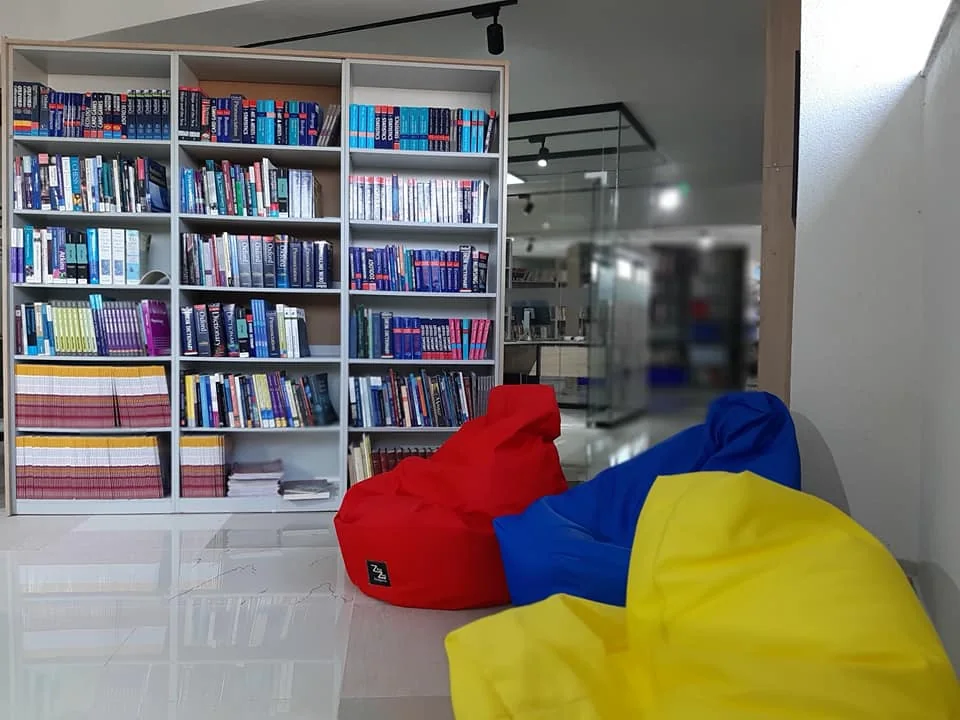
Library resources for independent study
The AAB University Library supports independent learning and access to literature relevant to the college’s study programs. Its official account describes library premises across the three campuses and collections combining printed books with electronic resources. Research literature and academic journals are provided to support subjects taught at the college, together with materials for reading beyond immediate course requirements.
The library website links to an electronic library and a digital catalogue, providing routes to explore its information resources. It also organizes information on library objectives, development policy, staff, and frequently asked questions. These services place access to books, journals, and digital materials within the academic support available to students. The combination of physical study space and electronic resources is intended to support both the learning process and the research activities associated with different programs.
Sources: University Library ↗
International mobility and intercultural learning
The International Office describes its mission as promoting internationalization through mobility, intercultural learning, and strategic partnerships. Its published approach applies to students, staff, and the wider community. Partnerships, global mobility programs, and international projects are presented as ways to create opportunities for academic and professional development beyond the institution’s immediate setting. The office’s vision connects these activities with inclusive and sustainable cooperation in the Western Balkans.
Its strategic objectives include expanding bilateral and multilateral university partnerships and increasing participation in international mobility schemes such as Erasmus+. It also identifies internationalization at home through joint curricula, guest lecturers, and intercultural events. Academic staff participation in international teaching and research collaborations is another stated priority. These objectives show that the office’s role encompasses both travel-based exchange and activities within the college, with international cooperation intended to influence learning, research, and interaction across the institutional community.
Projects supporting institutional development
AAB’s published account of the Projects Office’s fifth anniversary, dated 19 November 2025, provides a specific example of its organized approach to cooperation. The college described the office as a center for institutional development, helping to build academic capacity and relationships with universities and organizations in Europe and beyond. The report identifies Erasmus+ and Horizon among the programs through which project activity had developed.
The anniversary account links these projects with opportunities for students and academic staff and with modernization of the college. It also describes the institution’s participation as both a project coordinator and a partner, indicating different roles within collaborative work. The event brought together collaborators and staff associated with that development. As a dated institutional report, it documents how the college presented the office’s contribution at that point, complementing the broader mission and internationalization objectives with an example of an established organizational unit and its activities.
Sources: Projects Office fifth anniversary, November 2025 ↗